
DUBAI, United Arab Emirates — Iranian state television made headlines this week by claiming a foreign ship became grounded in the Strait of Hormuz after its crew ignored navigation instructions from the Islamic Republic’s paramilitary Revolutionary Guard. But a closer examination of the facts tells a very different story.
The vessel in question appears to be an Iranian-connected ship that has been stuck in those waters for months — not a foreign ship that recently defied Tehran’s orders.
Based on the ship’s physical appearance, its reported position, and other identifying details, experts believe the vessel is the container ship Arista, which appears to be flying a fraudulent flag connecting it to the island nation of Comoros. The Arista was previously known as the Panama-flagged Gauja — a ship the U.S. Treasury Department included in sanctions targeting what it described as a network that had been “generating tens of billions of dollars in profit” for Iran’s ruling elite.
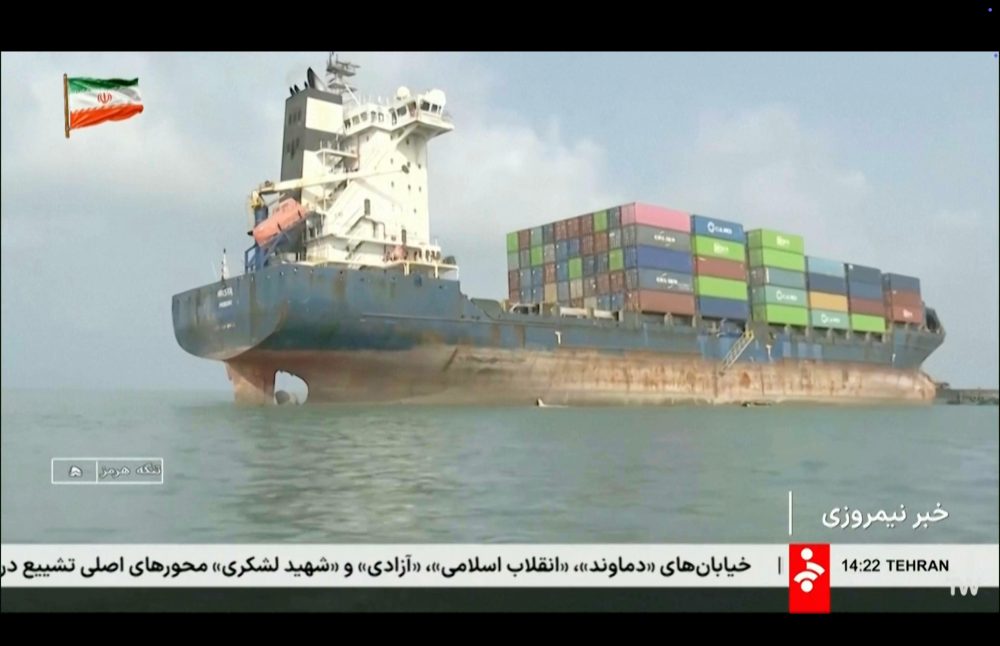
Iranian state television broadcast on-screen alerts Wednesday describing a foreign ship that had run aground after disregarding orders from the Guard’s naval forces. A news anchor on the broadcast stated: “A foreign container ship, because of choosing a route other than the one designated under the Iranian order, has run aground in the Strait of Hormuz. This comes as the navy of the Islamic Revolutionary Guard Corps has consistently warned that any entry into or exit from routes other than ‘the Route of Authority’ in the Persian Gulf could lead to irreparable incidents.”
The broadcast appeared designed to reinforce Tehran’s assertion that it holds authority over the strait, a critical passageway for global oil and natural gas shipments. Since the U.S. and Israel launched the war against Iran on Feb. 28, Tehran has used its ability to restrict traffic through the waterway as a major bargaining chip, causing disruptions in global energy markets and the flow of other essential goods.
TankerTrackers.com, a firm that monitors oil shipments at sea, was among the first to identify the vessel as the Arista. Video recorded by an Armenian news outlet matched the ship seen in Iranian state television footage to the Arista, with analysts pointing to the color patterns of the containers on deck and the vessel’s paint scheme as identifying features. Iranian state television never showed a close-up of the ship’s name or registration number — and in one shot, the name was deliberately blurred out.
Marine tracking records indicate the Arista has been grounded north of Hormuz Island, within Iran’s own territorial waters, since mid-March. Data shows the ship had been traveling between Hormuz and Asaluyeh, another Iranian port, when it became stuck.
Iranian state television and Iran’s mission to the United Nations did not respond to questions from The Associated Press on Thursday regarding the broadcast.
On July 30, the U.S. Treasury Department connected the Arista — at that time still known as the Gauja — to a large-scale oil smuggling operation run by Mohammad Hossein Shamkhani, a son of Ali Shamkhani, who had served as a senior security adviser to the late Supreme Leader Ayatollah Ali Khamenei. The elder Shamkhani was killed in an airstrike at the beginning of the war, along with Khamenei.
According to the Treasury Department, the smuggling network moved sanctioned Iranian and Russian oil, along with other commodities, to buyers across the globe.
“The Shamkhani family’s shipping empire highlights how the Iranian regime elites leverage their positions to accrue massive wealth and fund the regime’s dangerous behavior,” Treasury Secretary Scott Bessent said in a statement released at the time of the sanctions.
Following the imposition of those sanctions, the Gauja was renamed the Arista and began operating under a Comoros flag — which shipping records classify as a “false” flag, meaning it is used to conceal a vessel’s true origins. This practice is commonly used by ships in Iran’s so-called shadow fleet to avoid detection and enforcement.