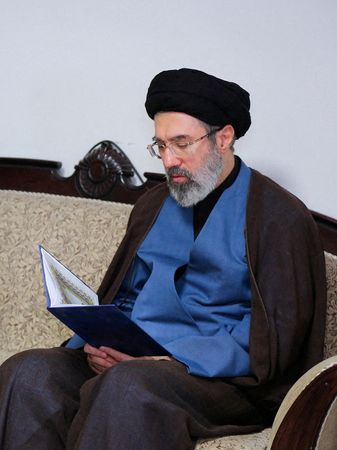

DUBAI, March 9 – Iran’s religious establishment has chosen defiance over diplomacy by selecting Mojtaba Khamenei as the nation’s new Supreme Leader following his father’s death, according to regional officials who view the decision as a direct challenge to President Donald Trump’s previous declaration that the son was “unacceptable.”
Ayatollah Ali Khamenei died in a joint U.S.-Israeli military operation at the beginning of the current conflict, which has now entered its second week.
The Assembly of Experts’ selection of Mojtaba as the new leader ensures hardline elements maintain their grip on power in Tehran – a strategic decision that could fundamentally alter Iran’s ongoing conflicts with the United States and Israel while creating ripple effects throughout the region.
“Having Mojtaba take over is the same playbook,” said Alex Vatanka, a senior fellow at the Middle East Institute.
“It’s a big humiliation for the United States to carry out an operation of this scale, risk so much, and end up killing an 86-year-old man, only to have him replaced by his hardline son.”
Within Iran’s intricate religious government structure, the Supreme Leader wields ultimate power over all major decisions, including nuclear policy and international relations, while also providing direction to elected officials and lawmakers.
DECISION SIGNALS CONTINUED CONFRONTATION
Experts believe Mojtaba’s selection – a hardline religious figure whose spouse, mother, and additional relatives also perished in U.S.-Israeli attacks – delivers a clear signal: Iran’s ruling class has abandoned any possibility of negotiation to maintain their system and views continued confrontation, retaliation, and resistance as their only option.
Sources close to the situation indicate that Mojtaba will confront enormous domestic and international pressure from an unhappy citizenry and escalating warfare, though he is anticipated to quickly work to strengthen his authority.
This approach will probably result in increased power for the Islamic Revolutionary Guard Corps, stricter domestic oversight, and widespread oppression to eliminate opposition.
“The world will miss the era of his father,” a regional official close to Tehran told Reuters. “Mojtaba will have no choice but to show an iron fist… even if the war ends, there will be severe internal repression.”
This position follows months of intensifying civil unrest – the most violent since the 1979 Islamic Revolution – which had already undermined the Islamic Republic before hostilities commenced.
Iran was struggling with economic devastation, rising inflation, currency devaluation, and expanding poverty, combined with increasing oppression that had sparked public outrage and demonstrations – challenges that will likely worsen under military governance.
CHALLENGING PERIOD ANTICIPATED
Harsh times await under Mojtaba’s leadership, featuring stricter internal oversight, heightened domestic pressure, and an increasingly aggressive international stance, according to another Iranian source with knowledge of conditions within the country.
Paul Salem, a senior fellow at the Middle East Institute, described Mojtaba as someone unlikely to negotiate with the United States or pursue diplomatic solutions.
“Nobody emerging now is going to be able to compromise,” Salem said. “This is a hardline choice, made in a hardline moment.”
From the perspective of Iran’s religious leaders, many who traditionally refer to America as the “Great Satan,” the killing of Khamenei, the Islamic Republic’s top spiritual leader, has transformed him into a “martyr.”
Religious authorities have portrayed the deceased leader as a heroic figure, comparing him to Imam Hussein – the Shi’ite symbol representing sacrifice and opposition to tyranny.
“Mojtaba is even worse and more hardline than his father,” said Alan Eyre, former U.S. diplomat and Iran specialist, adding that he was the preferred candidate of the Guards. “He’s going to have a lot of revenge to exact.”
This approach involves significant dangers. Israel has indicated that any replacement for Khamenei would become a target, while Trump has stated the conflict might only conclude after Iran’s military commanders and governing elite are eliminated.
NEW LEADER HISTORICALLY OPPOSED MODERATES
An influential mid-level cleric, the 56-year-old Mojtaba has consistently opposed moderate factions supporting Western engagement. His strong connections with senior religious figures and the IRGC – which controls Iran’s security apparatus and economic sectors – provide him with influence throughout the state’s political and enforcement mechanisms.
He built power under his father’s leadership as an important figure in the security structure and the extensive commercial network it oversees, functioning for years as Ali Khamenei’s intermediary and effectively operating as a “mini-supreme leader,” according to analysts.
His rise occurs as the U.S.-Israeli military campaign against Iran escalates, with coordinated attacks targeting fuel facilities and other infrastructure within Iran, while Iranian rockets and unmanned aircraft have attacked Gulf nations, expanding the conflict.
Mojtaba received his education from traditional clerics in Qom’s religious schools, the center of Shi’ite theological education, and maintains the religious title of Hojjatoleslam.
The U.S. Treasury imposed sanctions on Mojtaba in 2019, stating he acted as the supreme leader’s representative in an official role despite never serving in elected or formal government positions.
A Gulf source knowledgeable about regional government perspectives commented on Mojtaba’s selection: “This tells Trump and Washington that Iran will not back down, they will fight on until the finish.”
Salem, from the Middle East Institute, compared Iran’s current path to Iraq under Saddam Hussein after 1991 or Syria under Bashar al-Assad after 2012 – administrations that endured years of conflict and isolation while gradually losing authority.
“They’re doubling down on the hard line,” Salem said. “Internally, it’s terrible — and deeply destabilising.”