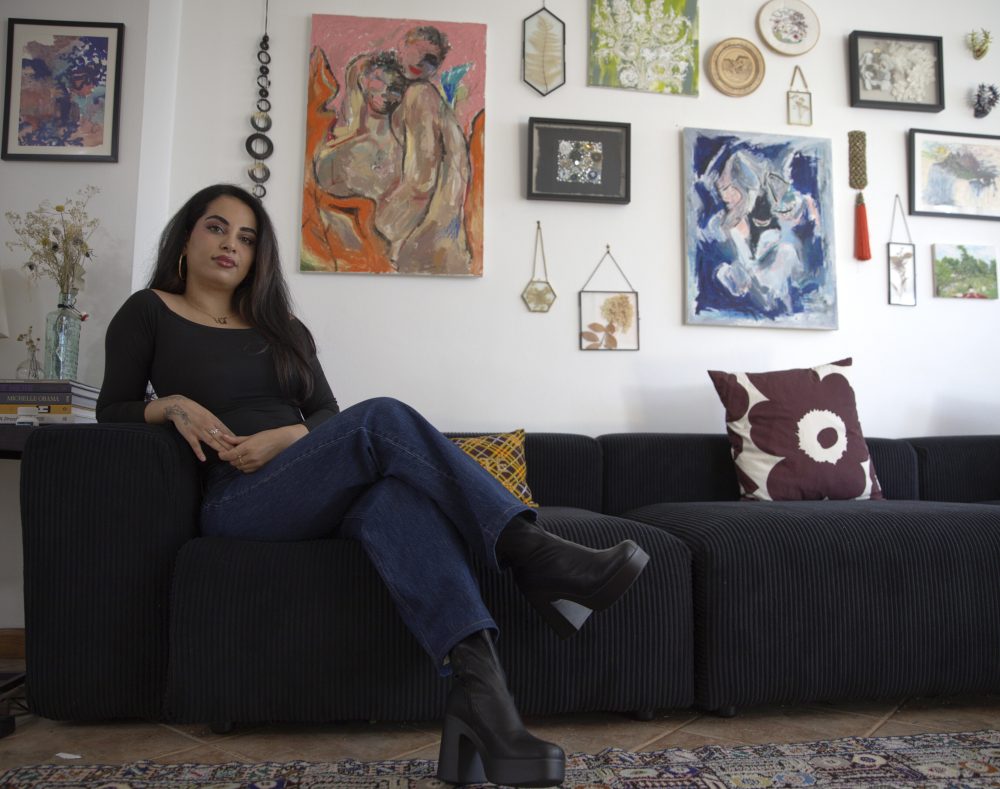

NEW YORK (AP) — Social media creator Ariana Afshar, an Iranian American, has been attempting to create content about the opening weeks of Middle Eastern warfare by drawing on viewpoints from people living in Iran.
However, the New York resident faces a significant challenge: Tehran’s government has implemented widespread internet restrictions that have cut off nearly all communication channels from the nation. This digital silence makes it extremely difficult to gather reliable opinions about the growing conflict from within Iran, where Afshar spent her teenage years and maintains family connections.
This communication void has elevated Iranian American content creators who are now using short, shareable videos to explain their homeland’s complex past and the mixed sentiments of its people.
Their material addresses growing American interest, as demonstrated by Google Search Trends data showing online queries such as “why are we at war with iran” jumped by 3,000% during March’s first week.
Several creators and analysts believe this outsized influence of external Iranian voices has deepened existing divisions within the diaspora community, which numbers approximately 750,000 people across the United States, per Pew Research Center data.
“I think it’s a huge problem among the Iranian diaspora, where they speak for Iranians a lot. I don’t want to fall into that,” Afshar explained. She maintains around 350,000 followers across Instagram and TikTok platforms.
Her online presence primarily challenges pro-war viewpoints through her bicultural upbringing experience. When she occasionally connects with family members, they typically remain too frightened to express genuine opinions about the conflict and their government.
“Content creators cannot thoroughly access the people’s opinions in Iran,” Afshar noted.
Creator perspectives vary widely on the conflict. Some endorse military action, arguing that war concerns are minor compared to a regime that eliminated thousands during January’s protest suppression. Others highlight destroyed infrastructure and rising death tolls — including over 165 fatalities from an elementary school attack — as warnings of future devastation, referencing previous American military campaigns in Iraq and Afghanistan.
“The outside media, especially Iranian diaspora, are playing a major role,” explained Babak Rahimi, a University of California San Diego professor specializing in Iranian culture, religion and technology. “It’s the kind of role that is not about really information, but it’s mostly about the circulation of emotions.”
Rahimi noted that most conflicts allow citizens to supplement official news coverage with personal social media accounts that spread widely. However, digital blackouts and government retaliation fears have drastically restricted this in Iran’s case.
Major news organizations including The Associated Press maintain journalists inside Iran, though communication limitations sometimes complicate reporting efforts. AP also relies on satellite images, telephone interviews, witness statements and verified user content for coverage.
Despite these efforts, false information flourishes on social platforms and messaging services like Telegram, where millions follow groups that easily distribute unverified and inaccurate material.
Iranian government sources produce some misinformation, including fabricated firsthand reports aimed at inflaming anti-war American sentiment, according to Houman Hemmati, who supports the conflict and departed Iran with his Persian Jewish family following the 1979 revolution.
Pro-American disinformation has also spread, including footage falsely claiming Iran conducted the school attack. Preliminary U.S. military findings suggest outdated intelligence probably caused the U.S. to execute that strike, based on reports from a U.S. official and another briefed individual.
When Iranians briefly manage to share information, Hemmati observed, it immediately attracts widespread attention, demonstrating the appetite for direct accounts.
“All it takes is for just a little bit to leak out, and those images and stories go viral,” said the 49-year-old Southern California resident, who appears regularly on Fox News and has accumulated over 83,000 X platform followers.
A 35-year-old Iranian New York resident, who requested anonymity to protect relatives in Iran, described how her family’s WhatsApp group between American and Iranian relatives demonstrates the blackout’s impact.
During brief connection windows, the chat serves as a vital news source for information her Iranian relatives struggle to obtain elsewhere.
Her Tehran cousin sent messages when bombing commenced: “Where did they hit?” one asked. “Everything I watch is just smoke and explosions.”
The family conversation has become a debate space about their homeland’s future, with relatives exchanging news articles and social media content presenting different perspectives on American involvement. She emphasized the stark contrast between her U.S.-based family members, who discuss war politics abstractly and passionately, versus those in Iran experiencing daily reality.
A longstanding “narrative war” exists among diaspora members, said 26-year-old content creator Ciara Moezidis, who was born in America and has Iranian extended family.
Her Instagram audience has grown by 2,000 followers since January, when she began posting support for Iranian demonstrators while opposing warfare.
“It’s been incredibly exhausting to navigate this while seeing bombs drop across Iran and not being able to reach our families,” Moezidis stated.
Content creator Zoya Biglary, an Iranian American with more than 600,000 Instagram followers, expressed hope that Iranians will someday witness the external support for their struggle.
“Maybe they’re looking for proof that someone on the outside kind of sees their humanity,” Biglary said.