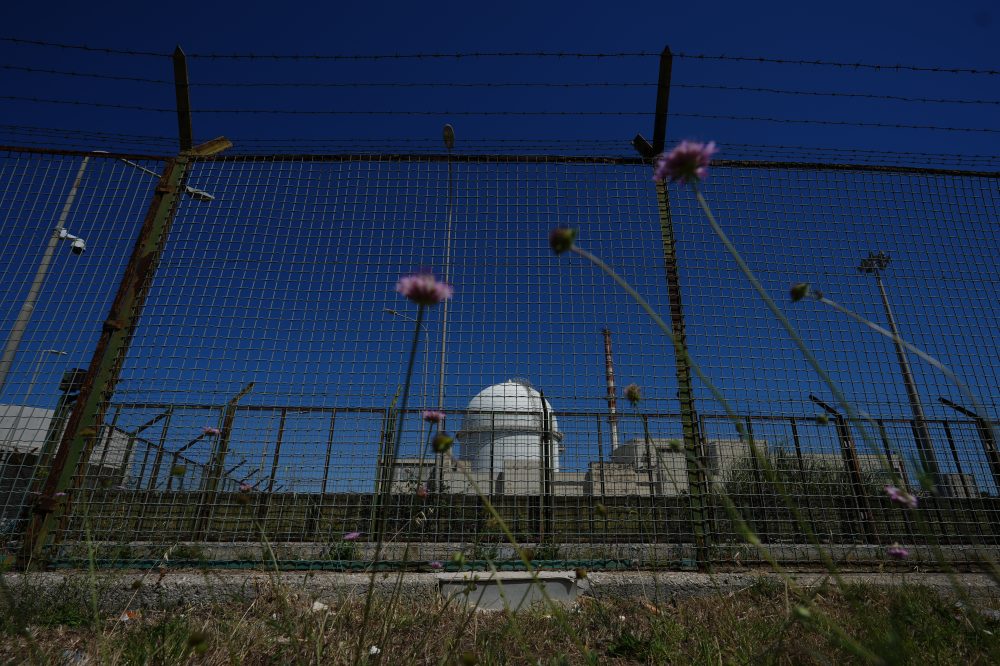

ROME (AP) — Forty years after the Chernobyl nuclear disaster sent radiation drifting across Europe and turned Italy against atomic energy, Premier Giorgia Meloni’s government is building the foundation for a nuclear comeback as the nation looks to strengthen its energy independence.
The government is banking on a younger generation of Italians who view nuclear power as a source of clean electricity, a weapon against climate change, and a way to secure stable energy supplies during a period of global instability stemming from the conflicts in Ukraine and Iran.
Officials are wagering that this newer perspective will outweigh the views of Italians who lived through the 1986 accident and continue to associate nuclear energy with catastrophe — a group that twice voted down nuclear power in national referenda, according to experts.
Parliament is expected to vote next week on government-backed legislation that would create a legal structure for next-generation nuclear technologies. If passed, the government would have 12 months to draft detailed decrees covering reactor licensing, safety requirements, waste handling, and site selection.
“The duty of the government at this moment is to create the conditions so that those who will eventually decide on installations will be able to do so,” said Gilberto Pichetto Fratin, minister for the Environment and Energy Security, in an interview with The Associated Press ahead of the vote.
Italy’s nuclear debate is unfolding alongside similar discussions in other European nations. Countries including France and Poland are expanding or pursuing nuclear programs amid shared concerns about energy security and climate commitments. Italy’s situation is unique, however, because it is attempting to rebuild an industry that voters chose to dismantle years ago.
Italy was once a nuclear pioneer on the continent. Four reactors operated in the country until a 1987 referendum effectively shut down the program following Chernobyl. A second attempt to revive nuclear power fell apart after Japan’s Fukushima disaster in 2011, when roughly 94% of voters rejected plans for new reactors.
Because of that history, any shift toward nuclear power in Italy would represent one of the most significant energy policy reversals in Europe.
Meloni’s government contends that growing electricity demand, climate targets, and energy security worries triggered by Russia’s invasion of Ukraine make a strong case for reintroducing nuclear energy into Italy’s power mix.
Pichetto Fratin said electricity demand could rise by at least 30% within roughly a decade, making it necessary to draw on a wider range of energy sources beyond renewables alone.
Rather than returning to the large-scale plants of previous decades, the government is focused on small modular reactors, known as SMRs, along with other advanced technologies that advocates say could be safer, more adaptable, and quicker to construct.
“We are talking about the third advanced generation (of nuclear power), much more workable compared to what are the needs, much safer because it is small in size with very short construction times,” Pichetto Fratin said.
“When people ask me for a timeline, I say 2033, 2034, 2035,” he added, pointing to when the first next-generation reactors could realistically come online.
Nuclear energy currently produces about 10% of the world’s electricity, accounting for roughly a quarter of all low-carbon power generation. Italy’s push for a nuclear revival fits into a broader global trend of nations reconsidering nuclear options, aided by advances in technology that have improved safety features and reduced construction and operating costs.
At the sprawling Latina nuclear plant south of Rome, workers in protective gear are still in the process of dismantling the remnants of Italy’s first nuclear era, even as politicians debate how to launch a second one.
The irony is not lost on Viviana Cruciani, who manages nuclear decommissioning at the site operated by the state-owned company Sogin.
“There is a generation that came right after Chernobyl that still sees nuclear energy in light of the accident at Chernobyl only,” Cruciani told AP.
“But there is another generation, a lot younger, that is enthusiastic about nuclear, and it is even sorry that the country has not yet made any progress towards a comeback to this technology.”
A survey conducted in June 2026 by research firm Only Numbers found that approximately 55% of Italians support next-generation nuclear plants.
Michele Governatori, a senior energy adviser at climate and energy think tank ECCO, said that backing for nuclear is most visible among younger Italians.
“There is greater openness, especially among younger generations,” he said, noting that many in that group connect nuclear power with technological advancement rather than with the disasters that defined public sentiment in earlier eras.
Cruciani echoed that view, saying younger Italians tend to look at nuclear energy through the lens of future energy needs and environmental goals rather than through the memory of Cold War-era catastrophes.
“I think nuclear power can help the environment too. It’s more sustainable,” said Cristian Giannetti, a 20-year-old tourist from the Tuscan seaside town of Forte dei Marmi visiting Rome.
When asked about the possibility of another Chernobyl-style accident, he said improvements in technology had significantly reduced that risk.
“With the expertise we have and all the resources available today, I think the probability is really minimal.”
Others back a nuclear return for more immediate, practical reasons.
“We have an energy problem, so it’s very important that nuclear power gets the green light in Italy too,” said Paola Giovannini Pasti, president of Confagricoltura Donna, the women’s branch of Italy’s main agricultural lobby.
Not everyone shares that enthusiasm.
“If we use nuclear as a backup … the average energy costs become devastating. So unfortunately it’s not a good complement to renewables and it’s not cheap,” Governatori said.
Pichetto Fratin acknowledged that nuclear power will not deliver quick relief on electricity bills.
“Nuclear power does not lower consumers’ bills today,” he said. “The nuclear power of tomorrow can help reduce them.”
Industry projections suggest a single 300-megawatt SMR could carry a price tag of between 3 billion and 6 billion euros before accounting for infrastructure and grid costs. The government is hoping that much of the funding would come from private investors, Pichetto Fratin said.
Governatori views the cost question as the most vulnerable part of the government’s argument.
“Nuclear power that is being built today in Europe has exorbitant costs,” he said. “On the one hand, costs are extremely high, and on the other, private investors are running away.”
He also raised doubts about whether SMRs would substantially change that financial picture, pointing out that the technology has not yet been commercially demonstrated at scale.
Even some critics, however, support creating a regulatory framework that would allow future projects to be judged on their individual merits.
Perhaps the biggest political hurdle will be identifying locations for reactors and nuclear waste storage. Italy still has no national repository for its existing nuclear waste, much of which sits in temporary storage facilities scattered across the country. Any proposed reactor or waste-storage location is expected to face fierce local resistance.
Even if Parliament passes the new legislation, opponents — including environmental organizations and left-wing political parties — could push for a fresh referendum once specific reactor sites and waste-storage plans are announced.
Polling data suggests that support for nuclear power falls sharply when Italians are asked whether they would accept a reactor near their own home. Surveys cited by experts indicate that roughly six in 10 Italians oppose having a reactor in their own province.
“When you have to seriously ask where a plant will be built and how much it will cost, it is likely that public opinion could become negative again,” Governatori said.