
Indonesia’s foreign ministry has issued a warning to defense officials about a United States proposal that would grant American military forces extensive rights to conduct flights over Indonesian territory, expressing concerns it could draw the nation into South China Sea disputes, according to sources familiar with the matter.
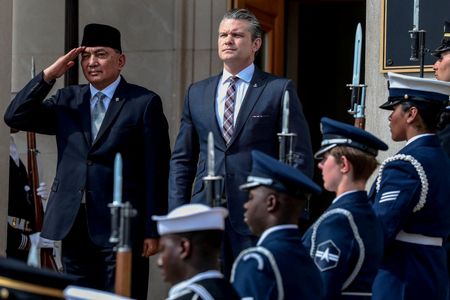
The confidential communication, marked as urgent, was sent in early April before Indonesian Defense Minister Sjafrie Sjamsoeddin met with U.S. Defense Secretary Pete Hegseth in Washington this past Monday, two Indonesian sources revealed.
The previously unreported correspondence advised the defense ministry to postpone any final decision on the agreement with Washington. It remains unclear whether the overflight arrangement was addressed during the Hegseth-Sjafrie discussions.
Sources indicated the agreement was scheduled to receive signatures during Monday’s meeting.
Following the Washington meeting, Pentagon officials announced the establishment of a significant defense cooperation partnership between the two nations, outlining various ways to strengthen military relationships, though overflight permissions were not specifically mentioned.
An unnamed U.S. official noted that the absence of overflight references in public statements doesn’t necessarily mean the topic wasn’t addressed privately.
Pentagon representatives have not yet provided comment on the matter.
While Indonesia’s defense ministry declined to confirm whether the proposal was discussed during the bilateral meeting, officials stated the U.S. request is undergoing thorough evaluation by Jakarta, with several modifications being considered to protect the country’s sovereignty and national interests.
The Southeast Asian archipelago nation, comprising over 17,000 islands, occupies a crucial position at the southern gateway to the South China Sea, where it administers the Natuna Islands while maintaining important relationships with both Beijing and Washington.
Beijing asserts territorial claims over nearly the entire South China Sea—a vital shipping route handling over $3 trillion in annual trade—despite competing claims from the Philippines, Brunei, Malaysia and Vietnam.
The foreign ministry’s letter emphasized that the American proposal requires careful consideration because it would enable Washington to expand surveillance and intelligence-gathering operations using Indonesian waters and territory, potentially impacting relationships with other regional strategic partners, particularly China.
The communication stated that such an agreement would create “the impression that Indonesia is involved in an alliance with the implication of increased national security risks because it places Indonesia as a potential target in a regional conflict situation.”
The letter also documented that U.S. military aircraft conducted surveillance missions in the South China Sea on 18 separate occasions between January 2024 and April 2025, which it characterized as violations of Indonesia’s territorial waters and airspace.
The document noted that Indonesia’s formal complaints about these operations have not received adequate responses from the United States.
Representatives from Indonesia’s foreign and defense ministries, along with Pentagon officials, have not yet responded to requests for comment regarding the concerns outlined by Indonesian foreign ministry officials.
Indonesia maintains a non-aligned foreign policy stance, and President Prabowo Subianto has pledged to maintain friendly relations with all nations.
The country serves as a prominent member of President Donald Trump’s Board of Peace initiative and has pledged the largest military contingent for the organization’s proposed peacekeeping force in Gaza.
Subianto has also preserved close ties with Beijing. His initial international trip as president in 2024 was to China, and he participated in a military parade hosted by President Xi Jinping last year, where he was photographed alongside U.S. adversaries including Russian President Vladimir Putin and North Korean leader Kim Jong Un.
Meanwhile, the United States and Australia have joined the Philippines for their second joint maritime training exercises in the South China Sea this year, as tensions continue with China over the disputed waters.