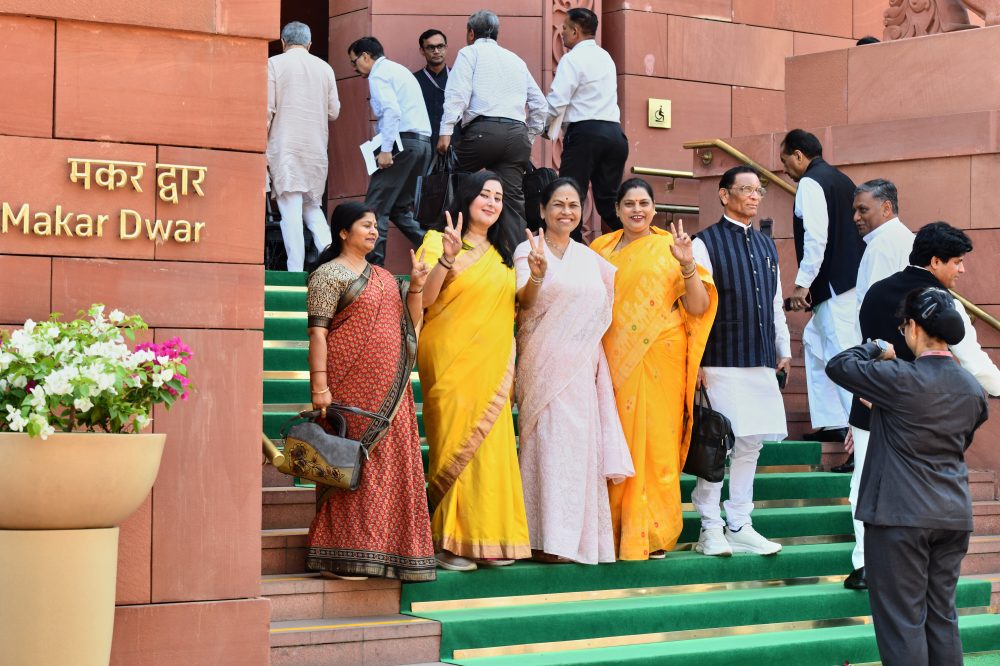

NEW DELHI (AP) — Indian lawmakers began deliberations Thursday on historic legislation that would guarantee women one-third of all seats in the nation’s Parliament, a move that could trigger extensive redistricting and heighten political conflicts across the country.
The proposed legislation would accelerate implementation of a 2023 law requiring 33% of parliamentary and state legislative positions be designated for women. This would represent one of the most significant changes to political representation since India gained independence and could dramatically expand female involvement in a government where women currently have limited presence.
However, the women’s quota proposal is connected to a contentious companion measure that would restructure voting districts, potentially expanding the lower house from its current 543 members to approximately 850.
Although broad cross-party support exists for increasing women’s parliamentary participation, opposition groups have expressed alarm about the redistricting component, cautioning it might shift the political landscape to benefit Prime Minister Narendra Modi’s Bharatiya Janata Party.
Both measures are under consideration during Parliament’s three-day special session and need approval from two-thirds of both legislative chambers. Modi’s governing National Democratic Alliance currently controls 293 parliamentary seats, falling short of the 360 needed for the required supermajority.
Multiple Asian nations, including India’s regional neighbors Nepal and Bangladesh, have established comparable quotas for women in their national legislatures. India already requires one-third of local government positions be reserved for women, yet women currently occupy just 14% of lower house parliamentary seats.
The quota system could bring hundreds of additional women into legislative roles, which advocates believe might shift policy focus toward women’s healthcare, education and combating gender-based violence. The method for distributing seats to women in an enlarged Parliament remains undetermined.
Women’s rights activist Ranjana Kumari described the initiative as making India’s “democracy truly representative” while compelling political parties to nominate more female candidates.
“(The) door is little open. Women will enter and fill the room slowly,” Kumari stated.
Many young Indian women view this development as symbolically important.
Pranita Gupta, a 23-year-old law graduate, explained it will create “a sense of confidence that we can participate in politics and we can be part of Parliament not only as an exception but as well as a norm.”
Implementation of the quota depends on population-based redistricting using information from the most recent completed census in 2011. While the schedule for this redistricting process remains uncertain, the proposal has already sparked political controversy.
Opposition parties caution that population-based constituency creation could transfer political influence toward rapidly growing northern states while reducing parliamentary representation and overall power of southern regions. They contend this could advantage Modi’s party, which enjoys strong northern state support.
India’s Constitution requires parliamentary seat distribution based on population and revision following each census. Nevertheless, boundaries haven’t been redrawn since the 1971 census, as consecutive governments postponed the process due to concerns about unequal population growth patterns.
Southern state leaders, where birth rates have dropped more dramatically, argue population-based redistricting could increase northern representation while disadvantaging southern areas that have controlled population growth and developed stronger economies.
Modi’s party has rejected criticism of the legislation, with Parliamentary Affairs Minister Kiren Rijiju describing the concerns as misleading on Wednesday.
However, opposition emerged Thursday when Tamil Nadu chief minister M.K. Stalin burned a copy of the bill and displayed a black flag in protest. He encouraged residents statewide to take similar action.
Several southern state leaders also appeared in Parliament wearing black clothing as a protest gesture.
Opposition leader Rahul Gandhi accused the redistricting effort of potentially being used to “gerrymander” parliamentary constituencies to favor Modi’s party before the 2029 national elections.
“Delimitation should be based on a transparent policy framework, developed after wide consultations with a consensus,” he posted Wednesday on X.