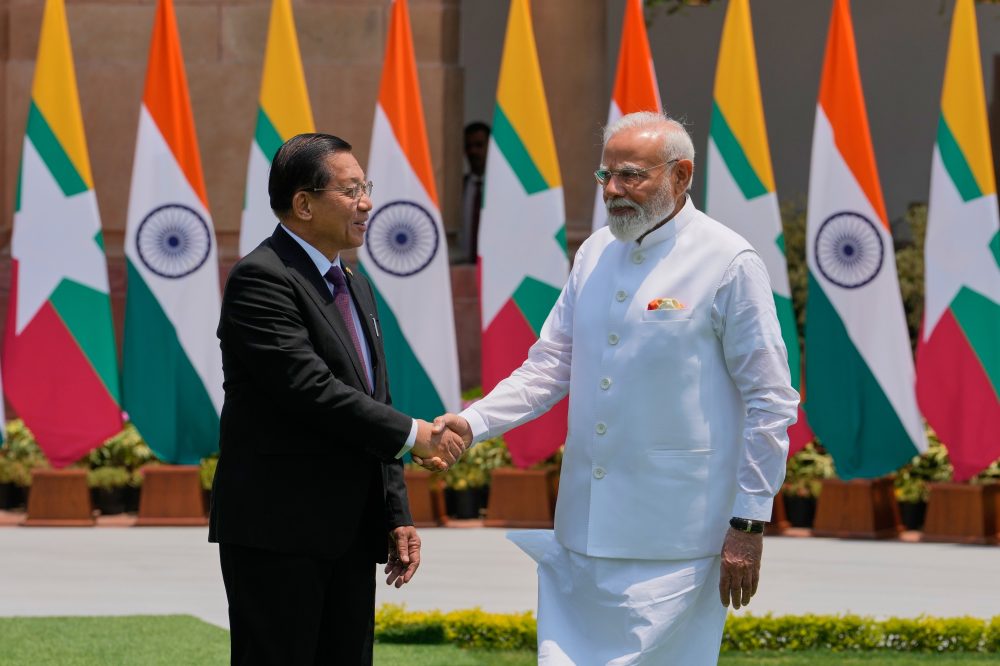

NEW DELHI (AP) — India announced it will maintain diplomatic relations with Myanmar following Monday’s meeting between Prime Minister Narendra Modi and the head of Myanmar’s military-backed administration, even as Western countries continue sanctions after the military takeover in 2021.
Speaking to reporters in New Delhi, Indian Foreign Secretary Vikram Misri explained that India’s approach is “not intended to be a commentary on the internal political arrangements” in Myanmar, with New Delhi viewing continued engagement as the most effective path forward.
Countries in the West have attempted to isolate Myanmar’s military leadership since they removed the democratically elected administration of Aung San Suu Kyi through a 2021 coup that sparked widespread repression and created a nationwide conflict and humanitarian emergency. Some observers and human rights organizations argue that Min Aung Hlaing’s trip to India could provide credibility to the military-controlled government.
“We have always proceeded on the principle that sustained dialogue is what is important,” Misri stated, emphasizing that cutting off Myanmar would prove ineffective.
“History has shown that disengagement doesn’t give us any results that are better than engagement,” he explained.
This marks Min Aung Hlaing’s initial trip to India since taking office as president in April after an election that opponents claim was structured to solidify military control. His previous Indian visit occurred in 2019 while serving as Myanmar’s top military commander.
India and Myanmar share a 1,643-kilometer (1,020-mile) land border plus a maritime boundary in the Bay of Bengal. India currently shelters thousands of Myanmar refugees, including many who escaped violence in northwestern Chin state and other war-torn regions.
Myanmar holds strategic significance for India’s security concerns. Both nations have coordinated on border protection and intelligence operations to counter insurgent organizations active along their shared frontier.
Following their discussion, Modi and Min Aung Hlaing did not speak publicly, breaking from the typical protocol for bilateral meetings with visiting foreign leaders in New Delhi.
However, Misri revealed that the leaders covered trade, defense and security partnerships, border oversight, and regional matters, with conversations also emphasizing expanded economic and technological relationships. He noted both parties committed to strengthening cooperation in multiple areas including commerce, energy and essential minerals, while accelerating major infrastructure projects.
The officials also addressed joint efforts against cybercrime and human trafficking, problems that have impacted thousands of Indians deceived into working at fraudulent operations throughout the region. Misri reported that India and Myanmar have collaborated to rescue over 2,400 Indian citizens during the past 18 months.
Throughout his stay, Min Aung Hlaing also conducted meetings with Indian President Droupadi Murmu, Foreign Minister Subrahmanyam Jaishankar and National Security Adviser Ajit Doval.