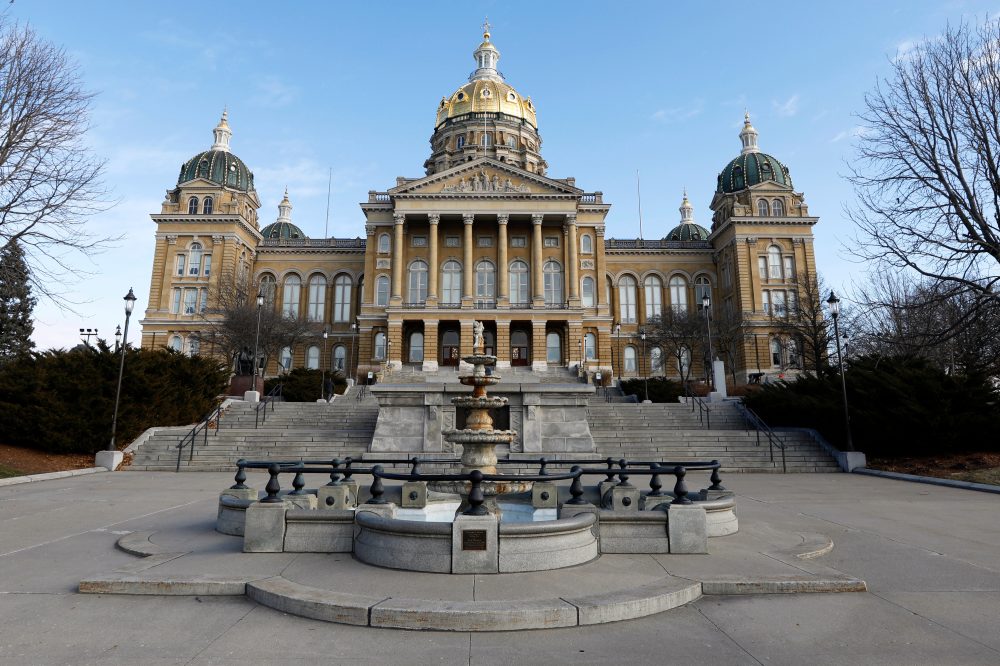

WASHINGTON — Tuesday’s primary elections in Iowa feature wide-open contests for the state’s top offices after two leading Republican figures decided not to seek reelection, setting up competitive races that will have significant implications for November’s general election.
The departure of Gov. Kim Reynolds and U.S. Sen. Joni Ernst from their respective races has created a domino effect of contested nominations and vacant seats throughout the ballot. These primary results will determine who competes in November’s crucial midterm elections, where Iowa’s federal legislative seats could help decide which party controls the closely divided Congress.
Four candidates are seeking to fill Ernst’s Senate seat after she declared in 2025 she wouldn’t pursue a third term. On the Republican side, U.S. Rep. Ashley Hinson is battling former state Sen. Jim Carlin, while Democrats will choose between state Rep. Josh Turek and state Sen. Zach Wahls. Carlin previously sought Iowa’s other Senate seat in 2022, earning approximately 27% of the primary vote in a race against U.S. Sen. Chuck Grassley.
Reynolds similarly announced in 2025 her decision against seeking another gubernatorial term. Five Republicans are competing for their party’s nomination: state Rep. Eddie Andrews, U.S. Rep. Randy Feenstra, entrepreneur and private school co-founder Zach Lahn, former state Rep. Brad Sherman, and former state administrative services director Adam Steen.
The Republican gubernatorial nominee will face Democratic state Auditor Rob Sand, who runs unopposed in his primary. Sand currently serves as Iowa’s sole Democrat holding statewide elected office.
The congressional campaigns of Hinson and Feenstra have opened up races in Iowa’s 2nd and 4th Congressional Districts. While Feenstra’s heavily Republican district is unlikely to impact chamber control, Hinson’s more competitive district could play a larger role, despite her 57% reelection victory in 2024.
Iowa’s most contested congressional races feature Republican U.S. Reps. Mariannette Miller-Meeks of the 1st District and Zach Nunn of the 3rd District both running for reelection. Miller-Meeks faces a second matchup with advertising executive David Pautsch, who captured about 44% of the vote in their 2024 primary battle. The Democratic field includes former state Rep. Christina Bohannan, who fell just 800 votes short of defeating Miller-Meeks in 2024.
In the 3rd Congressional District, both Nunn and his Democratic challenger, state Sen. Sarah Trone Garriott, face no primary opposition.
Republican Donald Trump secured approximately 54% of the 2024 presidential vote in both the 1st and 2nd Congressional Districts, and about 52% in the 3rd District.
The state’s three most populous counties — Polk, Linn, and Scott — will significantly influence both Republican and Democratic statewide primary outcomes. Johnson County ranks fourth in population, but its status as home to Iowa City and the University of Iowa makes it a Democratic stronghold with limited impact on Republican contests.
Polling locations close at 8 p.m. Central Time, which translates to 9 p.m. Eastern Time.
The Associated Press will track vote totals and announce winners in competitive primaries for U.S. Senate, U.S. House, governor, auditor, and state legislative positions.
Primary participation requires voter registration with the corresponding political party, though voters can switch party affiliations at polling places on election day.
Current voter registration data from May 4 shows approximately 2.1 million registered voters statewide, with about 692,000 Republicans, roughly 496,000 Democrats, and around 589,000 unaffiliated voters.
The 2022 U.S. Senate primaries drew about 196,000 Republican votes and approximately 157,000 Democratic votes.
Early voting comprised roughly 16% of Republican primary ballots and about 25% of Democratic primary ballots in the 2022 Senate primaries.
Through Thursday, approximately 41,000 ballots had been submitted for Tuesday’s election, with roughly 26,000 from Democratic primary voters and more than 15,000 from Republican primary participants.
Most counties report mail-in absentee results at the beginning of election night, though timing varies for in-person absentee vote reporting.
During the 2022 contested state primary, the AP began reporting results at 9:12 p.m. Eastern Time, just 12 minutes after polls closed. The final vote update occurred at 2:29 a.m. Eastern Time, with over 99% of votes tallied.
The AP bases winner declarations on mathematical certainty that trailing candidates cannot overcome existing vote gaps, rather than making projections. When races remain undecided, the AP continues covering significant developments while clearly stating no winner has been declared and explaining the reasoning.
Iowa lacks automatic recount provisions, but candidates may request and fund recounts. No payment is required for recounts when margins fall below 1% of total votes or fewer than 50 votes, whichever is greater. The AP may declare winners in recount-eligible races if the lead appears too substantial for recounts or legal challenges to alter the outcome.
Tuesday marks exactly 154 days before the 2026 midterm elections.