
NEW DELHI — India and Japan formalized several new agreements Thursday aimed at deepening their partnership across artificial intelligence, metals, and energy, with the two nations also mapping out a shared strategy for economic security.
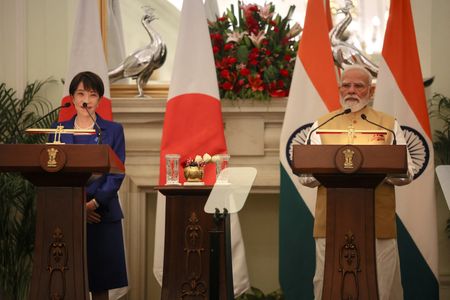
Indian Prime Minister Narendra Modi announced the deals following face-to-face discussions with Japanese Prime Minister Sanae Takaichi, who arrived in New Delhi for a three-day visit as part of the two countries’ 16th annual summit.
“The convergence of Japan’s precision technology and India’s software capabilities will give a new momentum and strength to global AI development,” Modi told reporters after the talks concluded.
According to Indian government figures, bilateral trade between the two nations hit $27.5 billion in fiscal year 2025/26, while Japanese investment flowing into India totaled $3.2 billion between April and December of 2025.
Both countries are also members of the Quad grouping, and Modi noted that they reached a milestone by signing an agreement on their very first joint defense co-development project.
Modi also highlighted a new initiative focused on clean energy. “Through the India-Japan bio-gas Initiative, we will set up 1,000 bio-gas and organic fertilizer plants in India,” he said.
Japan ranks among India’s top investors, with financial backing behind major infrastructure efforts such as the high-speed rail corridor connecting Mumbai and Ahmedabad. Japanese companies have also been increasing their stakes in Indian businesses, including a recent $1.6 billion investment for a 20% share in Yes Bank.
Takaichi made the trip accompanied by a sizeable business delegation and was scheduled to address a business conference later Thursday.