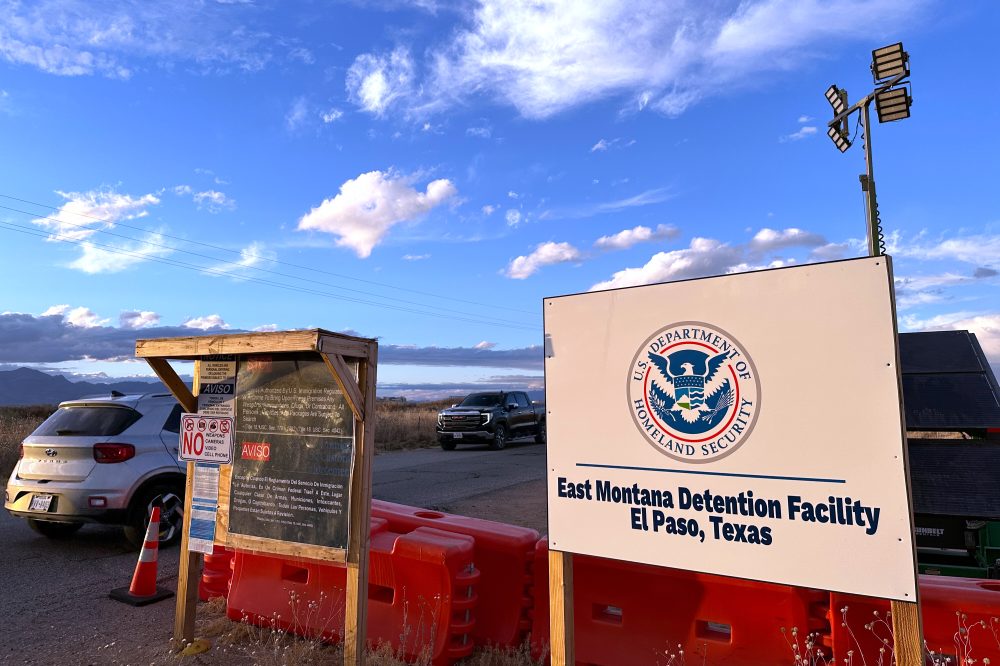

U.S. Immigration and Customs Enforcement is moving forward with plans to keep one of its largest and costliest detention centers operating for at least another year, brushing aside demands to shut it down over documented reports of human rights violations.
According to a notice published last week, ICE intends to extend the no-bid contract held by the company operating Camp East Montana in El Paso, Texas, through September 30, 2027. That extension could cost taxpayers an additional $776 million — on top of the $452 million initial contract awarded in March to Amentum Services Inc., a firm brought in to replace a previous contractor that was removed for poor performance.
Democratic members of Congress and multiple advocacy groups have been pushing for months to have Camp East Montana closed. Their calls stem from a series of troubling reports about conditions at the facility since it opened in August 2025.
Earlier this month, Human Rights Watch and the American Civil Liberties Union released a report alleging that staff members regularly beat detainees, withheld medical treatment, forced them to live in unsanitary conditions, and served them food that was unfit to eat. Federal agency investigations have also identified unsafe conditions at the facility and found that both the Army and ICE wasted millions of dollars on services that were not needed. At least three people held at Camp East Montana have died.
The facility is located at Fort Bliss, an Army installation near the U.S.-Mexico border. ICE data shows the camp has held an average of more than 2,000 male and female detainees per day since October 1, though that number has dropped considerably in recent months.
Angélica César, a fellow at Human Rights Watch and the ACLU who served as a lead researcher on the report, sharply criticized the decision. “Extending Amentum’s contract while ignoring well-documented abuses is reckless and demonstrates the Trump administration’s full-scale assault on human rights,” she said. “Instead of holding private contractors accountable, DHS is choosing to perpetuate a system of harm and abuse.”
A spokesperson for Amentum, Chanel Mann, directed all questions to ICE and its parent agency, the Department of Homeland Security. Neither agency responded to requests for comment.
ICE’s notice served as a formal justification for bypassing a competitive bidding process and extending Amentum’s contract directly. The agency argued that moving detainees to other facilities would be “impracticable” because there are not enough available beds elsewhere. It also stated that switching to a new contractor would require replacing Amentum’s “proprietary infrastructure” and hiring a new workforce, leading to unnecessary duplicate costs.
“Any lapse in contract coverage would directly threaten the life, safety, and well-being of detainees, severely disrupt law enforcement operations, and expose the government to substantial operational, legal, and humanitarian risks,” the notice stated.
ICE also acknowledged in the notice that the Army’s original contract — awarded to a company called Acquisition Logistics LLC, which had no prior experience running detention facilities — “did not accurately reflect ICE’s operational needs or the actual usage of the facility.”
In total, Virginia-based Amentum Services stands to collect more than $1.2 billion in taxpayer funds if it continues operating the camp from March 2026 through September 2027, according to the notice.