
A senior Pentagon official acknowledged Monday that the United States is still in the earliest and most difficult stage of building a domestic drone manufacturing industry, with current output nowhere near matching what Ukraine produces during wartime.
Travis Metz, deputy director and chief operating officer of the Defense Innovation Unit and head of the Pentagon’s Drone Dominance Program since last fall, told reporters that Ukraine is expected to manufacture between six and seven million small first-person-view attack drones in 2025 — roughly 500,000 per month.
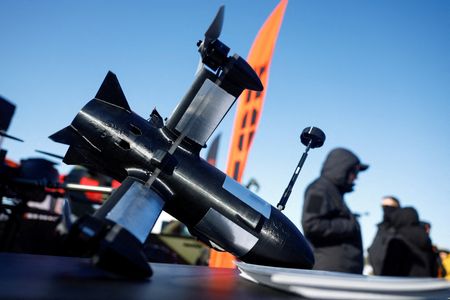
That figure dwarfs what the U.S. has managed so far. The Pentagon’s $1.1 billion program will have placed orders for just under 200,000 drones in total by February. Metz said the early phase of building that capacity is the hardest part, noting that going “from zero to 200,000” is more difficult than scaling up once a solid foundation is in place.
Adding to the challenge, the Pentagon recently made domestic production requirements significantly stricter. A revised supply chain framework released July 23 states that the government’s long-term goal is a supply chain that is “wholly domestic” for small unmanned aircraft systems.
Under the new rules, none of the 19 companies competing in an August testing event are permitted to use banned components — including Chinese-made brushless motors or battery packs. Metz noted this is a tougher standard than what was required in the program’s first phase, estimating that “the vast majority” of drones purchased earlier likely contained Chinese-made motors. “It’s an increasingly difficult thing,” he said.
Metz also pointed out that sourcing hard-to-find components like semiconductors remains a major challenge for U.S. manufacturing well beyond the drone sector.
Despite those hurdles, Metz expressed confidence that the U.S. will eventually compete with Ukraine’s drone industry. “I see no reason why we shouldn’t … be the world champions of this as well,” he said.
All six Ukrainian companies invited to next month’s “Gauntlet II” testing event at Fort Carson, Colorado, are either already in or moving toward joint ventures with American manufacturers — a requirement for receiving future orders. Ukrainian firm F-Drones has teamed up with Ohio-based Ukrainian Defense Drones, which has opened a facility near Toledo. Meanwhile, Ukrainian drone maker General Cherry has reached a joint venture agreement with Wilcox Industries, based in New Hampshire.
Metz said the arrangement is designed to bring Ukraine’s combat-proven drone expertise into American factories, building U.S. manufacturing capacity rather than creating a dependence on foreign imports.