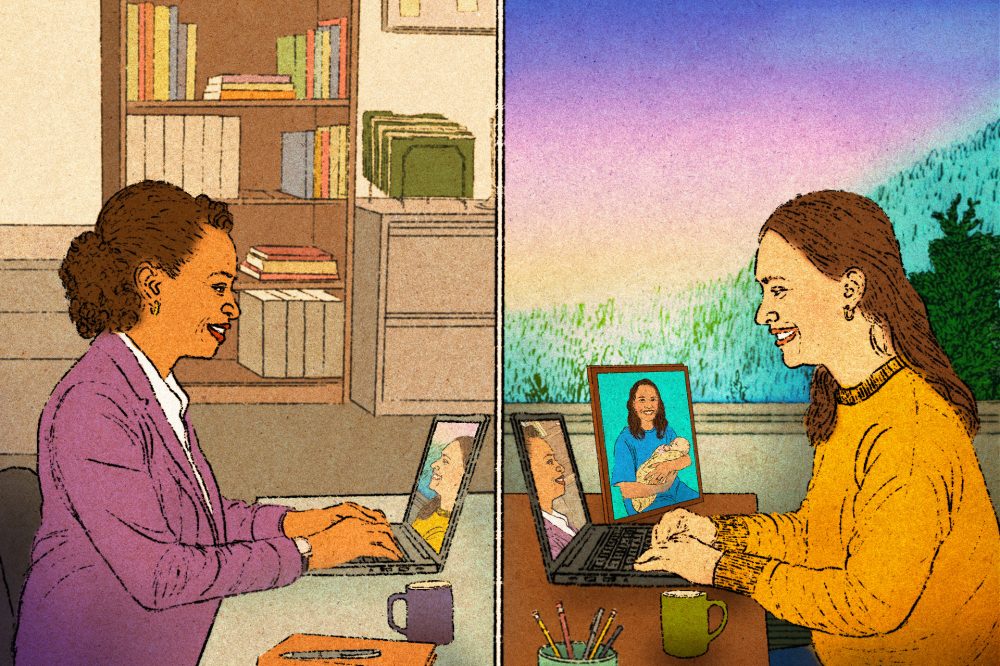

NEW YORK (AP) — When Monique Di Liberto decided to re-enter the workforce after stepping away from her career for 17 years to raise her children full-time, she was consumed by self-doubt.
“Who do you think you are trying this after 17 years?” Di Liberto recalled thinking to herself. “You have no business doing this.”
That sense of fear and uncertainty is something many job seekers can relate to — whether they were caught up in mass layoffs, stepped away to care for a sick family member, or took time off for personal reasons. One thing applicants can count on: questions about gaps in their work history will come up during the hiring process.
“You have to address it honestly and directly,” said Andy Decker, CEO of Goodwin Recruiting, a firm specializing in candidate recruitment and placement. “Make sure that you’ve included anything you did during that time. Did you get certifications? Did you volunteer?”
Decker noted that lengthy stretches between jobs have become far more common and carry less of a stigma than they once did — particularly since the COVID-19 pandemic, when many people worked remotely or left their jobs to care for children or family members. He said some job seekers now label these periods on their resumes as a “career break” or “family responsibility.”
Here are some strategies from a recruiter and people who have navigated career gaps themselves.
Decker said employers today tend to focus more on skills and results than on a flawless work history. Volunteering with a nonprofit, for example, can be a good way to keep professional skills sharp during a gap.
Di Liberto, 57, had been a classically trained opera singer before getting married and becoming a mother. While her husband built a chiropractic practice, she put her music career on hold to raise their children.
When she decided to return to work, Di Liberto didn’t have traditional 9-to-5 experience to put on a resume. So instead, she looked at activities outside of family life that demonstrated transferable skills.
Her time as PTA president at her children’s school, for instance, involved managing budgets and presenting project proposals to the school board. She had also assisted with budgeting, software rollouts, and hiring at her husband’s practice.
Even so, she repeatedly heard that she wasn’t qualified as she applied for administrative support positions. But one interviewer was intrigued, telling her: “This resume was so different than anything I had ever seen. I needed to see the person who created this.”
Rather than leave without an offer, Di Liberto proposed a 30-day trial period as an administrative assistant. Her pitch: “I recognize that you probably are getting resumes of people who are far more qualified than me, but I would challenge that they are not as tenacious and driven as me. If you give me 30 days, I’ll prove to you that I can learn this job and I can do this job.”
The company brought her on board. Over the following decade, she earned promotions, was recruited by other employers, and eventually rose to head of client services at an artificial intelligence company. Di Liberto said she was asked about her career gap every time she interviewed for a new role.
“I was fortunate enough to stay home for 17 years and raise amazing humans,” she tells prospective employers. “And I worked from the ground up to be where I am today.”
Laura Sandvik, who left a marketing position to care for her mother and later her children, took a different approach — highlighting in her LinkedIn profile the personal strengths she developed during that time.
“I have no regrets about those choices. They strengthened my patience, perspective, and sense of responsibility. In returning to formal roles, I have done so intentionally,” she wrote.
If a job loss was the result of company restructuring or layoffs, Decker said there’s no need to spell that out on a resume — but if an interviewer asks, honesty is the best policy.
“I would simply say, ‘I was one of 270 people caught up in this reduction of force,’ or if you made it through a few rounds of layoffs, say, ‘Over two years we had five rounds of reductions in force, I made it through four, I was caught up in the fifth,’” Decker suggested.
He also advised practicing answers before the interview and steering clear of negativity or blaming a former employer. “Own it, acknowledge it and move on,” Decker said.
Baura Zia, 35, was laid off in 2022 shortly after returning from maternity leave. While initially upset, she now says losing that job “was honestly a blessing in disguise” because it gave her three years at home with her two children.
On her resume, Zia refers to that stretch as a “parenting gap” and mentions that she also relocated across the country during that time. When she began searching for part-time work after her son’s first birthday, she was upfront in interviews that her previous employer had let her go not because of her performance, but because the contract she was working on was lost.
“Having grace with yourself is really important,” Zia said. “It’s not a flaw to have a career gap. If anything, you’ve grown so much from that.”
During her job search, Zia reached out online to people who worked at companies she had applied to, asking about their experiences. Most didn’t respond, but some did. She also reconnected with contacts from a women’s public relations networking group she had joined years earlier.
“When I was ready to go back to the workplace, it wasn’t as hard as I thought it would be, only because I had my network to tap into,” Zia said.
For those whose gaps stem from more significant barriers — such as a period of incarceration — addressing the issue can be especially challenging.
Ryan Cuellar, 29, was charged with felony possession of stolen property at age 18 and sent to jail just a month before he was expected to graduate high school. He said he takes pride in what he has overcome.
“Don’t reflect on your mistake but take pride in what you learn from it and what you are doing about it,” Cuellar said.
After serving a few months, Cuellar returned to high school to complete his senior year. He then took a series of jobs that didn’t require background checks — including acting work and operating machinery — while also attending college classes.
After earning a paralegal certification, Cuellar used that training to petition to have his criminal record sealed, which meant he was no longer required to disclose his legal history on job applications or worry about it coming up in background checks.
Despite that, Cuellar chose to tell potential employers about his past anyway, even knowing it sometimes cost him job opportunities. He also volunteered at the jail, helping people there develop skills to use after their release. He recently landed his first full-time position, selling online tutoring services for a company.
“It’s part of my story,” Cuellar said of his incarceration. “At the end of the day, I think that you need to know that about me as a person to understand my side and where I come from and my perspective.”