
WASHINGTON (AP) — With the United States marking its 250th birthday, many Americans are planning the classic summer trip to Washington, D.C. But those who visit the nation’s capital this year will find a city in the middle of a dramatic transformation driven by President Donald Trump.
In the roughly 17 months since returning to the White House, Trump has placed his name and likeness on federal buildings, demolished historic structures, launched major construction projects, and stationed armed military personnel throughout the city.
The landmarks tourists have always known are still there. But a closer look — with a willingness to wander and observe — reveals just how aggressively the president has worked to put his stamp on the capital.
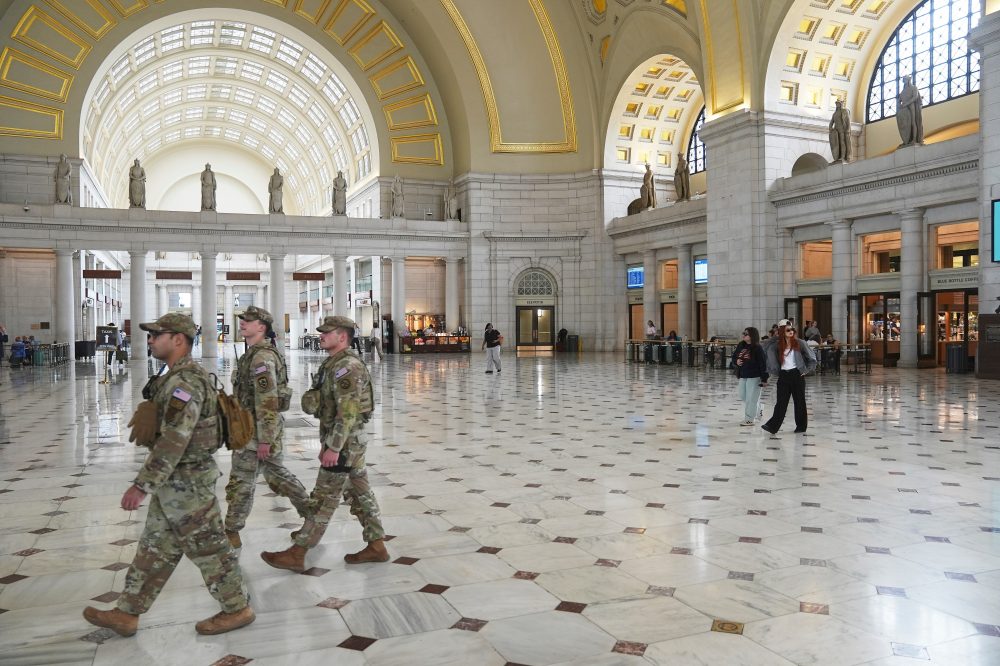
Any tour of the new Washington begins at Union Station and Metro Center, the city’s primary transit hubs. Alongside their distinctive architecture — Greco-Roman at the former, Brutalist at the latter — visitors will now notice something new: armed National Guard troops stationed at entrances and throughout the surrounding areas.
Guard members from Washington, D.C., and multiple states have been present since August 2025, deployed under an emergency order Trump signed, which he described as a measure to combat crime. The deployment is expected to continue through most or all of 2026, with troop numbers projected to reach 5,000 this summer.
Military deployments to the capital are not without precedent — troops were stationed in D.C. during the Civil War, following the 1968 assassination of Martin Luther King Jr., and briefly during the January 6, 2021, Capitol riot. But under Trump, soldiers at street corners and subway stations have become a routine feature of city life, with no clear end date in sight.
Heading down Pennsylvania Avenue from Union Station, visitors pass a building now closely associated with the Department of Government Efficiency — the Trump administration’s initiative to reduce the size of the federal government. The U.S. Agency for International Development, once headquartered there, was the first major federal agency targeted by then-DOGE leader Elon Musk. Tens of thousands of workers lost their jobs as cost-cutting measures swept through the agency.
USAID had previously distributed billions in humanitarian assistance around the world and was credited with saving millions of lives over its history. By cutting roughly 90% of foreign aid contracts, the Trump administration effectively eliminated around $60 billion in funding. After employees packed up last February, the Pennsylvania Avenue offices were converted to other government uses. The agency’s closure also contributed to a sharp rise in unemployment in the region, where approximately one-fifth of the workforce is employed by the federal government.
Heading south toward the National Mall along the numbered streets, visitors encounter another striking change: banners bearing Trump’s image on the facades of several government buildings. This kind of display is highly unusual for a sitting American president.
At the U.S. Department of the Interior, Trump’s image appears alongside that of George Washington on matching banners reading