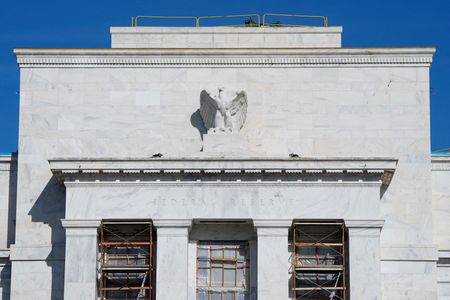

A growing majority of economists now believe the Federal Reserve will leave interest rates right where they are for the rest of this year, pushing back against financial market expectations for two rate increases, according to a new Reuters poll.
Inflation is currently running above 4% — the highest level in more than three years and twice the Fed’s stated target — even as the economy continues to grow and the job market shows improvement. However, oil prices have retreated to levels close to where they stood in February, before the U.S.-Israeli war with Iran got underway.
The central bank kept its benchmark rate steady at 3.50% to 3.75% at its most recent meeting, a move that was widely anticipated. Still, Fed Chair Kevin Warsh caught many observers off guard at his first press conference by making the return of inflation to the 2% target his central focus, with little attention given to employment conditions.
Despite that hawkish tone, most economists believe the Federal Open Market Committee will opt to leave rates unchanged in the months ahead.
“At the moment, holding rather than hiking is the most appropriate stance. The committee is effectively split right down the middle … there are a couple that would be swayed by this aggressive move in energy prices,” said Josh Hirt, senior U.S. economist at Vanguard, who had previously anticipated a rate cut.
Quarterly projections released last week by the Fed — not including Warsh, who abstained — showed that nine of the 19 policymakers now expect at least one rate hike before the end of 2026.
“If we continue to get data that moves in this direction, it’s going to be extremely difficult to justify not moving rates higher,” Hirt added.
For now, more than three-quarters of economists surveyed between June 23 and 25 expect the federal funds rate to stay put through the rest of 2026. That’s up from roughly 70% before the June meeting and just under half the month before. Survey medians now point to rates holding steady through the end of 2027, a reversal from expectations just weeks ago that called for cuts. Nearly 40% of respondents have raised their rate forecasts again after most had already done so earlier this month.
The recent spike in inflation is compounding existing price pressures tied to President Donald Trump’s broad import tariffs. The rising cost of living represents a political problem for Trump and his Republican Party heading into November’s midterm elections.
Trump made reducing inflation a central promise of his 2024 campaign and has repeatedly taken aim at Warsh’s predecessor, Jerome Powell, for not cutting rates.
“The public does not like higher interest rates but they dislike inflation even more,” said Alex Pelle, senior U.S. economist at Mizuho Securities USA. “There will always be politicians who have opinions on what the Fed should or should not be doing. But ultimately, the job is too big to let the political considerations dominate.”
Fifteen forecasters — including five primary dealers — now expect at least one rate hike this year, compared to nine who are forecasting cuts. It marks the first time since 2023 that the number of economists calling for hikes has exceeded those expecting cuts.
“We had expected only three people to write down hikes heading into the June meeting,” said Stephen Juneau, a U.S. economist at Bank of America, who now anticipates three rate hikes this year. “That’s a materially hawkish surprise and it does indicate the Fed’s reaction function has turned.”
Bank of America’s forecast was the most aggressive of any in the survey, while Citibank still projects two rate cuts this year.
A great deal will hinge on how the Fed communicates its decisions under Warsh, whose approach appears poised to become considerably more concise. At June’s meeting, the new Fed chief signaled a move away from forward guidance, releasing a streamlined policy statement that recalled the style used during former Chair Alan Greenspan’s tenure, and also announced a sweeping review of Fed operations.
Some economists are already expressing concern about such broad changes.
“The Fed still needs forward guidance to get its message across,” said Bank of America’s Juneau. “There are more pros than cons to maintaining some level of guidance and not going fully back to the early Greenspan years when it was much more opaque as to what the Fed was doing.”