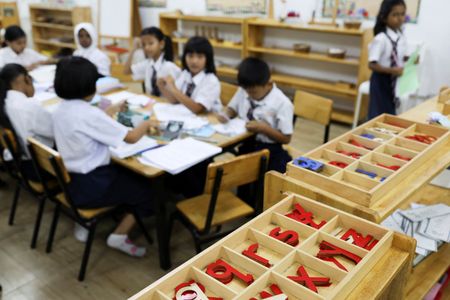

A 12-year-old Rohingya Muslim refugee in Malaysia named Nur has not set foot in school since June, after two men confronted and threatened to beat her while she was on her way to class.
“Why do you want to go to school? Do you want to take over our country?” the men reportedly said, according to Nur, whose family asked that her full name not be used out of fear of retaliation.
Nur’s situation is far from unique. Rights organizations and educators say harassment and threats like these have driven refugee schools throughout Malaysia to shut their doors.
“Children are so scared that they’re afraid to leave the house,” said Sharifah Shakirah, a Rohingya community activist who grew up in the Southeast Asian nation. “You’re not just harassing a child for a day or two, you’re creating a lasting trauma.”
Reuters confirmed that at least nine schools across Malaysia have closed following a surge of online hate speech and misinformation aimed at the Rohingya community — a development that has also raised concerns about how technology platforms regulate harmful content. Malaysia’s home affairs ministry did not respond to requests for comment on either the school closures or the online hate campaign.
Malaysia does not formally recognize the Rohingya as refugees, classifying them instead as illegal migrants, even though approximately 120,000 are registered with the United Nations refugee agency.
The Muslim-majority nation has historically shown sympathy toward the persecuted minority group from Myanmar. However, public sentiment shifted during the COVID-19 pandemic, when refugees faced accusations of spreading the virus, disrespecting cultural norms, and competing with locals for employment.
Malaysians “have begun feeling burdened by issues arising from managing the Rohingya community,” Deputy Foreign Minister Lukanisman Awang Sauni told parliament last week.
A fresh wave of hostility erupted in May across social media platforms operated by Meta Platforms Inc. and ByteDance’s TikTok, sparked by hygiene concerns tied to cattle slaughter performed as part of a Muslim religious ritual by one Rohingya group. An online petition calling on the government to “remove” Rohingya refugees gathered nearly half a million signatures before being taken down in June after rights organizations raised alarms.
“What we’re seeing now is 100 times worse than it was during COVID,” said Sharifah.
Some posts reviewed by Reuters called for violence against Rohingya refugees, including children. One discussion thread on Meta-owned Threads carried the title “Lempang Rohingya” — which translates to “Slap Rohingya” in Malay. Certain social media influencers also encouraged their followers to film Rohingya communities and report their whereabouts to authorities.
Home Minister Saifuddin Nasution Ismail stated in June that the government cannot arbitrarily deport refugees, saying it would respond by “balancing national security with humanitarian values,” though he offered no specifics.
Free speech advocacy organization Article 19 said the online campaign has intensified scrutiny of Rohingya communities, resulting in investigations, raids, and school closures. A spokesperson for the group said the government’s approach lacked human rights-based solutions, adding, “The government’s punitive measures are causing more harm than reducing tension and harassment.”
The U.N. refugee agency expressed concern over the growing online hate speech, disinformation, and dehumanizing language directed at Rohingya and other refugees. “We continue to monitor the situation closely and to support measures that reduce risks for refugees and host communities,” it said in a statement, without specifically addressing the school closures.
Authorities have shut down Rohingya-linked businesses and schools they say are operating without proper authorization. Because refugees are legally prohibited from working in Malaysia and their children are barred from the national school system, many families rely on schools run by non-governmental organizations or informal learning centers.
Following Nur’s frightening encounter, her teacher and the school’s operator suspended classes indefinitely due to safety concerns. Two neighboring refugee schools also closed. Rohingya children have additionally been chased away from public playgrounds, according to the teacher.
The teacher, himself a Rohingya refugee who founded the school in 2022 to provide basic education and prepare students for possible resettlement or a safe return home, pushed back against accusations that the school encouraged refugees to settle permanently in Malaysia or take jobs from locals. He requested anonymity for security reasons.
“Many accuse us of breaking Malaysian laws,” he said. “For me, starting this school is one way I can teach others how to understand and obey the law.”
In the northern state of Kedah, authorities shut down another school this month for lacking proper permits after videos of the facility were posted online, according to a teacher there who also spoke anonymously.
Teachers at three schools that remain open said they have adopted precautions to avoid becoming targets, including instructing students not to wear uniforms and canceling outdoor activities.
Activist Sharifah warned that the long-term consequences of the school closures will worsen existing social problems, such as child marriage among Rohingya girls and children living on the streets. “Many people complain about Rohingya children begging for money on the streets,” she said. “There will only be more of them if schools are closed.”
The crisis has also reignited debate about whether social media companies are doing enough to combat hate speech. Article 19 said that while some flagged posts were removed by Meta and TikTok, much of the harmful content remained online. Meta removed seven of ten items flagged by Reuters across Facebook, Instagram, and Threads, while TikTok removed eight of eleven.
Article 19’s spokesperson said enforcement by the platforms remains inconsistent, noting that AI moderation tools frequently struggle with coded language, visual content, and linguistic nuances. Both Meta and TikTok use a combination of automated detection and human review to enforce their policies. TikTok also features safety prompts reminding users to reconsider potentially harmful comments.
For the children caught in the middle, options are scarce. A tearful Nur told Reuters, “If I don’t go to school, I won’t be able to learn anything, and I can’t become anything.”