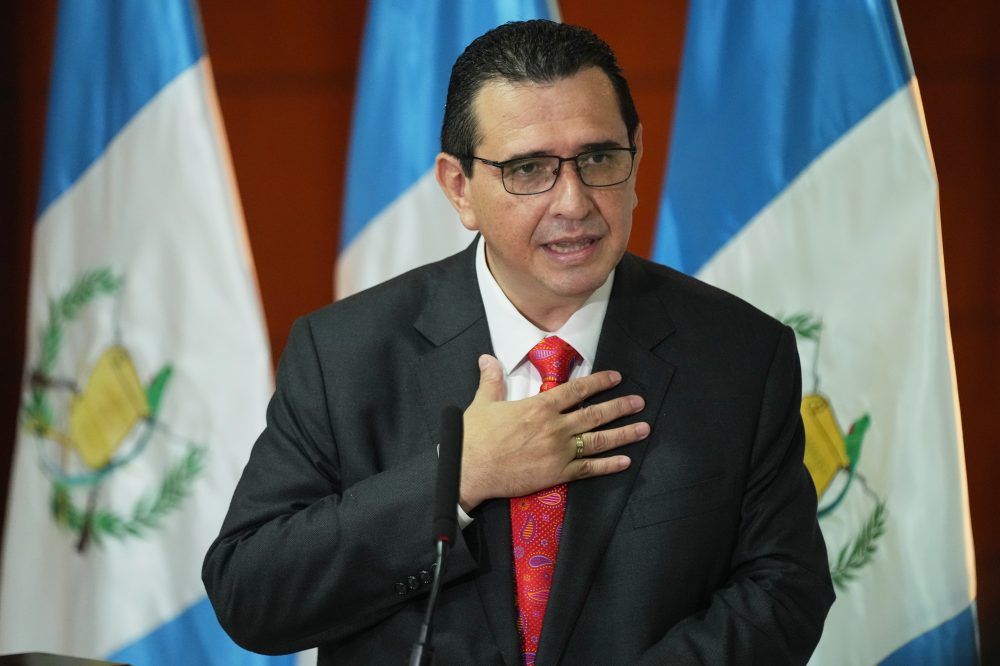

GUATEMALA CITY (AP) — Gabriel García Luna, who stepped into the role of Guatemala’s attorney general in May, announced Wednesday his intention to dismantle what he characterized as the “repressive and vengeful” legacy left by his predecessor — a figure who faced sanctions from multiple nations, including the United States, for undermining anti-corruption work.
Guatemala had previously been considered a reliable U.S. partner in fighting corruption throughout the region. That changed under Consuelo Porras, whose tenure saw corruption investigations suppressed, justice officials and journalists targeted, and many individuals forced to flee the country. Porras also made attempts to block President Bernardo Arévalo from taking office and sought to invalidate his presidency through unproven fraud claims.
“Everyone has a concept of a Public Prosecutor’s Office that can be used in a certain way, and we can no longer have that,” García Luna told The Associated Press. “It is not a political entity, nor a political weapon for anyone, and I do not intend to repeat the actions taken in previous administrations.”
García Luna has already taken steps to steer the institution in a new direction, breaking up the network of loyalists that Porras had placed in administrative and prosecutorial roles — individuals accused of using the office to criminalize and persecute former justice officials. He has also established a commission to examine cases involving people who were allegedly targeted.
Porras has rejected the accusations leveled against her. While she led the Public Prosecutor’s Office, it issued statements arguing that the allegations infringed upon her “right to honor, dignity, reputation and the presumption of innocence.”
During Wednesday’s remarks, García Luna outlined his commitment to sweeping reform, including a review of potential abuses that occurred under the previous administration and efforts to rebuild a prosecutorial profession that suffered greatly from the mass departure of experienced staff during Porras’ time in office.
García Luna said his predecessor “formed a parallel government that destroyed the prosecutorial profession, mainly by dismissing between 800 and 1,000 employees during her eight-year tenure.”
The new attorney general did not close the door on potential legal action against Porras, who faces several complaints including one related to human trafficking in irregular adoptions, as well as against her associates.
In instances where the prosecutor’s office — acting under Porras’ direction — allowed alleged corrupt officials, drug traffickers, and others accused of crimes to go free, García Luna stated those cases are being revisited, reopened, and that legal steps will be taken to prevent impunity.
Former prosecutor Juan Francisco Sandoval, who now lives in exile after accusing Porras of persecuting him for his work on major corruption cases, is among those calling for accountability. He and others argue the allegations against Porras and her associates must be handled through an “impartial and independent” process.
“These should not go unresolved, in accordance with the principle of equality before the law and the principle that no one should be above the law,” Sandoval said.
García Luna has received backing from the U.S. government and European Union member nations, which have pledged support in the fight against transnational crime, including drug and human trafficking. He also noted that the Attorney General’s Office is working alongside the Inter-American Commission on Human Rights, which has set an August 4 hearing to review cases involving individuals who reported political persecution under Porras.