
GOP-led states are accelerating efforts to redraw congressional boundaries in their favor before November’s midterm elections, following a recent Supreme Court ruling that reduced minority voting protections under federal law.
Within just a few weeks, revised U.S. House boundaries have already become law in Tennessee and Alabama, while similar measures have passed through at least one legislative chamber in Louisiana and South Carolina. However, legal and legislative obstacles still exist before these new maps can take effect for November voting.
Congressional boundaries are normally redrawn following each decade’s census. However, President Donald Trump has encouraged Republican-controlled states to pursue redistricting now as they work to maintain the GOP’s slim House majority amid challenging political conditions. Historically, a sitting president’s party tends to lose congressional seats during midterm elections, and Trump’s approval numbers remain underwater.
The aggressive redistricting strategy could yield significant gains for Republicans. Since Trump initially pushed Texas to revise its voting boundaries last year, GOP strategists believe they could secure up to 15 additional seats through new House districts across seven states. Democratic efforts have been more limited, targeting approximately six seats through new boundaries in two states.
Here’s an overview of the latest redistricting developments:
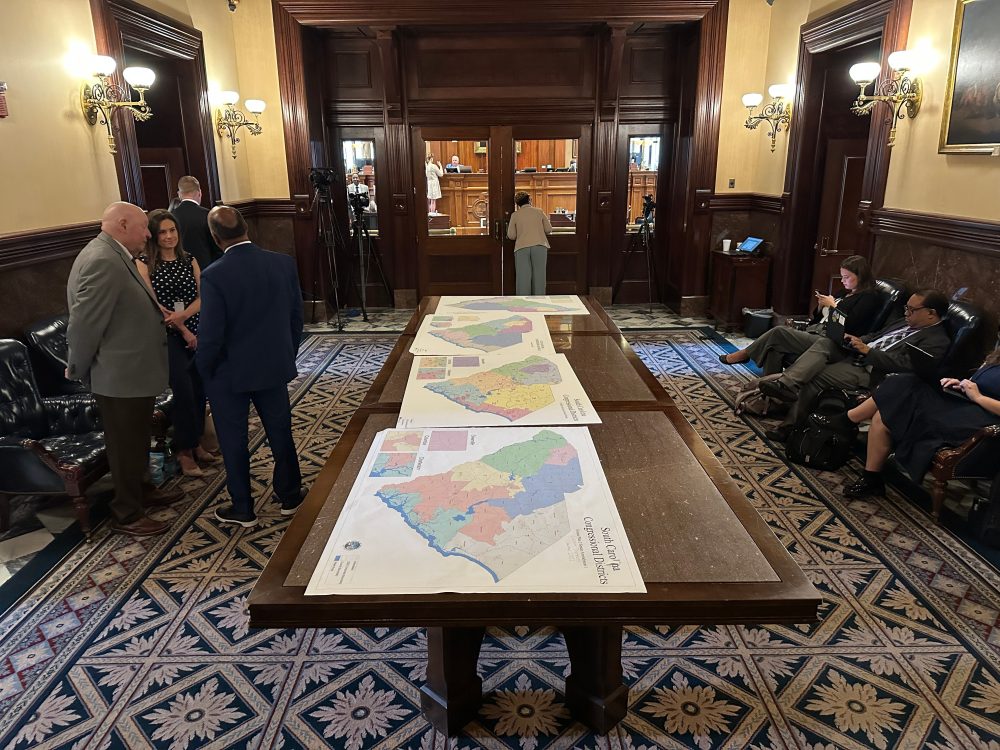
Republican Gov. Henry McMaster convened a special legislative session to address congressional redistricting. The GOP-controlled House approved a proposal early Wednesday designed to boost the party’s prospects of capturing the state’s sole Democratic-held seat.
Senate members are scheduled to convene Saturday — marking their third consecutive day of meetings — to review the redistricting proposal. However, approval remains uncertain.
Democratic lawmakers oppose the plan, while some Republicans also express concerns. Several GOP senators worry that their strategy to target the district represented by Democratic U.S. Rep. Jim Clyburn might backfire by distributing too many Democratic voters into Republican-held areas, potentially making those seats vulnerable.
South Carolina’s primary elections are scheduled for June 9. The proposed legislation would establish a new congressional primary date in August.
The Supreme Court invalidated Louisiana’s congressional map, which featured two majority-Black districts held by Democrats, ruling it constituted illegal racial gerrymandering. The state House is expected to consider a revised map next week that would substantially alter one of those districts while improving Republican chances of winning it.
While Republicans controlling the state Legislature agree on the general framework of the new map, the House and Senate have different approaches for dividing certain areas, including decisions about which parishes remain intact versus those that get divided.
A House committee modified a map that the Senate had previously approved. Should the chambers pass different versions, a joint legislative committee could attempt to broker a compromise before the session concludes June 1.
Republican Gov. Jeff Landry delayed Louisiana’s May 16 congressional primary until later in the summer to provide time for redistricting completion.
A federal court considered arguments Friday regarding a request to prevent Alabama from implementing congressional districts that could help Republicans secure an additional seat in the midterm elections. This represents the most recent development in an ongoing legal battle.
Republican state legislators approved a map in 2023 featuring one majority-Black district. The court had previously blocked that map and mandated a replacement that resulted in Democrats winning two seats where Black residents form a majority or near-majority.
However, the U.S. Supreme Court recently reversed that directive and instructed the lower court to reconsider the case based on the Louisiana ruling.
Legal representatives from the NAACP Legal Defense Fund and the ACLU, advocating for Black voters, want a three-judge panel to block the state from implementing the 2023 map. They argue a preliminary injunction is justified because the Louisiana decision shouldn’t impact a separate determination that Alabama’s map intentionally discriminated against Black voters.
Alabama conducted its primary elections on May 19. However, new congressional primaries are set for August for districts that differ under the 2023 map.
A state court panel considered arguments Thursday in another NAACP legal challenge aimed at overturning Tennessee’s new congressional map, which divides a Memphis-area, majority-Black district represented by a Democrat. The revised map could enhance Republican opportunities to claim all nine of the state’s seats.
The legal challenge argues that the General Assembly incorporated elements in the redistricting legislation that weren’t specifically authorized or required under a proclamation by Republican Gov. Bill Lee establishing the special session agenda. These include a provision eliminating a state law that bars mid-decade redistricting.
If lawmakers exceeded their constitutional authority, the lawsuit maintains that the new map cannot be implemented.