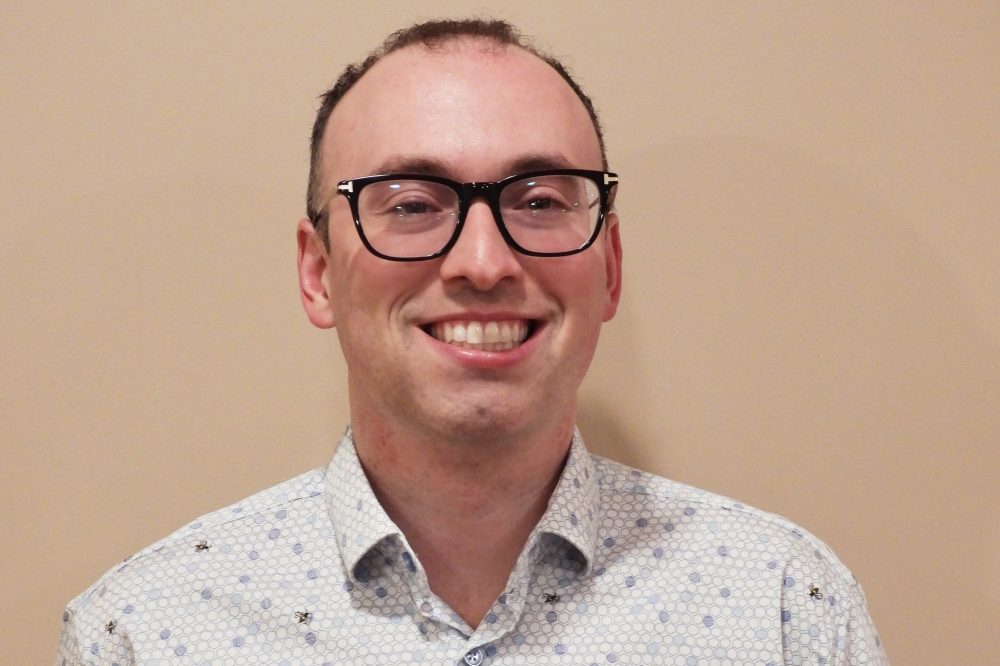

Two recent national spelling bee champions, Dev Shah from 2023 and Faizan Zaki from last year, shared nearly identical victory moments – standing on a confetti-covered stage alongside a man wearing glasses and an aloha shirt, proudly displaying his book “Words of Wisdom.”
That man is Scott Remer, and for him, those championship photos represent more than celebration – they’re essential marketing for his unique business.
The 32-year-old Remer holds the distinction of being America’s sole full-time professional spelling coach, while most others in the field are former competitors still attending college or high school. Though nearly every national champion from the last 15 years has received coaching, Remer stands alone in making it his primary profession.
At this year’s competition – running Tuesday through Thursday in Washington with 247 contestants – multiple finalists will likely be Remer’s pupils when the field narrows to roughly 10 competitors.
“He’s probably one of the most influential figures in spelling over the past 10 years,” said Shah, now 17.
Remer’s resume includes training five national champions, and following the competition’s return after pandemic interruptions in 2020 and 2021, he has expanded his coaching operation significantly. This year he claims 34 students, maintaining at least 29 pupils during each of the previous four competitions.
His fees exceed those of competitors: private sessions cost up to $180 per hour. Additionally, when students place in the top 10 and earn prize money, Remer collects up to 10% of their winnings as what he terms “a performance-based bonus.”
Despite his demanding personality during instruction, many families consider Remer’s services worthwhile – or perhaps valuable because of his intensity.
Consistently enthusiastic and outgoing regarding spelling matters, Remer traces his coaching passion to his disappointing fourth-place finish in 2008, his final competition year. He describes his motivation as sharing knowledge, helping children achieve their potential, and the challenge of uncovering competition-worthy words.
“This is really about the love of language and the love of the competition. Part of it is once you’re stung by the bee, there’s kind of no going back,” Remer said. “I’m not going to deny that it pays well, because it does. But I don’t know that there’s anything wrong with that.”
His two most recent champions credit him as essential to their victories.
“Even though his classes are more expensive, it’s definitely worth it,” Faizan said. “I saw results.”
Faizan’s father, Zaki Anwar, negotiated a reduced $120 hourly rate for Remer’s instruction since Faizan already possessed advanced spelling skills. Remer earned 7% of the champion’s $52,500 prize total – a $3,675 bonus.
“After winning, it doesn’t really matter,” Anwar said.
Remer’s instruction focuses on word roots, language patterns, and pattern exceptions. He aims to develop deep linguistic understanding enabling spellers to decode unfamiliar words, as Shah demonstrated with “rommack” in 2023.
However, Remer’s rates and teaching approach have driven some students to seek alternative coaches.
“I found it prohibitively expensive,” said Navneeth Murali, a University of Pennsylvania student who competed through 2020 and now coaches spellers at roughly $50 per hour. “It wasn’t a realistic option for me.”
Grace Walters, who trained 2022 champion Harini Logan, charges $75 hourly. Both she and Murali accept only a few students annually.
“I’m very much quality over quantity. It’s really important to me that I’m able to get to know each speller as a whole person, not just as a speller, and tailor my curriculum to them as individuals,” said Walters, a University of Kentucky linguistics graduate student. “But I have to give credit where it’s due: If everyone was doing it like me, there wouldn’t be enough coaches for all the spellers out there.”
Sree Vidya Siliveri worked with Remer before placing 60th in 2024 but struggled with his methods, according to her father, Sreedhar Siliveri. After finding new coaching, she finished 10th in 2025.
“We were looking for alternatives and found some of the fresh, like, high school students who can be friendlier and charge less,” Sreedhar Siliveri said.
Even devoted Remer supporters acknowledge his sometimes abrupt and demanding approach with middle school students. Simone Kaplan, who placed second among the “octo-champs” of 2019, valued Remer’s rigorous coaching while recognizing it doesn’t suit everyone.
“Scott is a true logophile, a master of languages. He pushes his students to keep up with him,” Kaplan said. “That can inspire some spellers to learn and succeed, but it can also leave a student feeling like they’ve disappointed him if they don’t spell every word right. And that’s difficult for a kid.”
Remer says his objective involves providing support while delivering necessary feedback to prevent repeated errors.
“I try to be tough but fair, and I also try to modulate my teaching methods, based on the kids’ needs and the kids’ personalities,” he said. “Whether I’m always successful at that is I guess an open question.”
A 2016 Yale graduate who earned a Cambridge master’s degree the following year, Remer published his first study guide, “Words of Wisdom: Keys to Success in the Scripps National Spelling Bee,” in 2010 as a teenager. That same year, he coached his first champion, Anamika Veeramani.
He has authored three additional books and previously worked for the Council on Foreign Relations and as communications coordinator for an LGBTQ-friendly New York synagogue. Since 2020, he has focused entirely on spelling coaching while also providing Chinese, Spanish, writing, and standardized test preparation tutoring. Born and raised in Cleveland’s suburbs, he currently resides in Mexico City.
Remer has penned annual Guardian op-eds about the competition since 2019. He distributes email lists featuring his students and progress updates, referring to them as “my spellers” despite many having multiple tutors. (Faizan worked with three coaches last year.) During competition week, Remer maintains constant visibility, conducting on-site lessons and sitting with families during television coverage.
While recognizing the need for self-promotion, he admits discomfort with marketing activities.
“I think I’m trying not to be particularly self-aggrandizing in general,” Remer said, “so if the question is, does it come naturally to me to do that sort of promotional and marketing work, the answer is no.”
Scripps, the Cincinnati media company operating the century-old competition, doesn’t endorse coaching, but executive director Corrie Loeffler considers the practice unavoidable given the competition’s intensity.
Loeffler diplomatically questioned whether any coach should claim responsibility for a speller’s achievements.
“It’s hard work, it’s study ethic, it’s perseverance,” she said. “These kids are doing pretty incredible things at a really high level, especially at a young age, and I want them to be able to take credit for that themselves, knowing that it’s a community and they’ve had so much support along the way.”