
While German Chancellor Friedrich Merz faces declining public support, far-right politician Ulrich Siegmund from the Alternative for Germany (AfD) is experiencing a surge in popularity that could make history.
Supported by national polling that shows his party leading Merz’s conservative coalition by up to 7 percentage points, the 35-year-old politician anticipates becoming Germany’s first AfD state leader following September elections in the eastern state of Saxony-Anhalt.
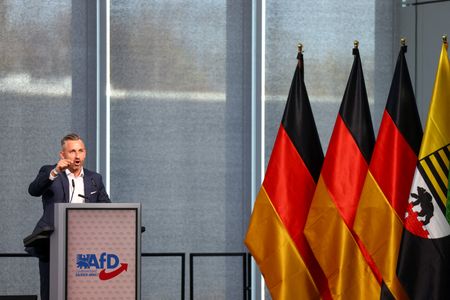
Months before formal campaign activities begin, Siegmund has been connecting with constituents through “citizen dialogues” to build support.
“People have simply had enough. They want their old, safe Germany back,” he explained to Reuters following a gathering in Halberstadt last week, where supporters lined up for photos. “There’s a wonderful sense of a new beginning in the state. And that’s exactly what we need.”
The town of Halberstadt, home to approximately 40,000 residents and featuring a medieval cathedral and traditional half-timbered architecture, defies the stereotype of economic decline often associated with former East Germany.
Despite challenges facing its traditional smoked sausage industry, the community has attracted significant investment, including a 500 million euro ($580 million) Daimler Truck logistics facility that employs 450 people. A renovated downtown shopping area is scheduled to open next month.
Nevertheless, Halberstadt hasn’t escaped the broader pessimism affecting Germany as global economic conditions deteriorate and Chinese competition threatens the nation’s manufacturing sector.
“People aren’t actually doing that badly,” observed Halberstadt mayor Daniel Szarata, a member of Merz’s Christian Democrat party. “But uncertain times always fuel fear.”
Throughout Europe, traditional political parties have lost support to groups like the AfD, which received slightly more than 20% in last year’s election and now polls at 29% according to a recent INSA survey, similar to Britain’s Reform Party, which gained significantly in recent local contests.
In Berlin, Merz’s coalition of conservatives and center-left Social Democrats has struggled with reform efforts while attempting to revitalize a job-shedding economy.
The administration has emphasized its immigration restrictions, a key issue driving AfD support since former Chancellor Angela Merkel welcomed over one million refugees in 2015.
However, Merz’s personal approval ratings have dropped to as low as 16% in Infratest dimap polling, as international conflicts have increased energy costs and the economy approaches stagnation.
The regional AfD chapter, which claims Germany faces losing its national character to widespread immigration and progressive social policies, has been labeled “far-right extremist” by the Saxony-Anhalt branch of the Verfassungsschutz, Germany’s internal security agency.
This designation hasn’t damaged the party’s electoral prospects. Current polling in Saxony-Anhalt, which has fewer foreign residents than more industrialized western regions, shows support reaching 41%, approaching the threshold needed for single-party governance.
“I like the fact they want to do something for us Germans,” said Ruediger Printky, one of hundreds attending Siegmund’s presentation. “Everything’s getting more expensive. And nobody is doing anything right. When I look at fuel prices and what the government has done, it’s a disaster.”
Established parties have committed to avoiding cooperation with the AfD through a “firewall” approach intended to prevent its participation in coalition governments.
But Siegmund, who views Saxony-Anhalt as a stepping stone toward national AfD success, declares his intention to govern independently.
The firewall represents an attack on democratic principles, he argued, “and that’s why here in Saxony-Anhalt, we’re saying quite clearly we have to go it alone.”
Through Germany’s federal structure, state administrations oversee education, law enforcement and domestic security, while participating in national governance via the upper parliamentary chamber, the Bundesrat. A far-right electoral victory would send shockwaves throughout the nation.
In Saxony-Anhalt, the AfD disputes claims that it threatens democratic institutions, while making clear its plans for substantial changes. The possibility of controlling the interior ministry and regional security services concerns government officials.
“If we take control of the interior ministry, we will be responsible for the Verfassungsschutz. Then we’ll have a look at the files,” stated Christian Hecht, an AfD state legislator who shared the platform with Siegmund in Halberstadt.
Szarata described the polling figures as “very, very alarming” while expressing hope that voters would reconsider their choices at the ballot box.
“They [the AfD] have the advantage that they have never had to prove they can run anything,” he explained. “People are investing their hopes, though honestly, I don’t think those hopes will be fulfilled.”
Siegmund, who maintains an approachable demeanor and substantial TikTok presence, rejects criticisms about lack of governing experience, blaming established parties for current problems while attacking the media, Merz’s coalition, transgender rights advocates and environmental activists.
In the packed auditorium, attendee Rene Doering seemed persuaded by the message. “You just have to give them a chance,” he commented.