
One thousand days have now passed since a Hamas-led assault on Israel set off the ongoing war in Gaza — a conflict that has reshaped the region, spawned additional fighting on multiple fronts, and left millions of lives in limbo.
The fate of more than 2 million Palestinians in Gaza remains deeply uncertain. Under the ceasefire that went into effect on October 10, Israeli forces already controlled more than half of the territory — and Israel’s government has since expanded that footprint, stating it intends to hold 70% of Gaza.
Movement in and out of the territory is severely restricted. Meanwhile, the next phases of the ceasefire agreement — including Hamas giving up its weapons and the enormous undertaking of rebuilding Gaza — have ground to a halt.
“Much more needs to be done so that even a semblance of normality can come back, and we are far, far away from this,” said Nicolas von Arx, the International Committee of the Red Cross regional director, in comments made this week.
Although Israeli airstrikes have decreased significantly since the ceasefire began, they have continued nearly every day. Gaza’s Health Ministry reported that 1,053 Palestinians have been killed since the ceasefire took effect, as of Tuesday — a count that includes more than 350 women and children. Among the recent victims were a teenage girl who was on her way to school and a mother along with her one-year-old daughter.
One Palestinian woman, Wisal Abu Khater, expressed raw frustration following yet another deadly strike this week. “Where is this ceasefire they keep talking about?! Shame on them,” she said, directing her anger at Arab nations she accused of abandoning Gaza’s people while watching World Cup matches.
The United Nations issued a warning Wednesday that Israel’s territorial expansion in Gaza is putting civilians at greater risk of being killed in “areas lacking clear demarcation on the ground.”
Gaza’s Health Ministry, which operates under the Hamas-led government and keeps detailed casualty records considered generally credible by U.N. agencies and independent analysts, reported more than 3,400 wounded since the ceasefire began. The ministry does not separate civilian deaths from militant deaths but notes that women and children account for roughly half of those killed. Israel’s military maintains that it targets Hamas fighters and other armed groups, often stating those individuals were preparing attacks, and charges Hamas with using civilians as cover.
The October 7, 2023 Hamas-led attack on southern Israel killed approximately 1,200 people and resulted in 251 hostages being taken. All of those hostages — or their remains — have since been released or transferred, with some survivors describing mistreatment during their captivity. In total, Israel’s retaliatory campaign has killed 73,066 Palestinians as of Tuesday, according to Gaza’s Health Ministry.
The senior diplomat managing the ceasefire, Nickolay Mladenov, has been direct about the impasse: progress toward the next stages of the U.S.-brokered agreement has stalled over the contentious question of Hamas disarming.
This situation has become a significant test for the Board of Peace, an initiative created and led by U.S. President Donald Trump. Launched with considerable attention and billions of dollars in international funding commitments earlier this year with the specific goal of helping Gaza recover from war, the board has gone largely quiet in recent weeks.
Hamas disarming would unlock other steps in the process, including establishing new governance in Gaza and bringing in an international stabilization force to help with security and rebuilding. Hamas has not flatly refused to disarm, but has signaled it wants to retain some weapons and is seeking additional concessions from Israel.
For Israelis, the past 1,000 days have been marked by trauma stemming from the October 7 attack — the deadliest in Israel’s history — as well as fighting that spread to Lebanon against the Iranian-backed Hezbollah militant group, to Yemen against Iranian-backed Houthi rebels, and against Iran itself. Iran’s armed proxy forces had launched attacks on Israel, claiming solidarity with Palestinians. Prime Minister Benjamin Netanyahu pushed U.S. President Trump on February 28 to join in striking Iran, a move that reignited the conflict in Lebanon, where Israeli forces have now pushed to their deepest position in more than 25 years.
None of those additional conflicts has fully quieted. The cumulative weight of these wars — including rising Israeli soldier casualties, continued attacks along the Lebanese border, and international accusations of genocide in Gaza that Israel disputes — is taking a toll on Israeli society as Netanyahu prepares to seek reelection this fall.
While Netanyahu has maintained a confident public posture, he faces serious political headwinds. A poll published last month by The Israel Democracy Institute found that more than 60% of Israelis believe he should not run again. Public anger remains elevated over the security lapses that allowed the October 7 attack to happen, the absence of a formal government inquiry into those failures, and controversial military service exemptions extended to Netanyahu’s ultra-Orthodox coalition partners.
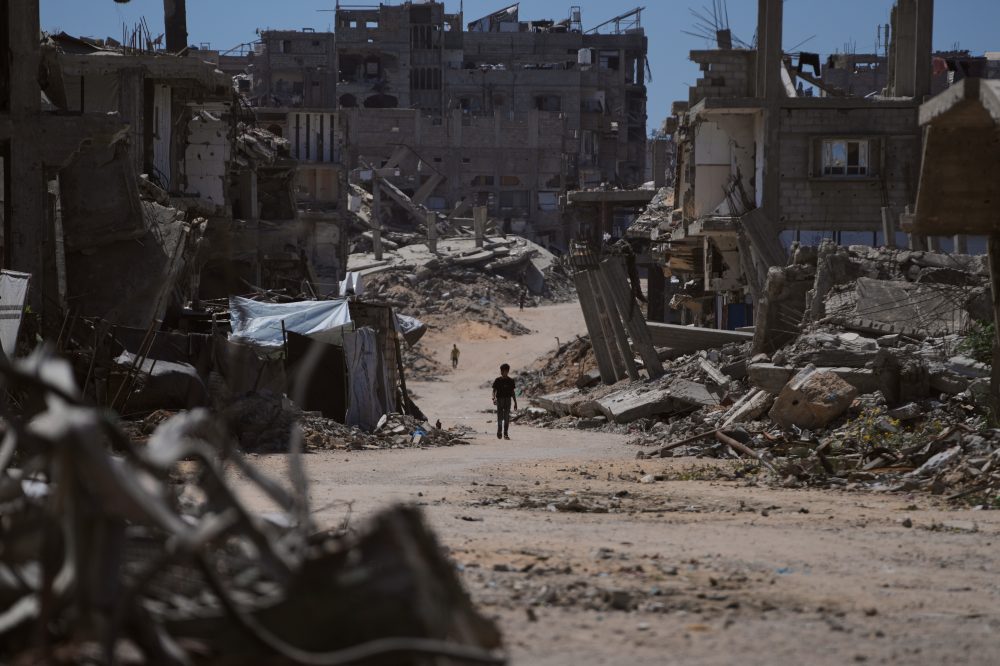
Palestinians in Gaza describe themselves as pushed to their breaking point. Many are sheltering in sprawling tent camps with little or no basic services, or in the gutted remains of bombed buildings, all while living under the constant buzz of Israeli surveillance drones and the ever-present threat of strikes.
The ceasefire was supposed to allow a significant increase in humanitarian supplies, including medicine and fuel. Aid organizations and others say that surge has not materialized. All border crossings into Gaza remain tightly controlled and have closed entirely at various points. The United Nations reported last month that 17 hospitals are still not operational.
U.N. humanitarian chief Tom Fletcher said last month that Israeli approval and customs procedures are “cumbersome” and are blocking essential supplies — noting that even prosthetic limbs have been held up over concerns they could potentially be used as weapons.
Famine was declared in Gaza City last August, though food security specialists later noted “notable improvements” following the ceasefire. The Israeli military body responsible for coordinating civilian matters in Gaza, COGAT, said Wednesday that “the quantities of food that are being brought in far exceed the nutritional needs of the Gazan civilian population.”
As Israeli forces push further into Gaza and Hamas militants face accusations of illegally executing Palestinians suspected of collaborating with Israel or committing crimes such as looting, residents describe themselves as exhausted and under constant stress.
“We had everything before the war,” said Mahmoud Ashour, a 33-year-old shop owner in Khan Younis. “And now we’re just craving a bite to eat.”