
SIDON, Lebanon — Dr. Mohammed Ziara witnessed firsthand how Israeli forces devastated Gaza’s medical infrastructure two years ago, bombing hospitals, targeting ambulances, and forcing patient evacuations.
Today, Ziara — alongside fellow healthcare professionals, human rights organizations, and civilians — cautions that an identical situation is developing in Lebanon.
Israeli forces are advancing deep into Lebanon’s southern regions during their offensive against Hezbollah, the Iranian-supported militant organization and political entity that has maintained effective authority over significant portions of Lebanon’s Shiite population.
When describing its military approach in this conflict, Israel’s armed forces reference the destruction they caused in Gaza following Hamas’s October 7, 2023, assault. Israeli aircraft distributed pamphlets over Beirut recently, stating that following “great success in Gaza, a new reality is coming to Lebanon, too.”
“I’ve lived this before,” said Ziara, a burn specialist originally from Gaza City, speaking to The Associated Press Thursday at the public hospital in Lebanon’s coastal city of Sidon. “I cannot go back to Gaza now,” Ziara explained. “But I can be here, in Lebanon.”
Similar to its accusations against Hamas in Gaza, Israel claims Hezbollah operates from civilian locations and utilizes hospitals and ambulances for military operations. Israeli forces have increasingly struck emergency responders and medical facilities, compelling multiple hospitals to evacuate.
“I was besieged in a hospital,” Ziara recalled about his Gaza experience. “I lost my brother in an airstrike. I feel what these people feel.”
Since fighting between Israel and Hezbollah resumed on March 2, Israeli bombardments have claimed the lives of at least 54 healthcare professionals through Sunday, Lebanon’s health ministry reports.
Israeli forces have conducted 152 strikes targeting emergency medical personnel and ambulances, while forcing six hospitals and 49 health clinics to close through direct attacks or intimidation, ministry officials state.
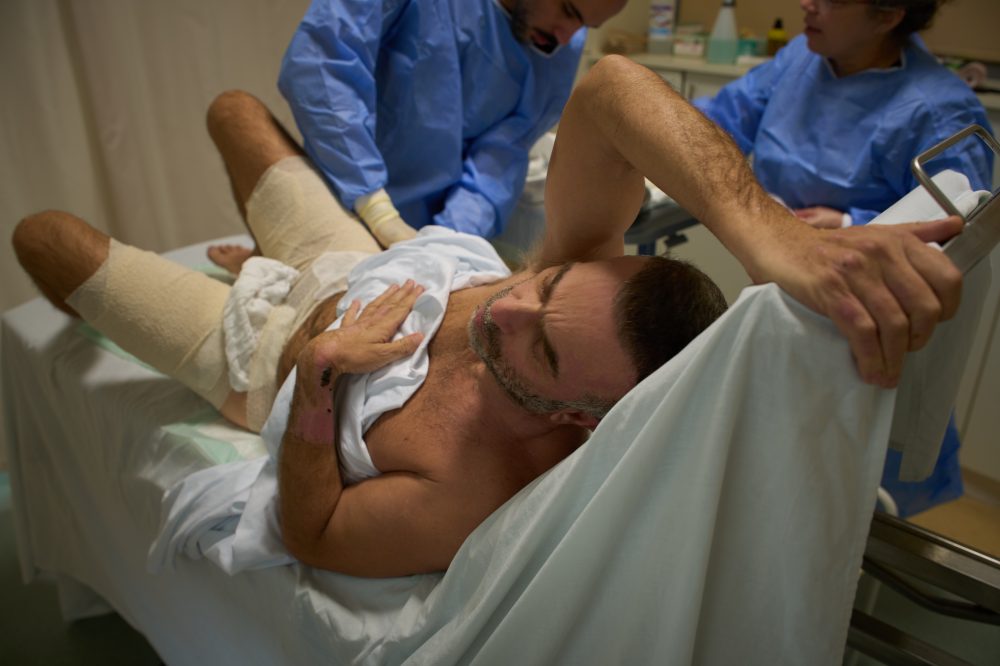
In Sidon, Ziara and his colleagues from the UK-based charity Interburns have established Lebanon’s public healthcare system’s first dedicated burn treatment center — an essential facility in this crisis-affected nation where the Israel-Hezbollah conflict has already claimed 1,461 lives and injured 4,430 people, ministry data shows. Israeli officials claim to have eliminated hundreds of Hezbollah fighters during recent bombing campaigns and ground operations.
Israel’s military contends that Hezbollah’s utilization of medical infrastructure renders these sites valid military objectives under international law. However, it provides no evidence supporting these assertions.
Hezbollah rejects claims of conducting military operations within civilian locations. While the organization’s presence in residential neighborhoods is well-established, no independent confirmation exists regarding its use of hospitals for military activities.
Interburns, which provides burn treatment training to local medical staff worldwide, started developing the Sidon unit during the 2024 Israel-Hezbollah conflict. Lebanese officials requested the team’s return when hostilities resumed last month.
As the first major city north of Israel’s evacuation zone encompassing nearly all of southern Lebanon, Sidon receives increasing numbers of wounded individuals daily.
Twenty-seven-year-old Kamal Fakih dislikes when people inquire about March 17 events.
His reluctance stems not from emotional pain but from complete memory loss. He regained awareness a day later at Sidon’s hospital, his body burned and cut by shrapnel from an Israeli airstrike.
After stabilization, Fakih attempted to contact the paramedic who rescued him and his friend Hassan from burning debris, hoping to learn details and express gratitude for saving their lives. However, by the time Fakih obtained contact information, Muhammad Tafili had perished alongside a fellow paramedic in an Israeli strike on ambulances in Kfar Tebnit village on March 28, according to Lebanon’s health ministry.
That identical day, Israeli attacks killed seven additional medics across four other villages, World Health Organization records show. The casualties included a medic struck while responding to an Israeli airstrike that killed three journalists from pro-Hezbollah television networks. Video evidence reveals two consecutive strikes — the first targeting journalists in their vehicle, the second hitting paramedics rushing to assist.
Israel’s military labeled the two medics and two of the three deceased journalists as Hezbollah operatives. This assertion concerned watchdog organizations that observed similar justifications for killing over 260 journalists and 1,700 healthcare workers in Gaza, United Nations humanitarian officials report.
While Lebanese medical personnel and journalists died during the 2024 Hezbollah conflict, “this time is different,” stated Ramzi Kaiss, Human Rights Watch’s Lebanon researcher.
He referenced a shocking pledge by Israeli Defense Minister Israel Katz last week that Israel would demolish all southern Lebanon houses to protect border communities from Hezbollah rockets “in accordance with the model used in Rafah and Beit Hanoun in Gaza” — two cities Israel nearly completely destroyed during its Hamas offensive in the territory.
“There’s a new kind of brazenness in declaring an intent to commit unlawful attacks,” Kaiss observed. “It appears impunity has emboldened the Israeli military.”
Extensive Israeli evacuation directives in recent weeks have displaced over one million Lebanese northward. As southern regions faced intense bombardment, medical clinics closed or halted services. Nabih Berri Hospital became overwhelmed with casualty influxes. To create space, it evacuated dozens of patients.
Such transfers require coordination between Lebanon’s army, health ministry, and UN peacekeeping forces — a communication chain that doctors say creates potentially fatal delays. Patient admissions present additional challenges; the Sidon burn unit must discharge patients to accommodate new arrivals.
However, referrals continue arriving, straining a healthcare system already devastated by economic collapse.
“The health system is on its knees,” Ziara said, as the hospital lost power until backup generators activated ten minutes later, reflecting Lebanon’s ongoing electricity crisis. “Now front-line hospitals are lacking staff and supplies. They’re overwhelmed.”
Lebanese civilians report that Israeli bombs strike without warning and hit randomly, creating a growing sentiment that Palestinians in Gaza understand well — that no location offers safety.
Fifty-three-year-old Mohammad Qubaisi said his Zuqaq al-Blat neighborhood in central Beirut had received no Israeli evacuation notice before March 18, when Israeli explosives struck his seventh-floor apartment.
While carrying his wife from the smoking wreckage, he called for his sons. His oldest, Adam, responded. But he heard nothing from Jad.
Qubaisi rushed back into the burning heat searching for his 15-year-old. When he awakened at the hospital hours later, his face scarred with second-degree burns, he understood his son was dead.
Israeli military officials stated they were targeting Hezbollah. Qubaisi disagreed.
“These are civilian buildings, not military targets. They hit us and we still don’t know why,” he said from the Sidon hospital. “We were sleeping safely in our home, and look what happened to us.”