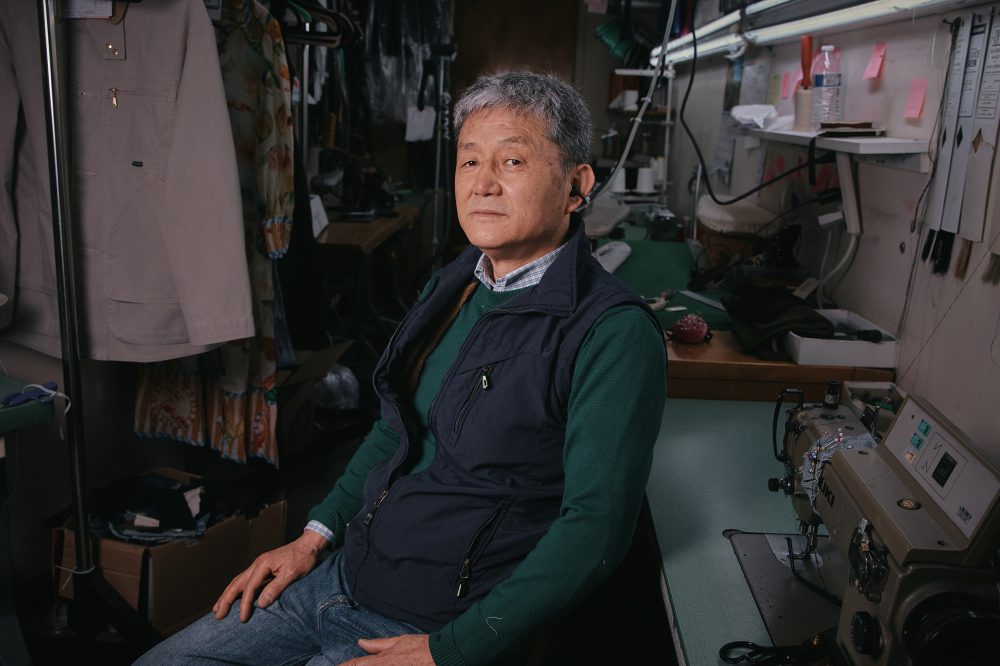

At his Manhattan tailoring business, Kil Bae works intently at his sewing machine, adjusting a dress when a modeling agent walks in carrying a vintage Tommy Hilfiger jacket needing alterations.
The customer purchased the reversible bomber jacket—featuring plaid on one side and red on the other—for just $20 at a thrift store. He’s now prepared to pay $280 to have it fitted properly. Such dramatic price differences between purchase and alteration costs would have been unusual several years ago, but Bae says these requests are sustaining his business, 85 Custom Tailor.
Bae meticulously inspects the cotton jacket before beginning to pin adjustments, moving around his client with the precision of an artist. Having begun his tailoring apprenticeship at 17 in South Korea, the now 63-year-old craftsman represents a vanishing profession in America, where skilled garment workers are retiring faster than new ones are entering the field.
Consumers raised on inexpensive fast fashion are increasingly turning to professional seamstresses and tailors for custom-fitted clothing, revitalizing thrift store purchases, and extending garment lifespans, fashion experts report. Popular weight-loss medications such as Zepbound and Wegovy have also created greater demand for clothing adjustments including waistband modifications and sleeve alterations, according to Bae.
“I recommend this job to young people because this one cannot be AI’d,” Bae explained, acknowledging that while artificial intelligence handles pattern creation, it cannot duplicate the handcrafted skills of professional tailors. “Different bodies. Different shape. They cannot copy like this. If I close this door, I can go out and find another one.”
Similar to other specialized trades like engraving and musical instrument repair, custom garment creation and fitting has failed to attract sufficient new workers to replace retiring professionals who are ending decades-long careers.
Federal labor statistics from nearly two years ago showed fewer than 17,000 tailors, custom sewers, and dressmakers employed at business establishments nationwide—representing a 30% drop from the previous decade.
When including independent contractors and household workers, the median age for all garment professionals reached 54 last year, which is 12 years above the median for all employed Americans, government data shows.
Fashion industry analysts suggest that relatively low wages compared to required skills and the physical demands of detailed work likely discourage younger people from pursuing these careers.
As of May 2024, tailors, dressmakers, and custom sewers earned an average annual salary of $44,050, significantly below the $68,000 average for all occupations, according to federal wage data.
“Most of fashion training is really aimed at mass production, not spending time in a shop handmaking a garment,” explained Scott Carnz, provost at LIM College, which offers fashion business degrees. “The work is also tedious.”
Online employment listings for sewing professionals have remained relatively steady, reports Cory Stahle, an economist with Indeed’s research division. From February 2020 through the same month this year, job postings decreased only 2%, while marketing and software positions dropped nearly 30%.
“There is a kind of a craftsmanship … that I think is an important piece that we can’t ignore,” said Stahle, who analyzes U.S. employment trends.
Foreign-born workers have sustained America’s garment industry for more than a century, including immigrants with various legal statuses, refugees, and naturalized citizens.
Recent census analysis by the Migration Policy Institute revealed approximately 40% of tailors, dressmakers, and sewers were born outside the United States, according to Julia Gelatt, associate director of the nonpartisan organization’s immigration policy program. The largest populations originated from Mexico, South Korea, Vietnam, and China.
To combat the growing worker shortage, the fashion industry is developing programs to train future master tailors.
Nordstrom, which employs more tailors and alteration specialists than any other North American retailer, collaborated with New York’s Fashion Institute of Technology to create a nine-week advanced sewing and alteration program.
“Customarily, tailoring has never been part of the American skill set,” noted FIT instructor and Broadway costume designer Michael Harrell, who leads the course.
The fashion school received 200 applications for its first class of 15 students, who began in October and completed certification in February, said Jacqueline Jenkins, executive director of the school’s Center for Continuing and Professional Studies.
This practical training prepares participants for employment at Nordstrom, where the upscale department store employs 1,500 people for tailoring and alterations ranging from basic hem adjustments and repairs to complex suit fittings and evening gown modifications.
Ten graduates from the initial class have been hired or are currently in the hiring process, according to Marco Esquivel, Nordstrom’s alterations director.
“We owe it to the broader industry to ensure that this is an art form that exists for years and years to come and continues to serve customers both within our walls as well as outside,” Esquivel stated.
Other retailers are simultaneously expanding their tailoring operations due to customer demand.
Brooks Brothers, a luxury brand manufacturing custom menswear since the 1800s, piloted women’s tailoring services at five locations last year. This year, the company expanded custom women’s clothing to 40 additional stores, with prices beginning at $165 for shirts and $1,398 for suits.
At 85 Custom Tailor, Bae repeatedly confirmed that the customer with the Tommy Hilfiger jacket wanted to proceed with the expensive alterations. Jonathan Reiss, 33, remained committed to the investment, planning to wear the jacket frequently.
“I think I fell victim to buying cheap stuff, and then you realize it just falls apart or shrinks or it just doesn’t last long,” Reiss explained.
Bae’s son is one year older than Reiss. The tailor attempted to convince him to learn the trade, but his son pursued computer work before opening a bagel shop.
“Young people. They just want to find a job in computers,” Bae observed. “I think that’s too boring. I think this is very interesting. Every time, I am drawing in my head. I am like an artist.”
Bae learned his craft from his older siblings at their custom clothing business approximately 93 miles from Seoul. After five years of training, he relocated to South Korea’s capital for custom orders and sample work with various companies. He later moved to the New York area, working as a pattern maker for designer brands including Ralph Lauren and Donna Karan.
He established his own Connecticut shop in 2011, but the COVID-19 pandemic forced closure after a decade of operation. He reopened at his current Manhattan location one year later.
His workshop features three specialized sewing machines: a standard model, a heavy-duty version for materials like denim and leather, and an overlock machine that simultaneously cuts, trims, and finishes fabric edges.
Bae plans to continue working as long as his hands remain steady enough for precise work.
“I’m always learning,” he said.