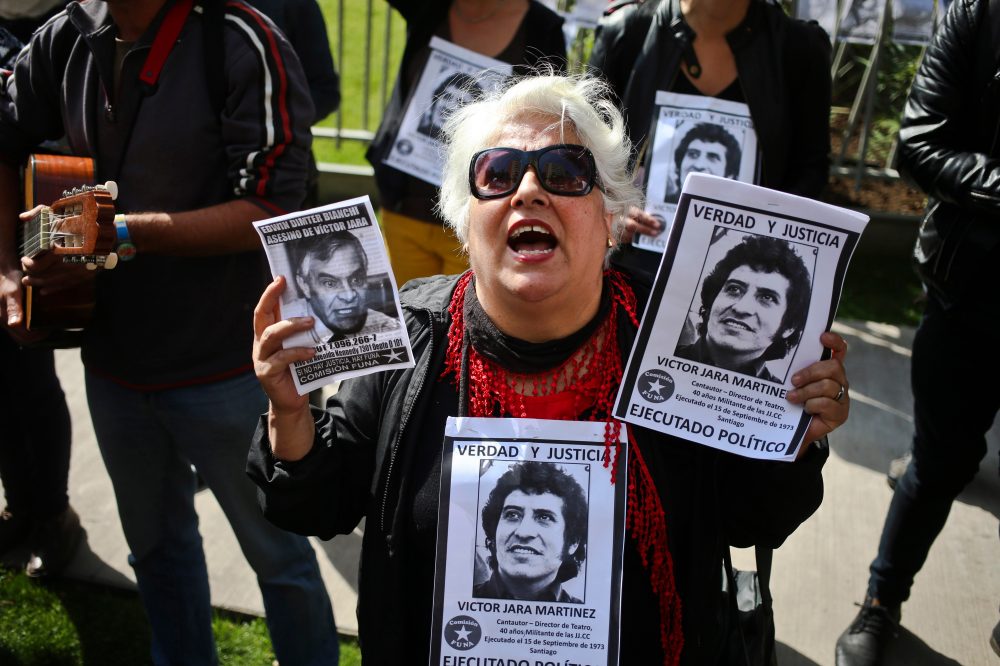

SANTIAGO, Chile — More than 50 years after the brutal killing of celebrated Chilean singer-songwriter Víctor Jara, a measure of accountability was finally delivered this past weekend.
Chilean authorities on Saturday took into custody a retired military colonel who had been on the run for three years. The man had previously been convicted of the kidnapping and murder of Jara during Chile’s military dictatorship and handed a 25-year prison sentence — but had evaded imprisonment until now.
Even with the arrest, Jara’s family made clear they remain unsatisfied with what has unfolded.
“We learned that retired Colonel Nelson Haase Mazzei, who had been a fugitive from justice since 2023, was found and imprisoned. We appreciate this news,” wrote Jara’s daughter, Amanda Jara, in a letter released Sunday evening. She added, however, that “it is difficult to consider this justice.”
Haase Mazzei, 80, had been convicted in 2018 for the kidnapping and murder of both Jara and then-Director General of Prisons Littré Quiroga Carvajal. His sentence was extended in 2023, along with the sentences of six other military officers. These crimes are regarded as among the most striking examples of the cruelty that defined the 17-year dictatorship of the late Gen. Augusto Pinochet.
The former officer disappeared before he was required to report to prison. He remained at large for three years until this weekend, when Judge Paola Plaza of the Santiago Court of Appeals ordered his “immediate imprisonment,” according to a statement from the Judiciary. Officials noted that Haase Mazzei was the final person among those convicted to begin serving his sentence.
Jara was a key figure in the New Chilean Song movement, a cultural and social phenomenon that emerged in the 1960s. He was killed on September 16, 1973 — only five days after the coup that removed former President Salvador Allende from power.
At the time of his death, Jara was 40 years old. He was a member of the Communist Party of Chile and also served as a professor at the State Technical University. He was seized on campus and transported to Chile Stadium, a facility that has since been renamed Víctor Jara Stadium. Once there, he was separated from the roughly 5,000 other detainees and taken to a secluded area. He and Quiroga were subjected to torture, violent assault, and ultimately executed. Investigators found that Jara suffered multiple bone fractures, and his body bore 44 bullet wounds.
In 1991, shortly after Pinochet’s fall from power and the return of democratic rule, an official body known as the National Commission for Truth and Reconciliation concluded that Jara had been the victim of a political execution and labeled his death a serious human rights violation. That same report found that 890 people died as a direct result of the military coup in just three months.
Over recent decades, Chile has formed multiple truth commissions to examine and assign responsibility for abuses carried out between 1973 and 1990, covering everything from killings and torture to forced disappearances and the illegal placement of children.
Government records estimate that throughout the 17-year dictatorship, approximately 40,000 people were victimized. That figure includes more than 2,000 who were executed, 1,469 who were forcibly disappeared, and thousands more who were tortured. Hundreds of military personnel and civilians have been convicted for crimes committed during this dark chapter of Chilean history, though no single consolidated record exists of all those sentenced.
Since 2024, Chile has also pursued what is called the National Search Plan, an effort to compile data and map out a strategy for locating disappeared detainees whose fates are still unknown — work that has largely been carried out by the victims’ own families over the years.
“We hope that the police will manage to find all those who fled for crimes against humanity,” Amanda Jara concluded in her letter. She currently leads the Víctor Jara Foundation.