
France has repositioned its nuclear-powered aircraft carrier strike group into the Red Sea, moving closer to the Strait of Hormuz as European nations prepare for a possible mission to reopen the vital shipping lane, French military officials announced Wednesday.
The strategic relocation brings Europe’s most formidable naval vessel within striking distance of the waterway whose blockade has become symbolic of the ongoing conflict with Iran, cutting off one-fifth of global oil supplies and creating what the International Energy Agency describes as the most significant supply shortage in oil market history.
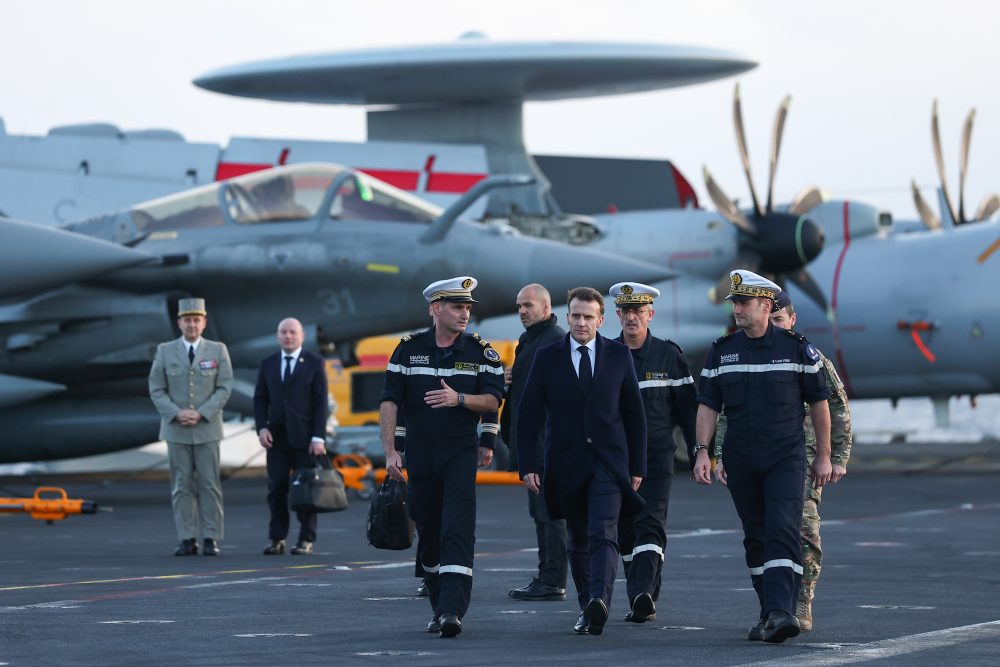
The Charles de Gaulle carrier and its accompanying vessels have been moved south of the Suez Canal as part of a Middle Eastern deployment that French President Emmanuel Macron first revealed during a March 3 television broadcast, just one day before Iran sealed off the strait.
This repositioning marks the first time France’s sole aircraft carrier — the only nuclear-powered carrier beyond those operated by the U.S. Navy — has been positioned this close to the Persian Gulf’s critical chokepoint since hostilities commenced.
“Going south of Suez is new for us,” Col. Guillaume Vernet, spokesman for the French armed forces chief of staff, told The Associated Press. “Geographically, it’s closer to the Strait of Hormuz and will therefore enable us to react faster, once the conditions are met.”
“Planning has been done and is ready to go,” he said.
However, Vernet emphasized that the broader Hormuz coalition — organized by France, Britain and more than 50 countries — will not commence operations until two key conditions are satisfied: shipping threats must decrease, and the maritime sector must gain sufficient confidence to utilize the strait.
Additionally, he noted that any military action would need approval from regional governments.
“Today the Strait of Hormuz is stuck because of the threat, and the insurance premiums are so high. Not a single ship will jeopardize their trip or go there,” he said.
This European initiative operates independently from the U.S. “Project Freedom” operation, which President Donald Trump launched on Sunday but suspended Tuesday night.
The United States has remained outside the French-British coordination efforts, which analysts compare to the European “coalition of the willing” that Macron and British Prime Minister Keir Starmer previously organized to aid Ukraine.
Unlike the American approach, the Franco-British alliance emphasizes a measured and protective strategy.
“The French position is the same since the beginning — defensive posture, respecting international law,” Vernet said.
Vernet explained that the proposal originated in early March, following Iran’s March 4 closure of the strait in response to combined U.S. and Israeli attacks that began February 28 and resulted in the death of Iranian Supreme Leader Ayatollah Ali Khamenei.
He stated that France sought a multinational approach to restore navigational freedom in the strait from the start of March.
“Right after that, we had the opportunity to build things with different countries,” including the U.K., Italy, the Netherlands and others, he said.
Macron and Starmer welcomed representatives from dozens of nations to a Paris conference on April 17, while military strategists from over 30 countries completed operational planning at Britain’s Permanent Joint Headquarters in Northwood during April 22-23.
Maritime war-risk insurance costs for strait passages have increased four to five times beyond pre-conflict rates, according to industry assessments, with approximately 2,000 vessels currently trapped in the Gulf.
Macron’s March 3 announcement ordered the Charles de Gaulle from the Baltic region to the eastern Mediterranean in what French officials called an “unprecedented” mobilization that also involves eight frigates and two Mistral-class amphibious assault vessels.
French Rafale aircraft stationed at Al Dhafra airbase in the United Arab Emirates have been engaging Iranian drones and missiles over the Gulf nation since fighting began February 28, operating under a longstanding defense agreement with Abu Dhabi that maintains approximately 900 French military personnel on the Gulf’s southern coast.
The carrier group’s southern deployment positions French aviation assets — including 20 Rafale fighters and E-2C Hawkeye early-warning planes — within operational range of the Strait of Hormuz while avoiding entry into the Gulf, where U.S. Navy forces have maintained a blockade of Iranian ports since April 13.
Vernet declined to provide a specific timeline for the French-British mission, explaining that the carrier was being positioned strategically to respond quickly should circumstances permit action.