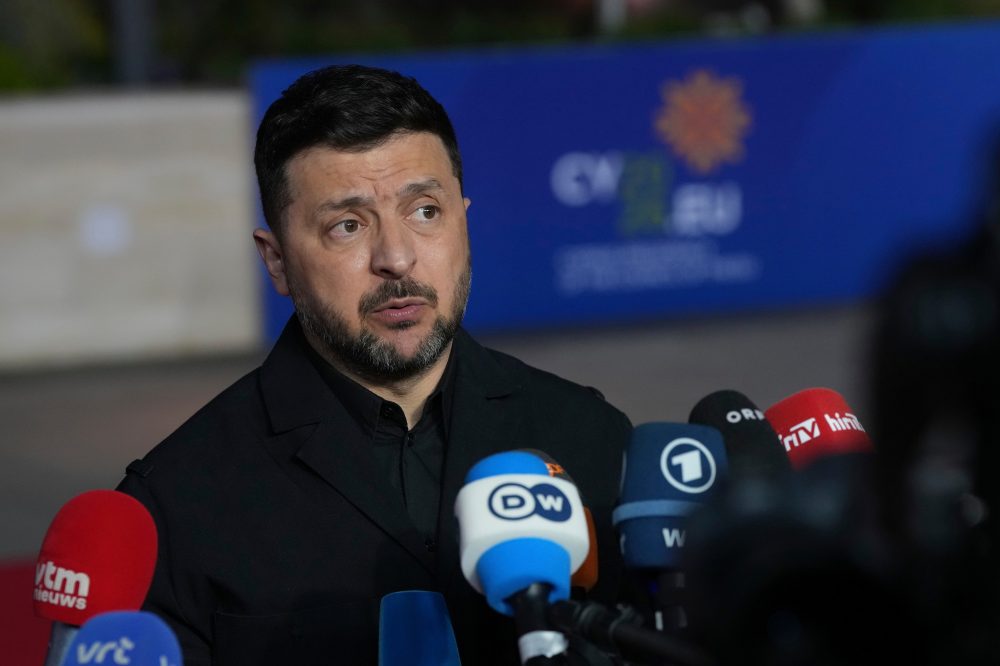

BUDAPEST, Hungary — Ukraine has recovered an $82 million shipment of cash and gold that Hungarian authorities confiscated earlier this year, Ukrainian President Volodymyr Zelenskyy announced Wednesday.
Hungarian counter-terrorism officials had intercepted the valuable cargo on March 5 as two armored vehicles attempted to transport it through the country. The seizure sparked anger in Ukraine, with government officials condemning Hungary’s pro-Russian leadership for what they called illegal actions and claiming the confiscation was being used as a political weapon in Prime Minister Viktor Orbán’s anti-Ukraine election strategy.
The two nations were already locked in a heated dispute over Hungary’s access to Russian petroleum via a pipeline running through Ukrainian soil.
However, Zelenskyy took to social media Wednesday to describe the asset recovery as “an important step in relations with Hungary” following Orbán’s overwhelming electoral loss last month, which has sparked optimism that the new administration will adopt a less hostile stance toward Kyiv.
“I am grateful to Hungary for its constructive approach and civilized step,” Zelenskyy wrote. “I thank everyone on Ukraine’s team who fought for a fair decision and defended the interests of our state and our people.”
When the confiscation occurred, Hungarian officials cited suspected money laundering activities, prompting Orbán to authorize holding the cargo — containing $40 million and 35 million euros in currency plus 9 kilograms (19.8 pounds) of gold — for as long as 60 days while the nation’s tax agency conducted an investigation.
Hungary’s tax authority has not yet provided a response to requests for comment.
Hungarian authorities detained the Ukrainian bank personnel accompanying the shipment for more than 24 hours before expelling them from Hungarian territory.
Ukrainian leaders characterized the shipment as a standard asset transfer between government banks and alleged that Orbán’s administration was using extortion tactics against Kyiv to force restoration of halted Russian oil deliveries through the Druzhba pipeline, which had sustained damage from a Russian drone attack.
Orbán directed the tax agency to investigate the shipment’s origins, destination and purpose, along with identifying the seven expelled Ukrainians “and their possible links to criminal or terrorist organizations.”
Without offering proof, Orbán also insinuated the shipment might have been meant to finance his main political rival, the center-right Tisza party, which eventually secured a two-thirds parliamentary majority in last month’s election.
Orbán’s administration had previously blocked a massive 90-billion euro ($106-billion) European Union loan package to Ukraine due to the Russian oil pipeline disruption. However, after oil flows resumed following Orbán’s election loss, Hungary removed its opposition and permitted the loan to proceed.