
Four astronauts are racing back to Earth aboard their Orion spacecraft Friday, preparing for an ocean landing that will cap off humanity’s first crewed lunar mission in more than five decades.
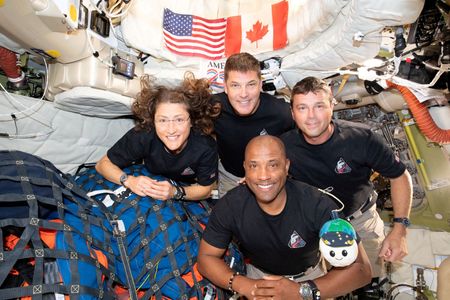
The crew members are expected to splash down in the Pacific Ocean near San Diego shortly after 8 p.m. Eastern Time, concluding NASA’s historic 10-day Artemis II journey. The astronauts include Americans Reid Wiseman, Victor Glover, and Christina Koch, along with Canadian crew member Jeremy Hansen.
Their return journey involves several critical phases, starting with the separation of their crew capsule from the service module, followed by a dramatic plunge through Earth’s atmosphere and a brief communication blackout before parachutes guide them safely to the ocean surface.
The crew launched from Cape Canaveral, Florida on April 1st, riding NASA’s massive Space Launch System rocket into Earth orbit before continuing around the moon’s far side. During their voyage, they traveled deeper into space than any previous human explorers.
This mission represents several historic firsts since the Apollo era of the 1960s and 70s. Glover became the first Black astronaut to participate in a lunar mission, while Koch made history as the first woman to journey to the moon’s vicinity. Hansen marked another milestone as the first non-American to take part in such a mission.
The flight serves as a crucial practice run following the unmanned Artemis I test mission that circled the moon in 2022. NASA plans to use lessons learned from this voyage for future missions aimed at landing astronauts on the lunar surface later this decade – something not accomplished since Apollo 17 in late 1972.
NASA’s broader Artemis program aims to create a permanent lunar base that could serve as a launching point for eventual human missions to Mars.
Similar to the Apollo program during the Cold War, this mission has unfolded during a period of political tension and military conflict. However, public opinion surveys indicate strong support for the mission’s objectives, and the voyage has captured global attention as a demonstration of scientific achievement during an era when technology companies face increasing skepticism.
The spacecraft’s return presents a crucial test for its heat shield system, which experienced more damage than anticipated during the 2022 unmanned flight. NASA engineers have modified the descent path to reduce heat exposure and minimize the risk of capsule damage.
Even with these adjustments, the Orion capsule will slam into the atmosphere at approximately 25,000 miles per hour, generating external temperatures reaching around 5,000 degrees Fahrenheit.
The modified descent route has also reduced the size of possible landing areas, giving mission controllers fewer backup options if weather conditions deteriorate. NASA officials reported Thursday that weather forecasts for the primary splashdown zone appear promising.
Beyond the heat shield performance, mission success depends on precise navigation through a series of thruster adjustments to maintain the correct descent angle and trajectory. The final thruster firing was scheduled for Friday afternoon, about five hours before ocean impact.
Once the capsule reaches the atmosphere’s edge, the entire descent process takes under 15 minutes, including a six-minute period when radio contact is lost, before dual parachute systems deploy and lower the crew to the sea.
Recovery teams will need approximately one hour to secure the Orion capsule, lift it onto a recovery vessel, and help each astronaut exit safely.
At the mission’s farthest point, the crew reached 252,756 miles from Earth, surpassing the previous distance record of roughly 248,000 miles established by the Apollo 13 crew in 1970.