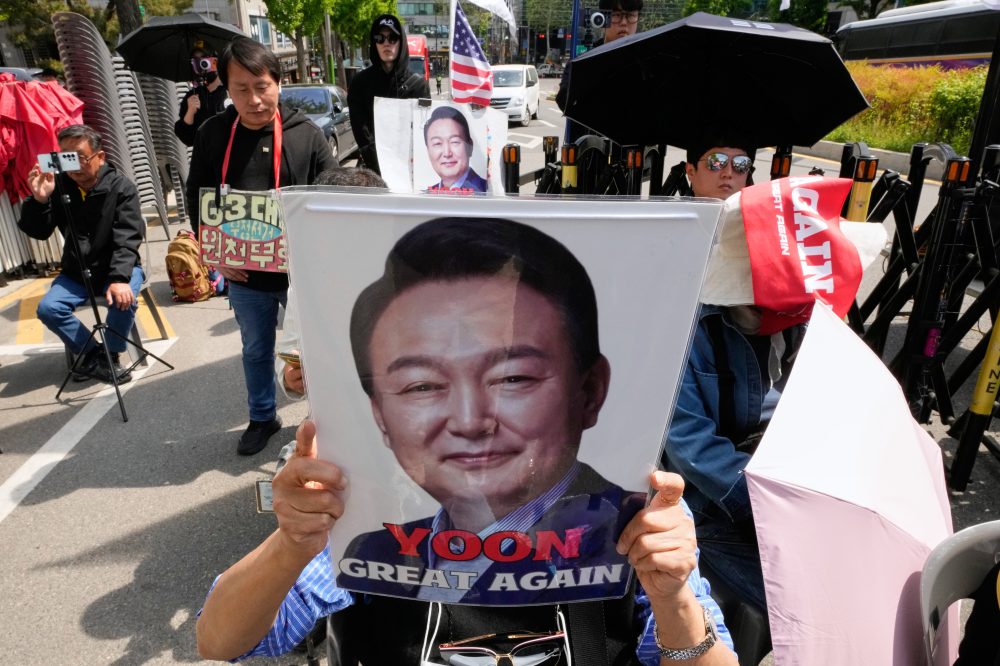

SEOUL, South Korea — Former South Korean President Yoon Suk Yeol received a seven-year prison sentence Wednesday from an appeals court for obstruction of justice and resisting arrest following his controversial martial law declaration last year.
The additional sentence compounds an already-imposed life term for rebellion charges connected to his December 2024 authoritarian actions that sparked South Korea’s most significant democratic crisis in recent decades.
Seoul High Court Judge Yoon Sung-sik determined that the former conservative leader circumvented required Cabinet procedures before announcing martial law, created false documentation to hide these violations, and used security personnel “like a private army” to prevent his arrest after impeachment. The former president remained silent during the verdict announcement and offered no statements.
A lower tribunal had previously given Yoon five years in January while partially dismissing abuse-of-power allegations related to the Cabinet meeting requirements, determining he wasn’t accountable for two members’ absence from the gathering.
The appeals court overturned that partial acquittal, convicting him on every charge and determining he infringed upon the rights of those two absent members plus seven additional Cabinet officials who weren’t informed, by assembling only a limited group to mimic an official meeting.
Yoon’s martial law announcement on December 3, 2024, despite lasting only briefly, plunged the nation into severe political upheaval, freezing governmental functions and international relations while destabilizing financial markets. The chaos subsided after his progressive opponent Lee Jae Myung secured victory in an emergency presidential election in June.
Parliament impeached Yoon on December 14, 2024, leading to his immediate suspension, and the Constitutional Court officially removed him from office in April 2025.
After his suspension, Yoon defied a Seoul court’s detention order for questioning, creating a tense confrontation where numerous investigators surrounded the presidential compound in early January 2025 but were prevented from entering by security forces and barriers. He was eventually detained later that month, freed by another court in March, then arrested again in July.
He has remained incarcerated since that time as multiple ongoing criminal proceedings continue.
Tuesday’s decision followed the same court’s enhancement of his wife Kim Keon Hee’s sentence to four years for accepting expensive gifts from the Unification Church, which pursued political influence from Yoon’s administration, and participating in stock manipulation activities.
In a separate case last week, prosecutors sought a 30-year sentence for Yoon regarding accusations that he intentionally escalated North Korean tensions in 2024 by authorizing drone missions over Pyongyang to establish justification for domestic martial law implementation.