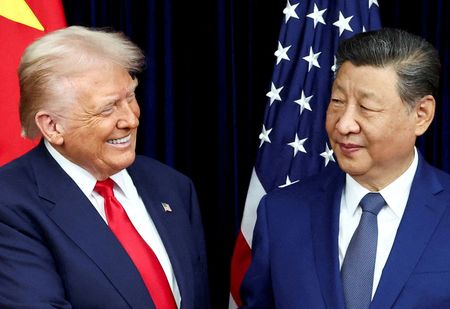

The fate of 23 million Taiwanese people may hinge on a crucial diplomatic encounter they won’t be part of.
Chinese President Xi Jinping is preparing to make Taiwan the centerpiece of discussions when President Donald Trump arrives in Beijing next month, marking a significant shift from their previous South Korea summit last year when Xi intentionally avoided the contentious topic.
Officials in Taipei are anxiously monitoring for any indication that Trump, known for his deal-making approach to international relationships, might modify America’s established Taiwan stance in exchange for Chinese purchases of U.S. aircraft and agricultural products or relief from economic tensions.
Wu Xinbo, who leads Fudan University’s Institute of International Studies and advises China’s foreign ministry, explained Beijing’s perspective: “Regarding Taiwan, the logic is simple: if the U.S. does not want to fight a major war with China over Taiwan, it should not support Taiwan independence.”
Wu continued: “Trump has no interest in going to war with China. To avoid a major conflict that involves the U.S., he should make it clear that he won’t support independence or take actions that encourage a separatist political agenda.”
Neither China’s foreign ministry nor the U.S. State Department provided responses to inquiries about the upcoming discussions.
America maintains its “one China policy,” which avoids taking an official stance on Taiwan’s sovereignty while recognizing, though not endorsing, Beijing’s territorial claims over the island. Washington states it “does not support” Taiwanese independence while committing to help the island defend itself.
Taiwan’s position as a semiconductor manufacturing hub makes it crucial to military stability across the western Pacific region. Even subtle modifications to American diplomatic language could influence how Beijing perceives U.S. determination to maintain its Taiwan support, according to regional analysts. Such changes would alarm Taipei and spark renewed concerns about Washington’s broader Asian security pledges.
Trump administration representatives have consistently stated that Taiwan policy remains unchanged and have regularly criticized Chinese pressure campaigns against the island.
Behind closed doors, administration sources emphasize that Trump has authorized significantly more weapons sales to Taiwan during his second term’s first year than predecessor Joe Biden approved throughout his entire presidency.
During a 2024 meeting with Biden, Xi requested that America alter its Taiwan language to state “we oppose Taiwan independence” instead of the current phrasing.
Washington rejected this proposed modification.
Sources familiar with summit preparations indicate that China has persistently conveyed similar messages through diplomatic channels leading up to the Trump-Xi meeting, though they declined to elaborate on specifics due to negotiation confidentiality.
Taiwanese officials, whose government disputes Beijing’s sovereignty assertions, remain vigilant about potential policy shifts.
Shen Yu-chung, deputy minister at Taiwan’s Mainland Affairs Council, which handles China policy, stated: “We will be watching whether the U.S. makes any changes to its position on Taiwan Strait issues as a result of that meeting.”
“We will use the remaining time to intensify policy communications with the U.S.,” Shen added.
Taiwan Foreign Ministry spokesperson Hsiao Kuang-wei noted this week that Trump’s administration “has continuously reaffirmed its support for Taiwan” since taking office.
Beijing has maintained that military action remains an option for bringing Taiwan under Chinese control. China conducted its most recent military exercises around the island in late December, responding to a U.S. announcement of an unprecedented $11 billion arms package for Taiwan.
In preparation for the summit, China has employed both incentives and pressure tactics.
Beijing has proposed trade and tourism “benefits” for Taiwan, while simultaneously taking punitive measures. Last week, Taipei accused China of convincing three African nations to deny overflight permissions for President Lai Ching-te’s planned trip to Eswatini, forcing its cancellation.
The United States issued sharp criticism of China’s interference.
President Lai maintains that Taiwan already functions as an independent nation under its official designation, the Republic of China. Beijing characterizes Lai as both a “separatist” and an illegitimate leader driving cross-strait relations toward armed conflict.
Raymond Greene, America’s top diplomatic representative in Taiwan, has been publicly reinforcing assurances that U.S. commitments, including arms sales mandated by the Taiwan Relations Act, remain “rock solid” as the summit approaches.
Former Trump adviser Robert O’Brien suggested the president would resist becoming “the first American president to lose Taiwan. That would not be a Donald Trump goal to have in mind. That’s not the legacy he wants.”
America also faces significant strategic considerations given Taiwan’s geographic importance, as Washington quietly utilizes the island’s sophisticated radar installations and surveillance facilities positioned in Taiwan’s mountainous regions to monitor China, according to security officials.
“Does the United States really want to lose one of its best locations for gathering intelligence on China?” questioned a Western security source, who requested anonymity when discussing sensitive security matters.