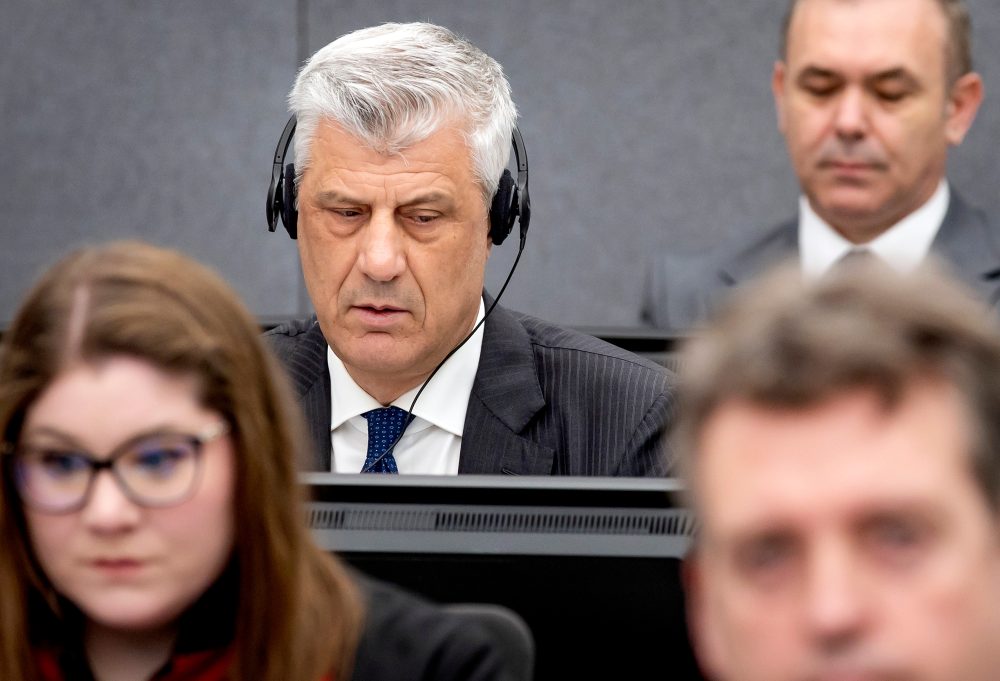

THE HAGUE, Netherlands — The former president of Kosovo made an impassioned final appeal Wednesday to international judges, positioning himself as a champion of peace while requesting full acquittal on what he described as baseless accusations of murder, torture and persecution stemming from his country’s fight for independence.
“Throughout my life, I stood with the people of Kosovo defending freedom, life and dignity. I was always guided by the Western ideals of democracy, equality and justice,” Hashim Thaci declared to the panel at the conclusion of his trial spanning nearly three years at the Kosovo Specialist Chambers.
Emotional supporters packed the courtroom’s public viewing area at the start of his address, pressing against the glass barrier to gesture toward their former leader before security personnel intervened. At least one observer was seen shedding tears during Thaci’s remarks.
The prosecution is demanding maximum sentences of 45 years behind bars for Thaci along with co-defendants Kadri Veseli, Rexhep Selimi and Jakup Krasniqi. Additionally, Thaci confronts a second upcoming trial on witness intimidation allegations scheduled to commence this month.
Thaci stepped down from the presidency in 2020 to confront 10 counts of crimes against humanity and war crimes allegedly perpetrated during Kosovo’s 1998-99 independence war against Serbia. He and three other former Kosovo Liberation Army (KLA) commanders have remained in detention since November 2020 at the Hague-based tribunal, which operates as part of Kosovo’s legal framework. The defendants now face what could be months of waiting before judges deliver their verdicts.
During his final courtroom address, Thaci, who has consistently maintained his innocence, stated “the only just decision would be my full acquittal.”
He described leaving his studies in Switzerland to help protect his homeland from violent assaults by Serbia, eventually becoming a prominent KLA negotiator in Western-mediated peace discussions and subsequently his nation’s president.
“During all that time, the only power I had was the power of my voice,” he testified.
“I used my voice to promote a multi-ethnic and tolerant society in my country, in Kosovo,” he continued.
However, prosecutor Kimberly West presented a dramatically different narrative on Monday, telling judges that witnesses offered “overwhelming evidence” showing Thaci and his co-defendants implemented a strategy of targeting political rivals and civilians viewed as collaborators and traitors while leading the Kosovo Liberation Army.
Thaci also rejected allegations that Kosovo Albanian combatants removed organs from captives during the conflict, calling such claims “Russian and Serbian propaganda.”
Wednesday’s final arguments followed a massive demonstration Tuesday in Kosovo’s capital city of Pristina, where thousands rallied in solidarity with Thaci and the other former fighters facing trial, coinciding with the country’s independence anniversary celebration.
Kosovo proclaimed independence from Serbia in 2008, though Belgrade continues to reject this declaration. Relations between the two nations remain strained despite nine years of European Union-facilitated negotiations backed by the United States.
Many Kosovo citizens view the court proceedings as an effort to distort their historical narrative, arguing it attempts to equate Serbia’s actions with their own suffering.
Ethnic Albanians comprised the majority of the approximately 13,000 war casualties in Kosovo. The conflict concluded after a 78-day NATO bombing campaign against Serbian military forces. Nearly one million ethnic Albanian Kosovars were forced to flee their residences.
Reflecting on his decision to join the struggle, Thaci stated: “I did not return to risk my life for control or for power. I returned to my homeland, risking my life, for freedom and for peace.”