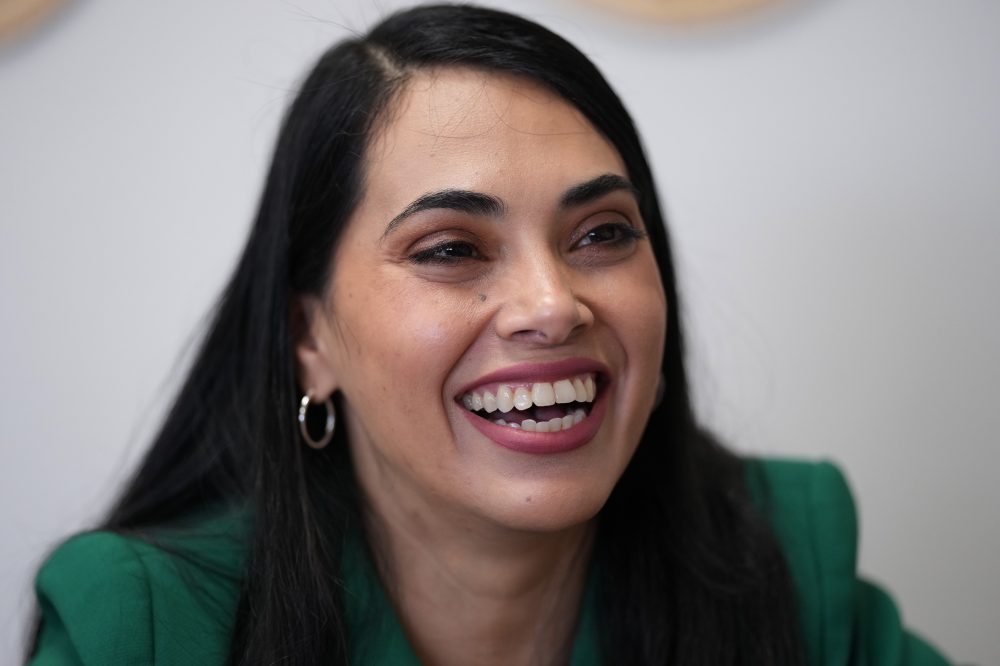

HARLINGEN, Texas — In a small side room at a Texas barbecue restaurant, former Republican Representative Mayra Flores addressed barely a dozen supporters in the Rio Grande Valley. Given only sixty seconds to make her case for returning to Washington, she stretched her remarks to three minutes while competing with the noise from a nearby ice machine.
The modest gathering was a stark contrast to the excitement Flores generated for her party in 2022, when her special election triumph made her the first GOP representative from the Rio Grande Valley in more than a century and a half. Though she subsequently lost two elections, that initial win demonstrated Republicans could appeal to working-class Latino voters in areas previously considered Democratic strongholds, previewing Donald Trump’s own regional gains in 2024.
“Don’t let anyone take that from us,” Flores told the small crowd.
However, as the March 3 primary approaches, Flores finds herself facing significant challenges within her own party. Campaign fundraising has proven difficult, and Trump has thrown his support behind challenger Eric Flores, an attorney and first-time candidate who shares her surname but no family connection.
This Flores versus Flores matchup has evolved into an intense and personal battle between two young Hispanic Republicans who represent their community’s conservative shift. The primary winner will become one of Texas’ most watched GOP candidates, tasked with unseating Democratic Representative Vicente Gonzalez, who has long been a Republican target. Recent redistricting efforts in Texas were partly aimed at making Gonzalez more vulnerable.
A November Republican win would cement the party’s position in this competitive region and indicate successful adaptation to changing American demographics. A defeat might suggest the GOP’s recent Rio Grande Valley successes were merely temporary.
Control of the House of Representatives may well be decided here at Texas’ southern edge, where the state meets Mexico at the Rio Grande River and Gulf of Mexico. Trump plans to visit the area Friday with a Corpus Christi appearance.
The Rio Grande Valley stretches as an interconnected urban expanse along 100 miles of the U.S.-Mexico border. This rapidly expanding region houses 1.5 million residents, nearly 90% Hispanic and predominantly working-class.
Historically Democratic, the area has experienced a notable political transformation. Trump narrowed his deficit by double digits between 2016 and 2020, despite losing both the region and presidency. Mayra Flores’ victory followed two years later, and Trump carried every regional county in 2024.
Following her special election success, Flores twice fell to Gonzalez, who has consistently outperformed Democratic presidential candidates. She blames her defeats on 2022 redistricting that favored Democrats, an issue Republicans addressed through additional redistricting last year.
Under Trump’s influence, Texas GOP legislators redrew district lines last fall to benefit Republicans, hoping to capture up to five Democratic House seats statewide and maintain House control. Three of these targeted districts are located in the Rio Grande Valley.
These represent the first elections under the revised map.
Texas Republicans are betting that the decade-long movement of working-class voters toward the GOP represents a lasting change, though that outcome remains uncertain.
“This area has a lot of conservative and Republican values–family, church,” explained Jonathan Campos, a Republican rancher near Brownsville seeking county commission election. “They just don’t realize it.”
Trump disrupted the race with his unexpected December endorsement of Eric Flores, a former federal prosecutor and Army officer who has attracted more financial support and momentum than Mayra Flores.
“Eric knows the Wisdom and Courage it takes to Ensure LAW AND ORDER,” Trump posted on Truth Social.
Following Trump’s endorsement, businessman Scott Mandel withdrew from the race and backed Eric Flores, despite having raised over $1 million for his own campaign.
The 34-year-old Eric Flores emphasizes his background with a Texas National Guard border patrol unit and his federal prosecution work in McAllen.
“I’m going to take that same tenacity that I served in uniform on the border, the same tenancy fighting the cartels and the human smugglers in the federal courtroom – that’s what I want to take to D.C.,” he stated.
He characterized Mayra Flores as having had her opportunity, labeling her an “opportunist” who benefits financially from her repeated district losses.
“Yeah, she had a short stint in Congress, but how about the remaining portion of her life?” he questioned. “Fact is, she’s been a career candidate for almost six years, paying herself with campaign funds.”
This message appeals to many supporters, including Doug Wells, a 60-year-old grocery clerk who acknowledged her congressional experience but said, “But overall, I think he’s got more life experience.”
The 40-year-old Mayra Flores dismissed Trump’s endorsement of her opponent as a decision made by his advisers.
She highlighted that Eric Flores only recently joined the Republican Party, pointing to his father Kino Flores’ background as a Democratic state legislator convicted of ethics violations. She has also criticized his prosecutorial work as service with the same “Biden DOJ” that pursued Trump.
While Joe Biden was president during Eric Flores’ tenure, he worked as a career attorney in Texas without involvement in Trump prosecutions or Washington policy decisions.
Mayra Flores counts Margaret Cervantes of Harlingen among her supporters. The 69-year-old retiree praised her strength and noted she hasn’t heard Flores speak negatively about opponents.
The following day, two hours away in Corpus Christi, Flores met privately at a coffee shop with Jack Cooper, a project manager and Army veteran who promised to encourage his contacts to support her.
In these intimate settings, Mayra Flores works to counter perceptions that her political moment has passed.
“I’ve been doing this since 2021” when Republican victory seemed impossible, she noted, arguing that her success created opportunities for her current challenger.
“I did it when it was hard,” she declared. “I ran so men like him could walk.”