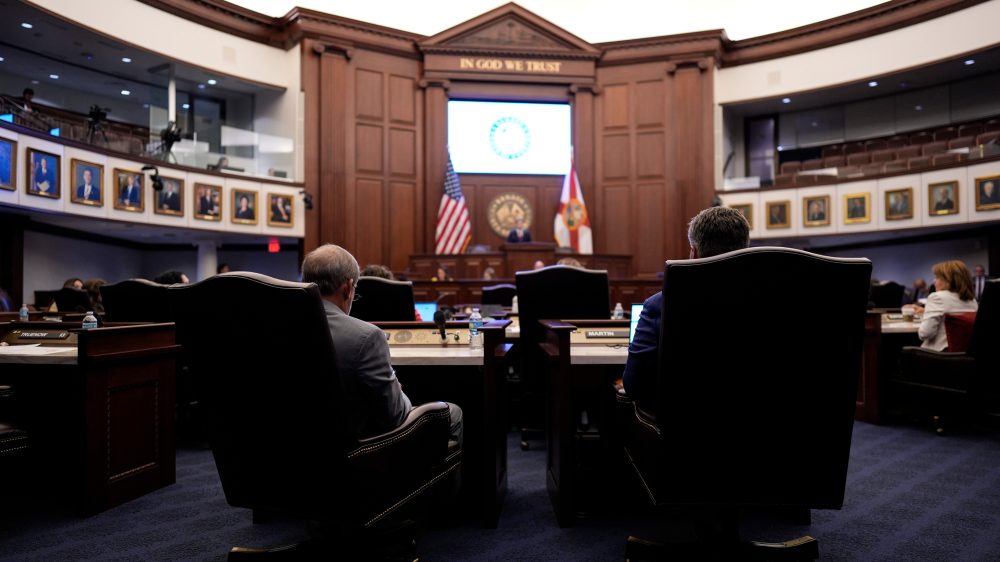

A Florida judge will hear arguments Friday on whether recently approved congressional districts violate the state’s constitutional prohibition against partisan gerrymandering, in a case that could significantly impact November’s midterm elections.
Legal challenges filed by voter advocacy groups seek to prevent the new districts from being implemented for the upcoming elections. The outcome could complicate President Donald Trump’s efforts to maintain a slim House majority through strategic redistricting that benefits the GOP.
The Republican Party currently controls 20 of Florida’s 28 House seats. The revised congressional map, enacted by Republican Gov. Ron DeSantis following a rapid two-day special legislative session, may boost GOP prospects to capture four more seats in November.
State lawmakers passed the new House boundaries on April 29 — the identical date the U.S. Supreme Court diminished federal Voting Rights Act safeguards for minorities by overturning a majority-Black congressional district in Louisiana. Following that decision, multiple Southern states have moved to dismantle minority districts that typically elect Democrats.
Congressional boundaries are normally redrawn every ten years following the census to adjust for population changes. However, since Trump advocated for mid-decade redistricting last year, Republicans believe they could secure up to 15 additional seats through new House maps across Texas, Missouri, North Carolina, Ohio, Florida, Tennessee and Alabama. Democrats expect to gain six seats through revised maps in California and Utah.
Democrats had anticipated winning up to four extra seats in Virginia. However, the Virginia Supreme Court recently invalidated a Democratic redistricting proposal approved by voters, determining the legislature failed to follow proper procedures when placing it on the ballot.
The U.S. Supreme Court determined in 2019 that federal courts lack jurisdiction over partisan gerrymandering disputes. The court noted that such claims could still be addressed in state courts under their respective constitutions and statutes.
Florida residents passed a state constitutional amendment in 2010 that forbids drawing U.S. House districts with the purpose of benefiting or harming a political party or sitting representative. The amendment prevents districts from reducing racial or language minorities’ capacity to choose their preferred representatives. It additionally mandates districts be geographically compact and utilize existing political and geographic boundaries when possible.
Legal action filed by voter representatives requests emergency relief blocking the new U.S. House map for violating that amendment. The litigation emphasizes allegations of political bias.
“The plan takes the state’s partisan skew to an unprecedented extreme,” stated one of three lawsuits filed in Leon County.
A court filing submitted on behalf of the Florida Senate contends that partisan motivation has not been established and emergency relief against the new districts is inappropriate before a complete trial.
While DeSantis convened lawmakers before the Supreme Court’s decision in the Louisiana case, he expected an eventual ruling that would weaken Voting Rights Act protections for minority districts. Among various modifications, Florida’s new map alters a southeastern Florida district that DeSantis’ office stated was designed to help elect a Black representative to satisfy federal Voting Rights Act requirements.
DeSantis’ office reported that no racial information was considered when creating the new map he submitted to the Legislature. In a communication to lawmakers, DeSantis’ General Counsel David Axelman claimed that Florida’s constitutional language regarding racial redistricting conflicts with the U.S. Constitution. If one component is invalid, Axelman argued, then the complete 2010 amendment becomes null, including sections prohibiting partisan gerrymandering.