
Civil rights organizations nationwide are mobilizing for what leaders describe as a new chapter in the ongoing battle for voting rights, following a recent Supreme Court decision that has significantly diminished protections for minority voters.
The movement’s leaders say they’re facing the same fundamental struggle as previous generations, but with fresh urgency after the nation’s highest court ruled two weeks ago to eliminate racial considerations in the drawing of congressional and legislative districts.
“We have to respond as quickly as possible,” said NAACP President Derrick Johnson during a recent interview. Johnson asked The Associated Press, “The real question is how do we as a country really address the effort to shrink us backwards into a 1950s reality?”
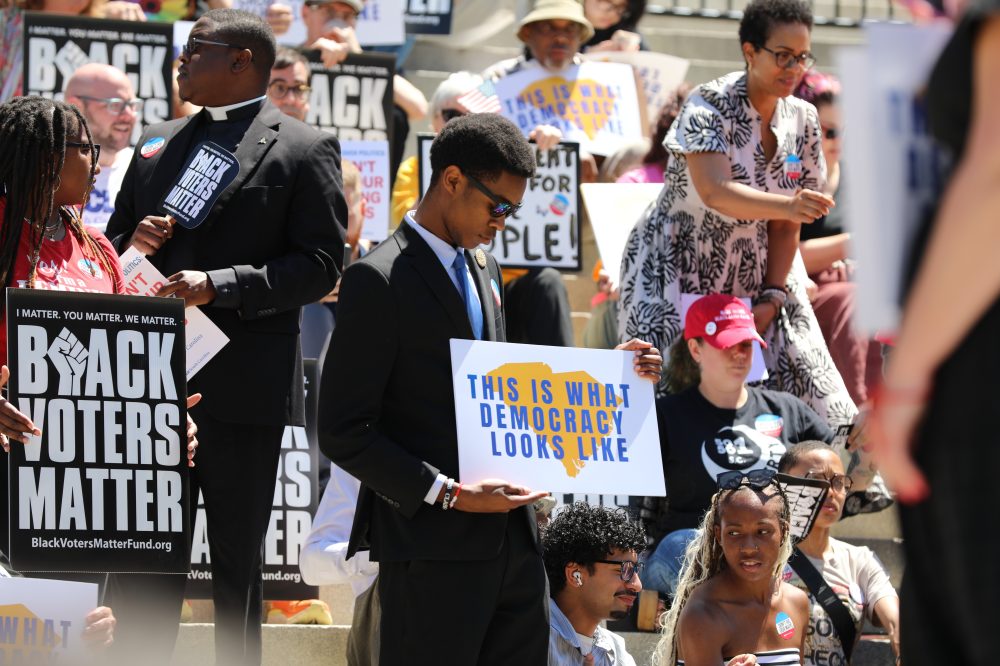
Johnson’s organization, which has championed Black political rights for 117 years, joins dozens of other groups gathering this Saturday in Alabama for demonstrations and ceremonies honoring the Civil Rights Movement that led to the 1965 Voting Rights Act. Activities are planned for both Selma, the site where voting rights marchers faced violent attacks from white police on Bloody Sunday, and Montgomery, where a postponed march ended two weeks afterward.
However, unlike the events of 61 years past, this weekend’s Alabama gatherings aren’t the culmination of an extended campaign. Civil rights advocates instead hope these events will spark a revitalized movement following the Supreme Court’s recent decision to further erode the VRA by prohibiting racial factors in district mapping.
Activists recognize the challenge of opposing a predominantly white conservative network that has gained control across the White House, Congress, federal judiciary, and numerous state governments throughout the former Confederacy, where most Black Americans continue to reside.
Jared Evans from the Louisiana-based Power Coalition for Equity and Justice described the VRA as “the foundational nucleus of the Civil Rights Movement.” Evans stated, “They’ve taken that from us,” referencing both the recent Louisiana v. Callais ruling on congressional boundaries and the 2013 Shelby v. Holder decision that eliminated federal supervision of election procedures in areas with histories of discrimination.
Georgia Sen. Raphael Warnock, who serves as senior pastor at Atlanta’s Ebenezer Baptist Church where the Rev. Martin Luther King Jr. once delivered sermons, characterized the situation from his pulpit as “Jim Crow in new clothes.”
Drawing inspiration from King and earlier voting rights campaigns, Warnock declared, “We need political power. We need economic power. We need personal power.” He reassured his congregation that “your adversaries know that your voice matters” because they’re “bending over backwards” to diminish it.
Evans looked to historical precedent when describing the path forward.
“Our response must be and will be a second Reconstruction period,” Evans declared.
According to organizers, their ultimate objective involves winning additional elections, influencing policy debates, and safeguarding diverse political representation across all governmental levels.
U.S. Rep. Terri Sewell, a Black congresswoman representing Selma, Alabama, identified an immediate priority to “reform and reintroduce” the Democrats’ primary voting legislation, the John R. Lewis Voting Rights Act.
Sewell, whose own congressional seat could face threats under redistricting changes, said Democrats aim to “completely” eliminate partisan gerrymandering.
The legislation would also “bring back pre-clearance,” she explained, referring to the federal approval requirements that the court eliminated in Shelby.
“We need to come up with a modern-day formula for showing just how egregious the behavior of these state actors is,” Sewell stated.
The Supreme Court determined in Callais that states aren’t required to create majority nonwhite districts under the Voting Rights Act and should actually avoid considering race entirely when establishing boundaries. By contending that the law’s anti-discrimination measures had themselves become discriminatory, the ruling permits states to redraw predominantly Black districts that historically elected Democrats while claiming the designs reflect partisan rather than racial motivations.
President Donald Trump celebrated the decision as “a BIG WIN for Equal Protection under the Law, as it returns the Voting Rights Act to its Original Intent, which was to protect against intentional Racial Discrimination.”
Many organizations planning to participate in Saturday’s Alabama events have already visited Southern state capitols, where white Republican legislators quickly moved to redraw congressional maps following Callais.
Lawmakers in Alabama and Louisiana returned to single majority-Black districts, abandoning second districts that lower federal courts had mandated under now-overturned VRA interpretations. Tennessee legislators dismantled a majority Black district by dividing greater Memphis across three separate sprawling districts — creating what Evans called an obvious racial gerrymander that courts had previously prohibited.
Expecting the Callais decision, Florida and Texas completed their redistricting before the ruling. Georgia Gov. Brian Kemp, a term-limited Republican, has scheduled a June session to redraw congressional boundaries for the 2028 election cycle. Mississippi and South Carolina have postponed action for now.
South Carolina state Senate Majority Leader Shane Massey stood among the few white Republicans opposing GOP redistricting proposals. He said that even pressure from Trump couldn’t convince him to disenfranchise Black South Carolinians rather than pursuing what’s best for his state.
Other white conservatives continue discussing plans to target Reps. Jim Clyburn and Bennie Thompson, the sole Black U.S. House representatives from South Carolina and Mississippi, respectively.
Evans, the Louisiana organizer, predicted the coming battle won’t focus solely on congressional representation.
“Look for them to go after state house and state senate seats — and then it will be the local level,” he warned, adding that “it’s going to be an entire erasure of Black representation.”
Predominantly minority districts created under the VRA before Callais consistently elected Democrats. Black Americans have overwhelmingly supported the party since President Lyndon B. Johnson signed the Civil Rights Act and Voting Rights Act, triggering a decades-long shift of most white Southern politicians to the Republicans. Latino and Hispanic voters also tend to favor Democrats in most regions.
The immediate conflict influences the midterm election battle for U.S. House control during Trump’s presidency’s final years. Trump initially urged Republican-controlled states to redistrict in ways that would preserve the party’s narrow House majority.
However, Johnson, the NAACP leader, argued that all voters should recognize more than partisan conflict or regional racial disputes.
Beyond party loyalty, Johnson contended, white conservatives seek to restrict various rights “depending on how you pray, depending on who you love,” while also promoting economic policies that harm workers across racial and ethnic boundaries. From legislation to federal judge confirmations that determine constitutional issues, these policy results begin with election outcomes.
“It’s not a Black problem,” Johnson emphasized. “That’s an American problem.”
Evans, Johnson and others acknowledged the complexity of uniting diverse organizations and energizing voters around issues like redistricting and gerrymandering. But they maintain that the bold nature of Republicans’ actions has increased participation.
Johnson reported participating in a Mississippi organizing call this week with 8,000 attendees. Evans noted crowded corridors in the state capitols of Baton Rouge and Nashville, respectively.
The NAACP and partner organizations have contested new maps in multiple states, despite Callais. Many groups aim to boost midterm participation among Black voters and others frustrated with white conservatives’ tactics in racially diverse communities.
Johnson emphasized the importance of persistence.
The 1954 Brown v. Board of Education ruling was transformative, with a unanimous court declaring segregated public schools unconstitutional and overturning 19th-century precedents that denied Black Americans’ basic rights.
Yet implementation required 17 years — and numerous additional court cases — before most Southern school districts complied. Disputes over mandatory student busing extended beyond the South. A full decade passed after Brown before Congress and Johnson enacted the movement’s landmark legislation.
No clear leader has emerged for a contemporary movement.
Johnson noted that even with King leading before his assassination, “there was tension around strategy” during the 1950s and 1960s.
But even “through that tension, through many episodes, we were able to get directly in the right place.”