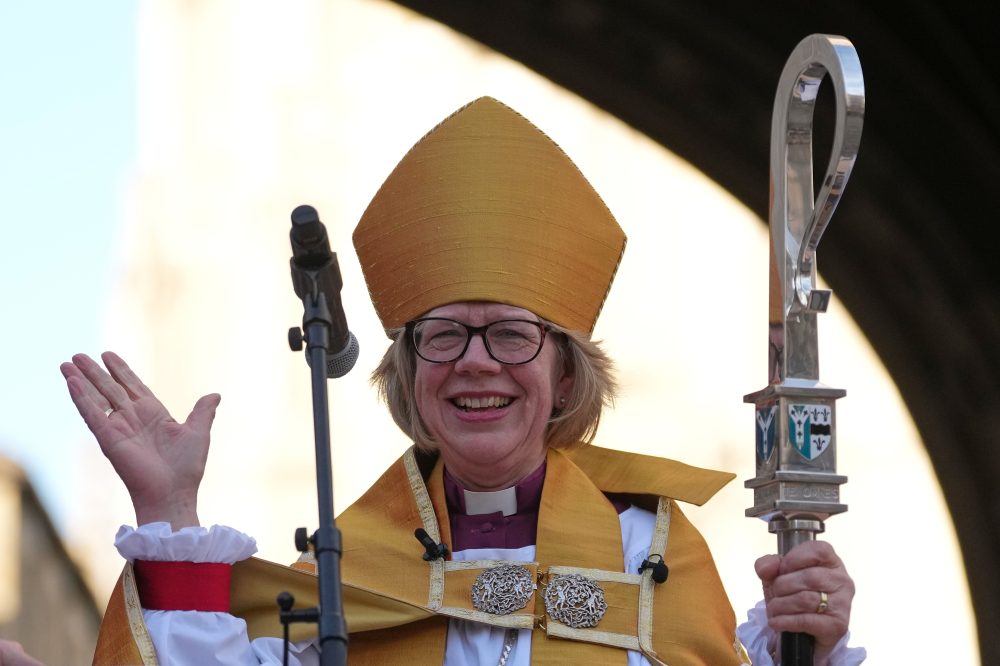

VATICAN CITY – Sarah Mullally, the newly appointed Archbishop of Canterbury and first woman to hold the position, conducted her inaugural international trip Monday with a significant meeting at the Vatican with Pope Leo XIV.
The groundbreaking visit began with a private meeting in the Pope’s library, followed by shared prayers in the Urban VIII Chapel within the Apostolic palace, according to Vatican officials.
Mullally’s appointment as the spiritual leader of the Church of England and millions of Anglicans worldwide has created divisions within the Anglican Communion. Her four-day religious journey to Rome has included stops at major papal basilicas, where she offered prayers at the burial sites of Saints Peter and Paul and conducted meetings with senior Vatican leadership.
According to Lambeth Palace, the visit seeks “to strengthen Anglican–Roman Catholic relations through prayer, personal encounter, and formal theological dialogue. It aims to deepen bonds of communion, affirm a shared witness, and encourage ongoing collaboration at both global and local levels.”
The Anglican Church broke away from Roman Catholic authority in 1534 after Pope Clement VII denied King Henry VIII’s request for a marriage annulment. While formal discussions between the denominations resumed in the 1960s, significant theological disagreements persist, particularly regarding women’s ordination – a practice the Catholic Church prohibits.
The Anglican Church began ordaining female priests in 1994, consecrated its first female bishop in 2015, and now has installed Mullally as its first female archbishop.
However, her historic appointment has deepened existing rifts within the Anglican Communion’s 100 million members across 165 nations, who remain divided on women’s roles and LGBTQ+ issues. While many in England and Western nations celebrated her selection as shattering religious barriers, conservative opposition has emerged from African churches.
The Global Anglican Future Conference, representing the communion’s largest and most rapidly expanding African congregations, has strongly opposed Mullally’s appointment and threatened complete separation. Similarly, the Anglican Church in North America, which split from more progressive U.S. and Canadian Episcopal churches, has endorsed the Gafcon position against her leadership.
Pope Leo XIV and Mullally have previously corresponded, with the Pope offering congratulations on her installation while acknowledging the “challenging” circumstances and persistent divisions between their churches.
“We also know that the ecumenical journey has not always been smooth,” Leo wrote. “Despite much progress, our immediate predecessors, Pope Francis and Archbishop Justin Welby, acknowledged frankly that new circumstances have presented new disagreements among us.”
Despite these challenges, Leo committed to continuing interfaith dialogue. In October, he hosted King Charles III and Queen Camilla at the Vatican, where they participated in prayers within the Sistine Chapel. Charles serves as the ceremonial head of the Church of England.
The October 25 gathering marked the first occasion since the Reformation that leaders of both Christian denominations had prayed together in the same location.
This year commemorates the 60th anniversary of the initial formal ecumenical agreement between Anglican and Roman Catholic Churches, established in 1966 at St. Paul’s Outside the Walls basilica by Archbishop Michael Ramsey and Pope Paul VI.
Mullally has publicly supported Leo’s peace initiatives, particularly after the American-born pontiff faced criticism from President Donald Trump regarding his calls for peace in Iran.