
MINNEAPOLIS — A federal court will consider Thursday whether to extend safeguards for legally admitted refugees in Minnesota who face potential arrest and removal from the country.
Federal Judge John Tunheim issued a temporary court order last month preventing the government from targeting these refugees, stating the case plaintiffs would likely succeed in proving “their detention and arrest, along with the policy used to justify these actions, violate the law.” The judge’s January 28 restraining order expires February 25 unless he approves a longer-lasting preliminary injunction.
Advocacy organizations for refugee rights filed suit against federal authorities in January following the December launch of Operation PARRIS by the Department of Homeland Security and U.S. Citizenship and Immigration Services. The operation’s name stands for Post-Admission Refugee Reverification and Integrity Strengthening.
Officials described the effort as a “comprehensive initiative” to review cases involving 5,600 Minnesota refugees who had not yet received permanent resident status, commonly called green cards. Federal agencies pointed to fraudulent activity in Minnesota public programs as their reasoning.
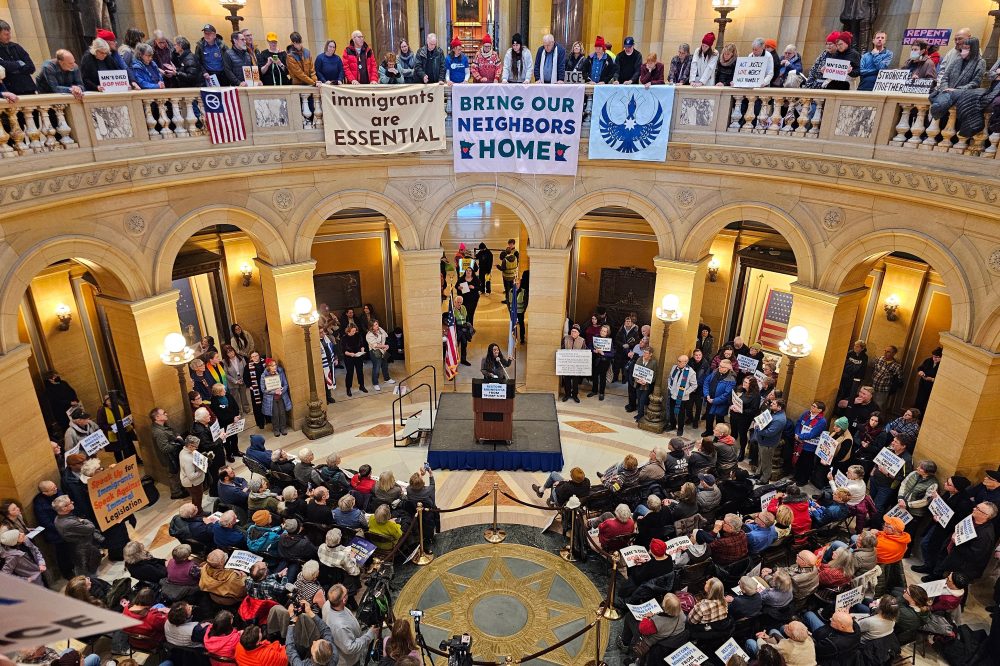
The operation was one component of the Trump administration’s wide-ranging immigration enforcement efforts focusing on Minnesota, which included deploying thousands of federal agents to the state. Homeland Security called it their most extensive immigration enforcement action in history. The operation prompted widespread demonstrations following the fatal shootings of Renee Good and Alex Pretti. White House border czar Tom Homan said last week the large-scale operation was concluding, though some federal personnel would stay.
According to the legal challenge, ICE agents conducted home visits under Operation PARRIS, detaining refugees and transporting them to Texas detention facilities where they couldn’t access legal representation. Some detainees were subsequently released onto Texas streets and had to arrange their own transportation back to Minnesota, the lawsuit claims.
Tunheim dismissed the government’s argument that it had authority to detain and arrest refugees who hadn’t secured green cards within one year of U.S. arrival. The judge called this position illogical and unreasonable, noting refugees cannot submit permanent residency applications until completing one year in the United States.
In his ruling, which only applies to Minnesota, Tunheim emphasized that refugees undergo thorough screening by multiple government agencies before U.S. resettlement. He noted that none of those detained in the operation had been classified as community threats or flight risks, and none faced criminal charges that could warrant deportation.
The judge referenced specific cases from lawsuit plaintiffs, including an individual identified as U.H.A., a refugee with no criminal background. This person entered the U.S. in 2024 and was detained by ICE on January 18 while traveling to work. “He was stopped, forced from his vehicle, restrained with handcuffs, and held in custody without a warrant or clear justification,” Tunheim wrote.
The judge emphasized that refugees covered by his order had been admitted to the U.S. due to persecution in their native countries. He banned additional arrests under Operation PARRIS and mandated the release and return to Minnesota of all individuals still detained from the operation.
“These individuals are not engaging in criminal activity in our communities, nor did they enter the border illegally. Refugees possess legal authorization to remain in the United States, authorization to work, authorization to live in peace — and crucially, authorization not to face the fear of warrantless or unjustified arrest and detention in their homes or while attending religious services or shopping for necessities,” he stated.
“At its finest, America provides sanctuary for individual freedoms in a world frequently marked by oppression and brutality. We betray that principle when we subject our community members to anxiety and disorder,” he added.
In a subsequent February 9 order, Tunheim denied a government request to remove the temporary restraining order.