
SAN JUAN, Puerto Rico — A federal audit made public Wednesday revealed a stark reality for Puerto Rico: just 25% of approximately $14 billion in federal money committed to rebuilding the island’s power grid has actually been delivered, nearly ten years after Hurricane Maria destroyed it.
Of the roughly $11 billion committed by the U.S. Federal Emergency Management Agency, only about $2.7 billion has been paid out — primarily for equipment, materials, and architectural and engineering design work — according to the U.S. Government Accountability Office. When the government obligates funds, it is legally required to spend that money for the designated purpose.
The 86-page report stems from an audit conducted between August 2024 and June 2026 and was released by Democratic members of Congress.
“The people of Puerto Rico have waited nine years for their government to keep its word,” said Rep. Jared Hoffman, a California Democrat, in a written statement. “They watched billions get appropriated and almost none of it arrive.”
Hurricane Maria slammed into Puerto Rico in September 2017 as a ferocious Category 4 storm, leaving some neighborhoods without power for nearly a full year — the longest blackout in U.S. history. An estimated 2,975 people died in the brutal heat and chaos that followed.
Just two weeks before Maria made landfall, Hurricane Irma had already clipped the island’s northeastern edge as a Category 5 storm, also knocking out electricity. The power infrastructure was further weakened by a string of powerful earthquakes that struck southern Puerto Rico in late 2019 and into early 2020.
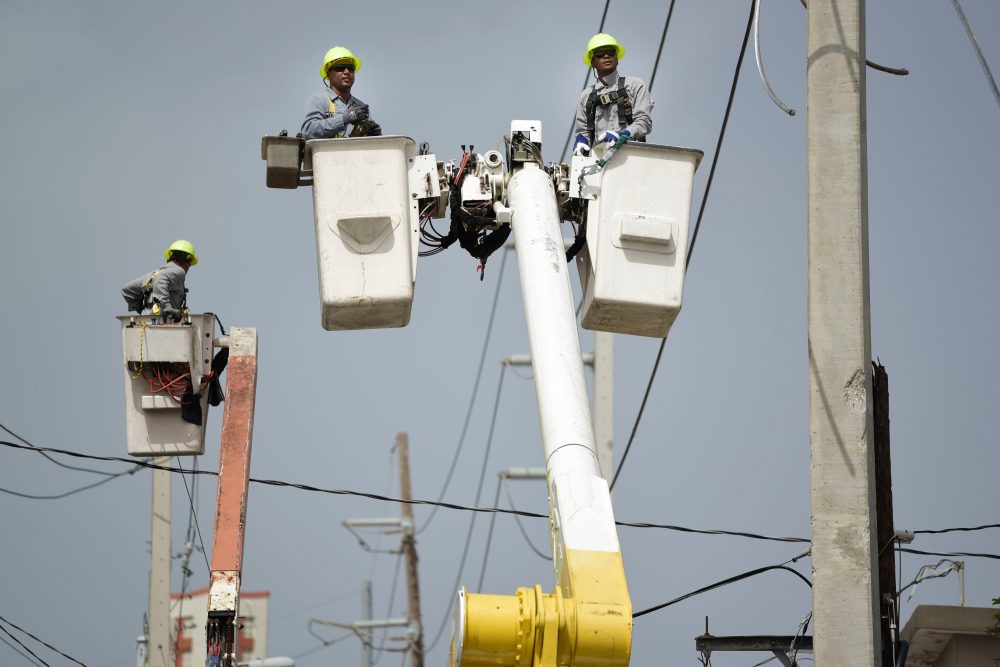
The relentless blackouts led Puerto Rico’s governor to declare a state of emergency in April 2025, yet outages continue. Roughly half of those incidents are attributed to vegetation growing over transmission and distribution lines.
As of February, federal funds had paid for clearing only 400 miles out of a planned 16,000 miles of power lines. In total, nearly 2,800 miles of lines were cleared during fiscal year 2025, according to Luma Energy, the private company responsible for overseeing power transmission and distribution on the island. Luma Energy is currently the target of a lawsuit by Puerto Rico’s government seeking to end its contract; the company has filed a counter lawsuit in response.
The audit identified several factors slowing progress, including high staff turnover, what it called “onerous” project review processes, and the dire financial condition of Puerto Rico’s Electric Power Authority, which is still working to restructure more than $10 billion in debt.
An additional setback came in June 2025 when the then-Homeland Security Secretary implemented a policy requiring personal approval of any Department of Homeland Security expenditure exceeding $100,000. That policy was reversed in April by the incoming Homeland Security Secretary.
As of December 2025, nine large FEMA-funded projects had been completed — most tied to power generation — while 133 projects remain in various stages of progress. FEMA has also committed roughly $1.3 billion toward 24 critical generation projects, seven of which are finished.
The report also pointed out that repair work frequently requires planned outages, and that sourcing replacement parts can take as long as two years.
Of the $2.9 billion allocated by the U.S. Department of Housing and Urban Development to modernize and fix the grid, only around $589 million had been paid out as of February. The U.S. Department of Energy, which obligated $1 billion, has disbursed approximately $255 million so far.
About $365 million originally set aside for solar energy projects has been redirected toward the power grid for what department officials described to auditors as “practical fixes and emergency repairs.” The Department of Energy also canceled up to $350 million in grants under a solar access program. However, the full $1.2 million designated for hubs meant to supply electricity to vulnerable communities during disasters was fully disbursed.
The Government Accountability Office recommended that FEMA update its guidance to reflect available flexibilities, and urged the Department of Energy to clarify roles and responsibilities and develop a coordination plan.
“Given the complexity of funding, the numerous players involved, and the various plans for grid recovery, extensive coordination across Puerto Rico and federal entities is vital,” the report stated.
Both the Department of Energy and the Department of Homeland Security agreed with the recommendations, though Homeland Security noted that “the government of Puerto Rico is ultimately responsible for developing a comprehensive solution and rebuilding the electrical grid.”