
U.S. financial markets are bracing for a high-stakes week ahead, with a Federal Reserve policy meeting and a flood of corporate earnings reports — many from major technology and artificial intelligence companies — poised to set the direction for stocks.
Major stock indexes were on pace to finish the week lower, largely due to sharp drops Thursday from Alphabet and Tesla after both companies released their quarterly earnings. Alphabet’s results — which included plans to dramatically increase its already enormous AI spending — cast a shadow over what investors can expect from other big AI spenders reporting next week, including Microsoft, Amazon, and Meta Platforms.
AI-linked stocks have been a key driver of market gains this year, helping push the bull market toward its fourth year. Despite this week’s turbulence, the S&P 500 remains up 8% in 2026. Still, the market “feels very frothy,” according to Kristina Hooper, chief market strategist at Man Group.
“Investors are, to a certain extent, walking on eggshells,” Hooper said. “And they’re more likely to react negatively to any signs of imperfection.”
Adding to the uncertainty is a surge in oil prices driven by rising tensions in the Middle East. Brent crude reached $100 per barrel on Thursday, stoking fears that the Fed may need to be more aggressive about raising interest rates to bring inflation under control — inflation that has consistently run well above the Fed’s 2% annual target.
The Fed was widely expected to leave rates unchanged when it releases its monetary policy statement on Wednesday. However, Fed fund futures on Thursday afternoon showed a 36% chance of a quarter-point rate increase, according to LSEG data.
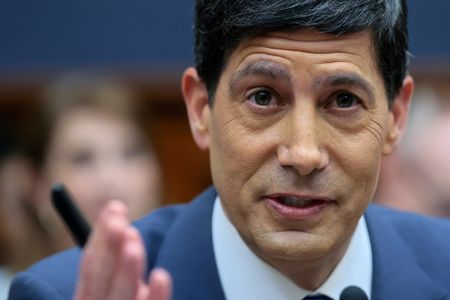
Wall Street is also keeping a close eye on the Fed’s new chair, Kevin Warsh, who has been reshaping how the central bank communicates its policy decisions. Warsh has moved away from offering forward guidance while pledging to get inflation back to target.
“The possibility of a shock rate hike cannot be ruled out entirely,” economists at BNP Paribas wrote in a note this week.
This will be the second Fed meeting under Warsh’s leadership. “He’s really not showing the Fed’s cards,” said Paul Nolte, senior wealth advisor and market strategist at Murphy & Sylvest Wealth Management.
Even if rates stay put Wednesday, investors will be listening carefully to the policy statement and Warsh’s press conference for clues about what comes next. Fed funds futures currently price in two quarter-point rate increases by the January 2027 meeting.
“If you get the feeling that there are more committee members that are moving towards these multi-hike scenarios over the balance of the year, then I think that’s going to be a problem for the market,” said Scott Wren, senior global market strategist at the Wells Fargo Investment Institute.
Rising interest rates make borrowing more expensive for both consumers and businesses, which can slow economic growth and put downward pressure on stocks. Higher rates also tend to push up Treasury yields, which have already been climbing in recent weeks, offering competition to equities. The benchmark 10-year Treasury yield crossed 4.7% Thursday, its highest point since early 2025.
Investors will also receive a batch of economic data next week, including reports on second-quarter gross domestic product, monthly inflation figures, and consumer sentiment.
On the earnings front, roughly one-third of S&P 500 companies are scheduled to report results, making it the busiest stretch of the second-quarter season. Notable names include Apple, Visa, Chevron, and Coca-Cola.
With more than 80 companies having already reported as of Wednesday, S&P 500 second-quarter earnings were on track to show a 26.5% increase compared to the same period last year, according to LSEG IBES — a strong profit performance that Wall Street had largely anticipated and built into stock prices.
AI spending has been central to stock market performance in 2026, lifting semiconductor companies and businesses tied to data center construction and related infrastructure. But investors are growing more concerned about whether the companies pouring money into AI will ultimately see a return on those massive investments.
That question came up with Alphabet’s report and could shape how markets respond to results from Microsoft, Amazon, and Meta next week. Even strong earnings and upbeat guidance might not be enough to satisfy investors if their outlook on AI spending has shifted, Man Group’s Hooper noted.
“Where they saw opportunities, now they’re more likely to see risks,” she said.