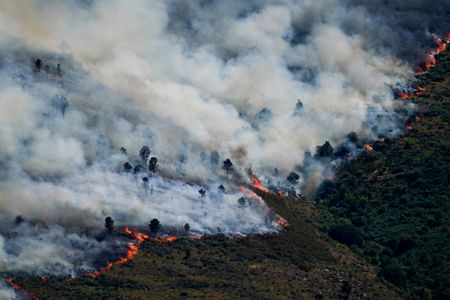

Spain has declared a national emergency because of wildfires for the first time in the country’s history, while France ordered a massive evacuation of a popular coastal destination as extreme heat continued to drive dangerous fires across Europe on Friday.
French officials ordered the complete evacuation of the Cap Ferret peninsula — a busy summer tourist destination — after smoke and flames crept dangerously close to homes. Roughly 63,000 people were forced to leave the area, with many transported to safety by boat, according to officials.
A nearby fire in the town of Biscarrosse also drove residents from their homes.
Yoan Urien, 26, was among those who fled late Thursday after police ordered his neighborhood to evacuate. “From our home, we had a view of the fires … We could see the clouds becoming darker and darker,” he told Reuters. “I was able to find somewhere to take shelter with my pets, but … it’s quite a shock.”
A fire that started in Saumos, located north of Cap Ferret, is now threatening to block the only road leading off the peninsula. Interior Minister Laurent Nunez described it as the largest fire so far this season in France, telling local television that it has scorched 10,000 hectares — roughly 24,700 acres — and destroyed 80 homes, with about 50 burned completely to the ground.
In Spain, more than 10,000 people were evacuated from communities in the mountainous region west of the capital, Madrid, as firefighters worked to keep three separate fires in that area and the neighboring Avila province from merging into one. Interior Minister Fernando Grande-Marlaska said the region is heavily populated, partly because many Madrid residents keep second homes there.
Grande-Marlaska said that population density, combined with the aggressive behavior of the fires and hot, windy conditions, drove the government’s decision to declare a national emergency — a step that allows for better coordination of the response. It marks the first time Spain has ever declared such an emergency due to a wildfire. The last comparable emergency declaration came after a major nationwide power outage last year.
Spain has also requested assistance from the European Union, the Interior Ministry confirmed.
In the Avila province town of Navaluenga, residents wearing masks to protect themselves from smoke watched firefighting helicopters pull water from the local river. “I’ve lived here for 36 years and I’ve never seen anything like it. Nor did I expect it. I thought they were going to get it under control last night, but it was already late, and it was all out of control,” resident Javier Martin told Reuters.
Spanish officials said more than 270 emergency workers and 40 ground units have been deployed across the affected areas, along with multiple contingents from the Military Emergency Unit.
This is the second year in a row that Spain has endured a particularly destructive fire season. Environment Minister Sara Aagesen noted in a social media post that more than 29 major fires have broken out in Spain so far this year, burning an area five times larger than at the same point in 2025 — which itself set a record for destruction.
French President Emmanuel Macron announced he had formally requested firefighting aircraft from the EU to help battle the Cap Ferret blaze, which has already burned through 8,700 hectares — about 21,500 acres. Macron said on X that several specialized planes from other European nations should be arriving soon.
After a brief cool-down over the weekend, temperatures across France are expected to climb sharply again next week, according to Global Forecast System data compiled by LSEG. The rising heat is expected to warm the rivers used to cool nuclear reactors, potentially leading to further output restrictions. The Golfech 2 nuclear reactor in southern France has been offline since July 7 due to heat-related restrictions, according to data from its operator, EDF.
The prolonged stretch of hot weather is also damaging France’s maize crop. France is the EU’s largest grain producer, and farm office FranceAgriMer reported Friday that crop conditions have been deteriorating under the heat.