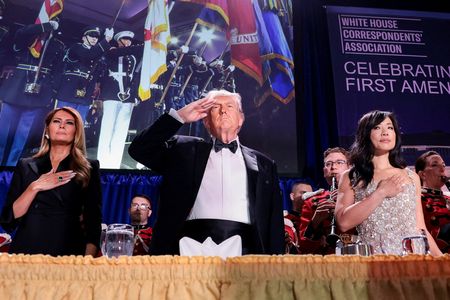

President Donald Trump is expected to speak at a rescheduled White House Correspondents’ Association dinner this Friday — an event that was cut short back in April when a gunman opened fire outside the ballroom where Trump and his cabinet had gathered.
The original black-tie event on April 25 was abruptly called off after a man attempted to push through a security checkpoint and discharged a shotgun just outside the ballroom at the Washington Hilton hotel. The suspect, identified as Cole Allen, entered a not guilty plea in May to charges that include attempting to assassinate the president.
The rescheduled dinner has been relocated to the Waldorf Astoria hotel, where officials say a robust security operation will be in place. Secret Service Director Sean Curran briefed reporters Wednesday, saying his team was rolling out a thorough security plan at the new venue.
“We do expect bad people to show up,” Curran said. “It’s just a reality of where we are, but we’re treating it no differently than any other site that the president goes to.”
Trump has pointed to the April shooting as justification for a $400 million ballroom currently under construction at the White House, arguing that hosting such events on White House grounds would better protect the president.
Friday’s dinner will pay tribute to Secret Service officer Victor Gonzales, who was shot at the security checkpoint during the April incident and is credited with preventing further harm. Gonzales was wearing a protective vest and was the only person injured that night. Hotel staff at the Washington Hilton who helped guests during the chaos will also be recognized, according to the White House Correspondents’ Association.
The annual dinner has been a Washington tradition for more than a century. It raises funds for journalism scholarships and celebrates the First Amendment, which guarantees freedom of speech and freedom of the press. In addition to Trump’s remarks, mentalist Oz Pearlman is scheduled to entertain guests.
April’s interrupted event marked Trump’s first-ever appearance at the correspondents’ dinner. During his previous time in office, he chose to skip the event entirely.
Trump has had a contentious relationship with the press, having filed lawsuits against several news organizations, repeatedly dismissing critical coverage as “fake news,” and calling out individual journalists by name. His administration has blocked the Associated Press from the White House press pool and placed restrictions on certain journalists’ access to the Pentagon, among other actions.
Just last week, Trump threatened to pull the broadcast licenses of television networks that declined to air his prime-time address on election security — a speech that included claims about foreign interference that contradicted findings from a U.S. intelligence assessment.
The White House has stood by these measures, saying the administration is working to protect sensitive information, strengthen security, and hold what it describes as biased media outlets more accountable.
Despite the ongoing friction, Trump has given reporters more direct access than some of his recent predecessors, frequently fielding questions during public appearances and speaking with journalists over the phone.
Hundreds of experienced journalists, along with eight professional journalism organizations, have signed onto a letter calling on the White House Correspondents’ Association to use Friday’s dinner as an opportunity to speak out against what they describe as Trump’s efforts to undermine First Amendment protections.
WHCA President Weijia Jiang said the event “will be a statement that violence has no place in American life and a free press will not be intimidated into silence.”