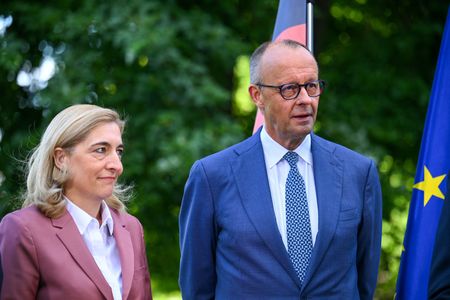

German Chancellor Friedrich Merz announced a significant government shake-up on Friday, appointing Health Minister Nina Warken as his new chief of staff — making her the first woman ever to hold that position.
The cabinet reshuffle is designed to breathe new life into Merz’s government, which has struggled in the polls ahead of challenging state elections scheduled for September. Merz also signaled that additional changes are on the way, though he declined to provide specifics.
Two sources with knowledge of the situation indicated that Transport Minister Patrick Schnieder is also expected to be replaced, largely due to public frustration over Germany’s troubled rail system and deteriorating infrastructure. However, that change is being delayed after Merz’s initial pick for the role backed out after first agreeing to accept it.
Warken, 47, was previously tasked with tackling Germany’s rapidly rising healthcare costs. That responsibility will now shift to another senior party figure, Carsten Linnemann. In her new role, Warken will serve as a critical link between the chancellor’s office, government ministries, and lawmakers — a key position as Merz pushes forward with economic reforms.
Merz described Warken as “assertive and well-versed in security policy” and “a tough negotiator.”
“We are a reform-oriented government, and we intend to continue demonstrating that,” Merz told reporters in Berlin, vowing to “hit the ground running” once parliament returns from its summer recess.
The reshuffle also follows the sudden resignation of senior conservative figure Jens Spahn from his role as parliamentary faction chief. Spahn stepped down amid controversy over his decision to have a child through surrogacy — a practice his own party strongly opposes. Merz’s departing chief of staff, Thorsten Frei, will now step in to lead the CDU/CSU parliamentary faction in Spahn’s place.
The political backdrop for all of this is difficult for Merz. A recent RTL/ntv Trendbarometer poll showed his approval rating at an all-time low, with only 14% of respondents saying they are satisfied with his performance, compared to 85% who are not.
At the national level, the far-right Alternative for Germany party — known as the AfD — is leading polls at 26%, ahead of Merz’s conservatives at 22%. The AfD is hoping strong showings in the eastern state elections in Saxony-Anhalt and Mecklenburg-Vorpommern this September could help propel the party toward broader national success.
Germany’s economy continues to face headwinds, with sluggish growth, rising domestic costs, stiff international competition, global trade tensions, and the economic fallout from the energy shock tied to the Iran war all weighing on the country’s traditionally export-driven economy.
Political analyst Oliver Lembcke noted that Merz, 70, appears to be trying to project strength while also making his government appear younger and more diverse in terms of gender. But Lembcke warned that the process carries risks.
“However, he must be careful not to bungle the process,” Lembcke said. “Anyone who wavers here quickly squanders their authority, and the chancellor cannot afford any further loss of authority.”
Germany’s train drivers’ union also weighed in, pushing back against the idea that the rail network’s problems can be pinned on any single individual. The union argued that policymakers had long failed to set clear goals or provide consistent direction for the rail system.
“Germany does not need further political reshuffles, but rather determination, expertise, and reliability,” the union said.