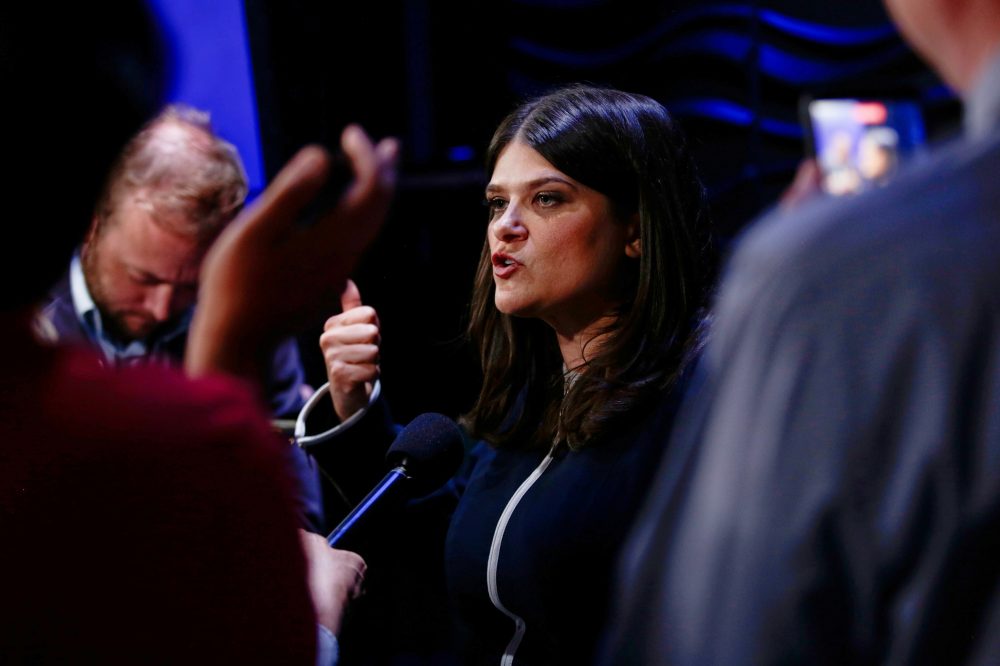

SOUTH HAVEN, Mich. (AP) — As Michigan’s Democratic Senate primary enters its final stretch, U.S. Rep. Haley Stevens is making one central argument to voters: she knows how to beat Republicans.
Stevens captured a Republican-held House seat in suburban Detroit back in 2018 and has won every race since — including a hard-fought primary against a fellow Democratic incumbent following redistricting in 2022. She says that record is what separates her from progressive challenger Abdul El-Sayed ahead of the August 4th primary.
“It is not a hypothetical that I beat Republicans,” Stevens told the Associated Press following a campaign stop in West Michigan. “I win tough races. I have had Republicans throw everything at me and still managed to win.”
Keeping Michigan’s Senate seat in Democratic hands is considered critical to the party’s chances of reclaiming a Senate majority this fall. That urgency intensified this week after Democrats’ nominee in Maine, Graham Platner, announced plans to withdraw from his race following sexual assault allegations — threatening yet another seat the party had hoped to keep competitive. While no Republican has claimed a Michigan U.S. Senate seat since 1994, former U.S. Rep. Mike Rogers came within 20,000 votes of breaking that streak in 2024.
Those stakes have prompted Senate Democratic leader Chuck Schumer and prominent Michigan Democrats — including former Sen. Debbie Stabenow — to throw their support behind Stevens, arguing she represents the party’s best shot at defeating Rogers, who is running again.
But whether Democratic primary voters share that electability-first mentality remains an open question.
“Democratic leadership should think more in terms of what we want to accomplish, and less about, ‘We’ve got to make it appeal to everybody,’” said Dave Burdick, 71, of Douglas, Michigan, who is supporting El-Sayed. The progressive challenger has gained momentum by arguing that Democrats can win without moving toward the political center.
El-Sayed has built his campaign on sweeping policy proposals, refusing corporate PAC money and positioning himself as a challenge to the Democratic Party’s current direction.
“People don’t want a moderate. They want somebody who’s going to come in and effect change,” Burdick added.
On a recent summer afternoon in the Lake Michigan community of South Haven, Stevens moved through a pet supply store with the confidence of a veteran politician. She quickly struck up conversations with the store’s owner, greeted reporters by name, and chatted easily with shoppers — shifting smoothly between casual conversation and campaign talk, weaving in mentions of legislation she’s supported and asking for votes.
“I thought she was great fun,” said store owner Roxanne Leder. “She was energetic and had a positive outlook.”
Stevens’ supporters say that kind of personal, ground-level campaigning has been the hallmark of her political career. They concede she hasn’t produced the viral progressive moments that have powered El-Sayed’s momentum, but argue she excels in the settings where elections are actually decided — small gatherings, union halls, and local businesses.
Stevens has drawn that contrast herself, including during a recent debate.
“Unlike my opponent, I’m not running at the first mic or camera I see,” she said. “We do not need a celebrity senator. We need a workhorse.”
That approach echoes a familiar pattern among successful Michigan Democrats. Both former Gov. Jennifer Granholm and current Gov. Gretchen Whitmer paired upbeat, approachable campaign styles with pragmatic, economy-focused messaging.
However, Stevens has not yet generated the kind of widespread grassroots enthusiasm that characterized those statewide campaigns. El-Sayed, by contrast, has drawn large crowds of progressive supporters and secured high-profile endorsements.
Stevens has instead relied heavily on outside spending — a factor that could become a significant vulnerability in the primary. Outside groups have poured more than $30 million into supporting her campaign, vastly outpacing spending on El-Sayed’s behalf. The biggest contributor, United Democracy Project — the super PAC connected to the American Israel Public Affairs Committee, known as AIPAC — has spent more than $13 million supporting Stevens and reserved an additional $7 million ahead of the primary.
For Burdick, that AIPAC backing is a dealbreaker. He said he would not cast a vote for Stevens even in the general election because of that support.
Leder, on the other hand, said she expects to vote for Stevens in August, largely because she knows the congresswoman far better than she knows El-Sayed — though she said she still plans to do more research before deciding.
“I’m just a Democrat,” Leder said. “Please, please no Mike Rogers.”
El-Sayed’s platform includes Medicare for All, campaign finance reform, abolishing U.S. Immigration and Customs Enforcement, and ending all U.S. weapons sales to Israel. He is also a Muslim who has never held elected office — factors that, to many Washington Democrats, make him a risky candidate in a battleground state long associated with manufacturing and moderate politics.
Yet Michigan has a history of rewarding candidates who position themselves as outsiders taking on the political establishment. In 2016, Sen. Bernie Sanders defeated Hillary Clinton in the state’s Democratic presidential primary by running against party leadership. Donald Trump later assembled his own anti-establishment coalition, winning Michigan in both 2016 and 2024.
Burdick, who describes himself as “an old white guy living in rural Michigan” and a democratic socialist, said both Trump and Sanders connected with voters because people were angry.
“Well, you know what? They’re still mad,” he said. “They portray people like Abdul as unrealistic, but I think it’s unrealistic to think that we can continue the way that we’re heading.”
The race shifted on Sunday when state Sen. Mallory McMorrow suspended her campaign, prompting several establishment Democrats to publicly back Stevens — including the Democratic group EMILY’s List and Attorney General Dana Nessel.
“Haley is wicked smart, has won multiple highly competitive races, and she connects with people on a level so sincere and genuine that everyone who meets her feels truly seen and heard,” Nessel said in a statement.
El-Sayed has also earned backing from influential labor organizations, including an endorsement from the United Auto Workers.
Fems for Dems, a prominent Democratic grassroots organization in Michigan, is not taking sides in the primary. But its founder, Lori Goldman, told the AP she personally plans to vote for El-Sayed.
“I personally am not going to have business as usual when I go to the ballot box. I want to vote for people, candidates that are going to go there and fight on our behalf,” she said.
Goldman, who launched the group a decade ago in politically significant Oakland County, acknowledged that the dynamics of Democratic primaries are shifting.
“Who would the natural choice be 10 years ago? Haley Stevens, right? Because we just followed the party line,” she said. “People are breaking away from the party line. People want change.”