
In the southern Italian region of Calabria, more than 200 Cuban medical professionals are keeping hospitals running — and the regional government is refusing U.S. demands to send them home.
Cuba has operated international medical missions for decades, deploying doctors to developing nations across the globe. Calabria, the poorest region in Italy, became one of the latest recipients of that program when Cuban physicians began arriving in January 2023. Their presence filled a critical void left by a severe shortage of locally trained healthcare workers that had forced some hospital departments to shut their doors entirely.
“It was a disaster. I was keeping the emergency room open all by myself,” said Francesco Moschella, the chief physician at Polistena hospital, describing the situation before the Cuban doctors arrived.
The arrangement caught the attention of U.S. officials, who visited the region this year. Washington has long taken aim at Cuba’s international medical missions, calling them a financial lifeline for the Cuban government — one the Trump administration has worked to cut off through sanctions and diplomatic pressure.
Several Caribbean and Central American countries have already canceled their agreements with Cuba under that pressure. Jamaica ended a 50-year medical cooperation agreement in March, displacing nearly 300 healthcare workers. Honduras expelled more than 150. But Calabria’s governor has held firm.
Calabria ranks last among Italy’s 20 regions in access to public healthcare, according to the country’s health ministry. For 17 years until April, the region operated under special government administration because of chronic budget deficits, corruption scandals, and organized crime infiltration — all of which hampered investment in healthcare. Many newly trained Italian doctors chose to build their careers in the wealthier north rather than stay.
During the COVID-19 pandemic, Cuba dispatched doctors to several parts of Italy. Calabria kept the arrangement going long after the pandemic ended.
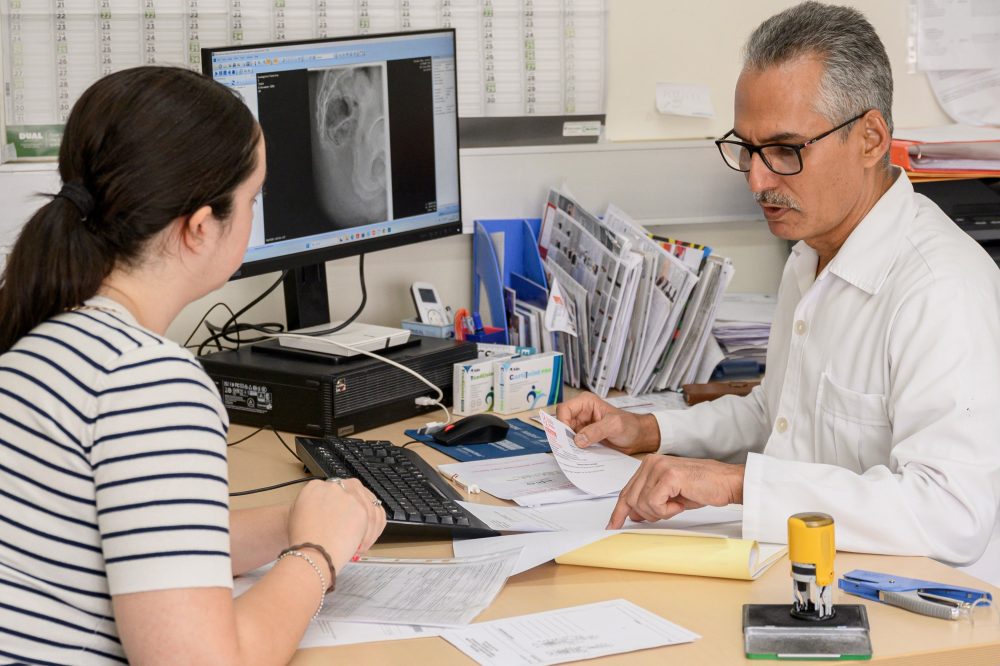
Emergency medicine specialist Zoila Yakelin Arevalo Cruz is one of those doctors. She left her young son behind in Cuba in mid-2023 to work in Polistena. The emergency room where she works treats 30,000 patients each year, and six Cuban doctors make up half of its staff.
“For a first-world country, Europe, we had a completely different idea. We didn’t think that the shortage of doctors was so serious,” said Arevalo Cruz, 38. “In this hospital there were lines that lasted up to eight or 12 hours. Now, thanks to our work, in less than an hour a doctor visits you.”
During a recent visit by the Associated Press, Arevalo Cruz carried out her duties in fluent Italian — a language she says she even picked up traces of in the local dialect through conversations with grateful former patients who stop by just to say hello.
U.S. Secretary of State Marco Rubio has labeled the Cuban missions a “form of human trafficking,” pointing to the Cuban government’s practice of keeping a large portion of the doctors’ salaries and allegedly confiscating passports in some cases.
“Cuban medical brigades are a key source of hard cash for the failing regime,” the State Department told the AP, adding that it was sharing information with partner nations about “the sobering realities of Cuban medical brigades to which they might otherwise be unaware.”
Mexico’s President Claudia Sheinbaum pushed back in March, defending the program as essential care for underserved communities.
Cuba’s government has said it has 22,000 medical personnel working across 55 countries as part of what it describes as a “mission of solidarity.”
Calabria’s governor, Roberto Occhiuto, makes for an unlikely champion of the Cuban program. He is a senior figure in a political party with deep anti-Communist roots — yet he has embraced the Cuban doctors as a practical necessity.
The deal even earned coverage in Cuba’s Communist Party newspaper, Granma. “Can you imagine, I got my photo in Granma?” Occhiuto said with a smile.
The arrangement also drew a direct visit from U.S. officials. The charge d’affaires to Cuba, Mike Hammer, flew to Calabria in February along with the U.S. consul-general in Naples. While the talks were described as cordial, Hammer made it clear that Washington would prefer Calabria find alternative sources of international medical staff.
“I had some pressures also during the Biden administration. But pressure grew under Trump,” Occhiuto said. He told Hammer his government is working on incentives to bring Calabrian-born doctors back home.
“But at the same time, I have also reiterated to the U.S. Ambassador Hammer that I needed to keep hospitals open and that I intend to keep the Cuban doctors who are currently in Italy in their posts,” Occhiuto said.
He told the AP he would like to expand the Cuban medical workforce to around 1,000 but has held back on doing so to avoid further friction with Washington.
Rather than funneling payments through the Cuban government agency that oversees medical missions, Calabria structured individual contracts directly with the doctors and deposits their pay into Italian bank accounts. Even so, Cuban doctors told the AP they voluntarily send as much as half their earnings back to the Cuban government.
“We are all aware of the economic situation Cuba is going through. It’s a contribution that we make voluntarily because Cuba trained us, educated us and made us doctors,” Arevalo Cruz said.
Cuban cardiologist Daisy Luperon Loforte rejected the characterization of the doctors as victims: “We do not consider ourselves modern-day slaves at all, as somebody called it. We love our country, we give an economic contribution and we are happy to do so.”
Occhiuto also confirmed that 63 Cuban doctors — some of whom had previously participated in Cuba’s international mission — recently applied to work independently within Calabria’s healthcare system. The Cuban government declined to comment on those applications.
For local patients, the diplomatic tensions are largely invisible. “They’re smart, they have empathy and they’re also humble — something you don’t often see with Italian doctors,” said area resident Maria Morano. “We are lucky they came, otherwise our hospital would have been closed.”