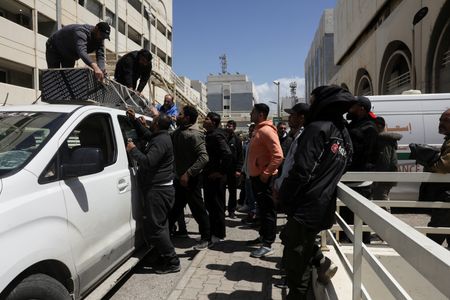

Emergency vehicles rushed to a Beirut medical facility Thursday, heading directly to the morgue rather than the emergency department as weary medical staff removed bags containing remains for family members to identify.
Search and rescue teams continued working around the clock to pull victims from the debris of collapsed buildings, nearly a full day after Israel launched its most devastating assault on Lebanon’s capital in recent memory. Wednesday’s bombardment claimed more than 250 lives throughout Lebanon, including strikes on downtown Beirut that occurred without advance notice.
Kheir Hamiyeh, 54, lost his brother and teenage nephew in an attack on Hay el-Sellum, a crowded neighborhood in Beirut.
“We are waiting because there’s so many people, there are so martyrs… all of them children and women,” Hamiyeh said while standing outside the morgue at Rafik Hariri University Hospital.
The Israeli bombardment, which Israel claims targets the Iranian-backed Hezbollah militant organization, leveled their residence and injured his young niece Khadija, who stood beside him with facial bandages.
“Her father was killed. Her brother was killed. She has one brother left. What are we supposed to do?” Hamiyeh said.
Zeinab, Khadija’s mother, spoke to Reuters through tears, describing how she had to transport the remains of her husband and 13-year-old son to the building’s ground level by herself.
Lebanon’s emergency response agency reported that Israeli strikes killed at least 92 people in Beirut proper on Wednesday, with another 61 fatalities in the city’s southern districts.
One rescue worker stationed outside Rafik Hariri Hospital described spending both Wednesday and Thursday extracting casualties from demolished residential towers throughout the city.
“We’re piecing people together because they’re all cut up into different body parts. I’ve never seen anything like this,” the rescuer told Reuters, requesting anonymity since he lacked authorization to speak with media.
Family members waiting outside the morgue wept openly, making phone calls to inform other relatives when they successfully identified a deceased loved one. Three women sat huddled together on the pavement, supporting each other to prevent collapse.
“The numbers are high, the situation is disastrous and painful,” hospital director Dr. Mohammad al-Zaatari said during a press briefing.
While al-Zaatari wouldn’t specify the morgue’s current capacity, a rescue worker informed Reuters that at least 100 bodies were housed inside.
Al-Zaatari advised anyone seeking missing family members to contact Beirut’s medical facilities, noting that DNA analysis would begin later to identify remains too damaged for visual recognition.
Rescue teams told Reuters they faced significant challenges reaching certain bombed structures due to narrow streets that prevented ambulances and heavy machinery from accessing the sites.
Nada Jaber informed Reuters that her nephew died in a strike, but rescue workers only retrieved his body Thursday morning. “The houses just blew up,” she explained.
Prior to the attacks, Israeli military forces issued widespread evacuation alerts for Beirut’s southern suburbs and southern Lebanon, though they didn’t specify exact target locations. No advance warnings were provided for central Beirut, which also came under bombardment.
Abdelrahman Mohammed, a 24-year-old Syrian resident who has lived in Beirut since conflict began in his homeland in 2011, lost five family members.
He had just brought his sister home when an Israeli strike hit their area.
“I came back and didn’t find the building. I didn’t find my sister, and I didn’t find my family. Any of them,” he told Reuters.
“I don’t have any sisters anymore… I came from Syria in 2011 and now I’m going back to Syria carrying five martyrs who are my family,” Mohammed said.
Reuters interviewed several other Syrians who reported losing relatives in the bombardment.
“There are many Syrian martyrs, not just my family. A lot. Go ask. It’s full of Syrian martyrs. Lebanese and Syrian blood are mixed,” Mohammed said.
Israel, which launched a ground operation in Lebanon last month to eliminate Hezbollah while simultaneously conducting its war on Iran, maintains that its Lebanese operations fall outside the ceasefire agreement announced late Tuesday by President Donald Trump. Pakistan, which assisted in mediating the U.S.-Iran negotiations, has indicated the truce would encompass Lebanon.