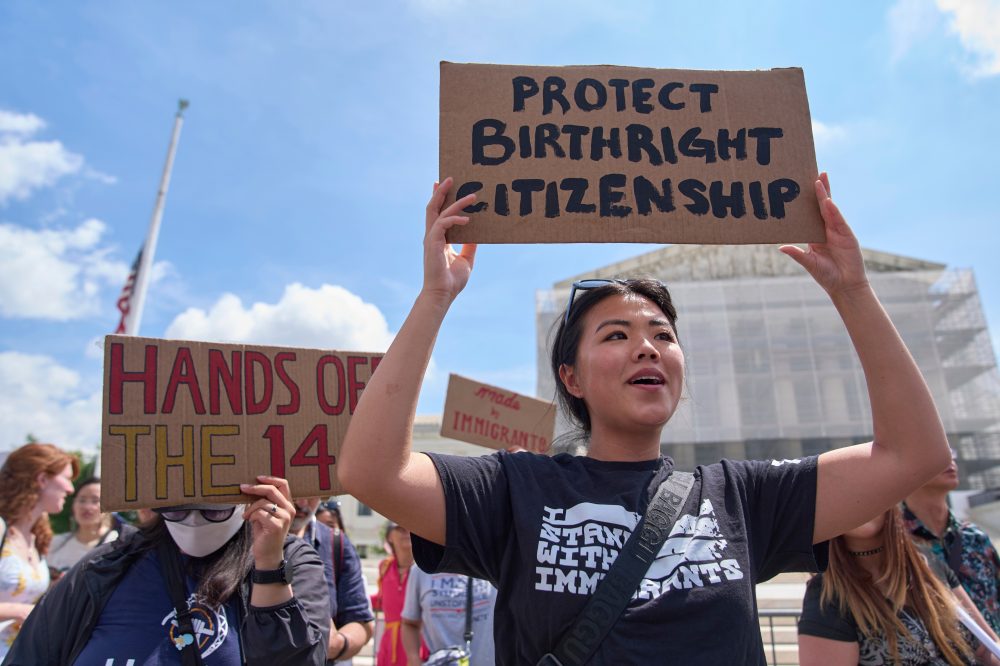

The Trump administration has been anything but quiet when it comes to birthright citizenship — the longstanding policy that automatically grants U.S. citizenship to nearly anyone born on American soil.
President Donald Trump has called the practice “a disgrace.” Top White House adviser Stephen Miller went further, describing it on X as “the gravest and most preposterous of all constitutional abominations.” Vice President JD Vance, speaking in 2025, called it “the dumbest immigration policy in the world.”
The Supreme Court is expected to rule in the coming days on a Trump executive order that would overturn more than a century of constitutional precedent on the matter. “It’s all up to a couple of people,” Trump told reporters recently. “I hope they do what’s right.”
One claim Trump has repeated often is that the United States stands alone in offering birthright citizenship. “You know, we’re the only country that has it,” he has said in multiple interviews. That claim, however, is false.
Here is a closer look at the facts surrounding birthright citizenship.
Birthright citizenship was established in 1868 when the 14th Amendment was ratified following the Civil War. One of its primary purposes was to ensure that formerly enslaved people would be recognized as citizens.
In the late 1800s, the Supreme Court expanded the policy through the case of Wong Kim Ark — a man born in the United States to Chinese parents — to include children of immigrants. Later court rulings extended that protection further, establishing that anyone born on U.S. soil is a citizen, even if their parents are in the country illegally or only temporarily.
A small number of exceptions exist, primarily for children born in the U.S. to foreign diplomats.
For most of American history, birthright citizenship was considered settled law and attracted little controversy. That includes among Republicans — President Ronald Reagan, speaking at a 1984 naturalization ceremony in Detroit, praised immigrants who “have crawled over walls and under barbed wire and through mine fields” to reach the United States, adding, “And all of them have added to the sum total of what your new country is.”
Opposition to immigration has been a defining theme of Trump’s political career. He has pointed to frustrations over illegal border crossings, including during the Biden administration when border arrests from Mexico hit a record high of 250,000 in a single month.
The administration frames birthright citizenship as a “magnet for illegal immigration,” frequently citing illegal “birth tourism” operations that allegedly bring non-citizens to the U.S. specifically to give birth. Government lawyers have focused their legal challenge on a single phrase in the 14th Amendment — “subject to the jurisdiction thereof” — arguing it allows the government to deny citizenship to babies born to mothers who are in the country illegally. That interpretation breaks with the view held by most legal scholars.
Even some conservative justices on the Supreme Court expressed skepticism about that argument during oral arguments held in April.
As for the claim that the U.S. is unique in its birthright citizenship policy — that is not accurate. While it is true that most countries tie a child’s citizenship to that of their parents regardless of birthplace, dozens of other nations also offer unrestricted birthright citizenship. The majority are in the Western Hemisphere, including Canada, Mexico, and numerous countries throughout Central and South America.
Many additional countries, ranging from Germany to Australia, use a combination of factors — including parentage, place of birth, residency, and ethnicity — to determine citizenship, representing a middle-ground approach.