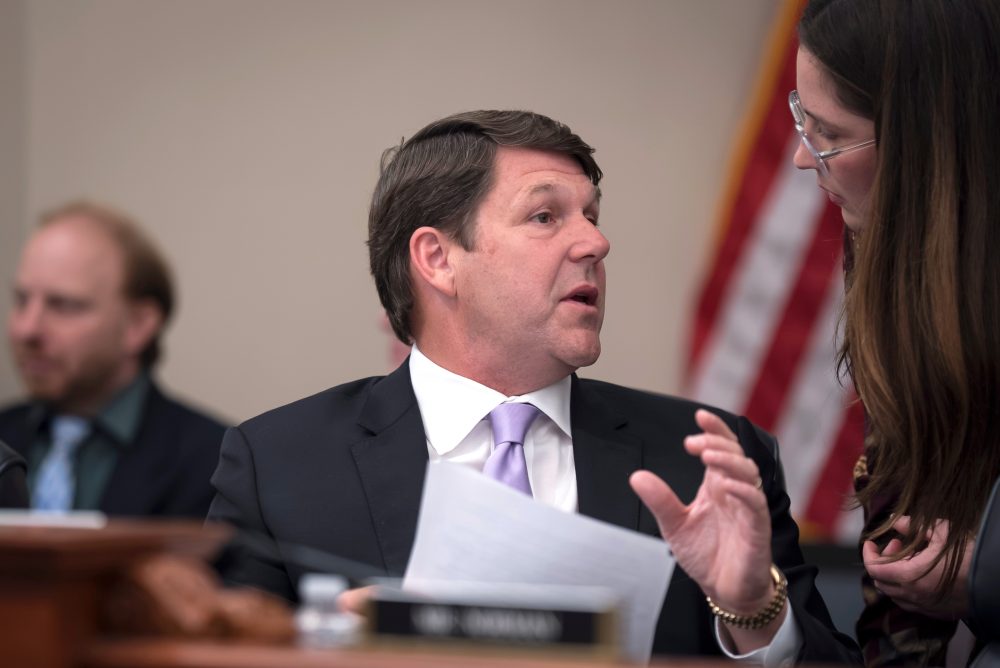

WASHINGTON — Republicans on the House Budget Committee pushed forward a $95 billion spending package Thursday that bundles funding for the Iran war, agricultural assistance, and President Donald Trump’s push for stricter voter identification rules — all on a party-line vote of 20-14.
Budget Committee Chairman Jodey Arrington, a Republican from Texas, cast the proposal as a final opportunity to deliver on promises to voters before midterm elections that will decide which party controls Congress.
“We are rallying to finish what we started when the American people sent us here,” Arrington said.
The largest chunk of the package — roughly $60 billion — is earmarked for the Iran war. Arrington acknowledged that debate exists over “why we’re there” in the overseas conflict, but argued the funding comes down to basic battlefield necessities. “Just the bombs, bullets and battlefield readiness for our men and women in uniform to finish the fight successfully and return home safely — that’s it,” he said.
Beyond war funding, the resolution directs congressional committees to develop proposals allocating $13 billion for Intelligence, $12 billion for Agriculture, and $10 billion for Administration, which oversees voting and elections.
This marks the third time Republicans have used the budget reconciliation process this session to push Trump’s agenda past Democratic opposition. The procedure requires only a simple majority for passage. House Speaker Mike Johnson previously used the same approach to pass Trump’s major tax cuts legislation and to secure four years of Homeland Security funding after Democrats refused to fund the department following the deaths of Americans protesting Immigration and Customs Enforcement earlier this year.
Johnson has been driving the effort largely on his own, without full support from his narrow House Republican majority or from Senate Republicans. He held extended meetings with Trump at the White House this week and brought Republican members together for a private session at Camp David to work through the details.
Even so, the 47-page package faces a steep climb — viewed by some members as too modest and by others as too expensive — ahead of an expected full House vote next week.
Rep. Chip Roy, an influential Freedom Caucus member who has raised concerns about the package, was absent from Thursday’s committee vote as his home state of Texas dealt with flooding.
Democrats remained firmly opposed, voting against the measure during Thursday’s committee session. Rep. Brendan Boyle of Pennsylvania, the top Democrat on the Budget Committee, pointed out that the 6,500-word document never once addresses what he called the number one issue on Americans’ minds: the cost of living.
“People know this is a failed presidency, and a failed Republican majority,” Boyle said.
Democrats introduced more than a dozen amendments during the lengthy committee session and pressed for answers on how the new spending would be financed — whether through cuts to existing programs or by adding to the national debt.
Boyle pushed an amendment to restore enhanced Affordable Care Act subsidies that Republicans let expire last year, which contributed to a government shutdown. Rep. Ilhan Omar of Minnesota sought to bring back funding for the Supplemental Nutrition Assistance Program, commonly known as food stamps. Rep. Scott Peters of California attempted to redirect Homeland Security funds to cover costs elsewhere.
Rep. Lloyd Doggett of Texas tied rising living costs directly to the Iran war, saying Americans are “paying for a war that should never have been started” every time they open their refrigerators or fill up at the gas pump.
The path forward remains uncertain. The House is scheduled to hold a rare Saturday pro forma session — a mostly administrative meeting — that will allow the resolution to be formally filed in time for a vote next week. Johnson has little room for error, as he is relying solely on Republican votes and can only afford to lose a handful of members from his side.
The resolution would also need Senate approval. Republican senators have largely been critical of the House’s approach, taking a wait-and-see stance on whether Johnson can get it through. Sen. Ron Johnson of Wisconsin, who is expected to chair the Senate Budget Committee following the sudden death of Sen. Lindsey Graham, has been a vocal critic of the nation’s growing deficits.
House committees are expected to work on the detailed bill language during the August recess, with a final vote on the full package anticipated in the fall.