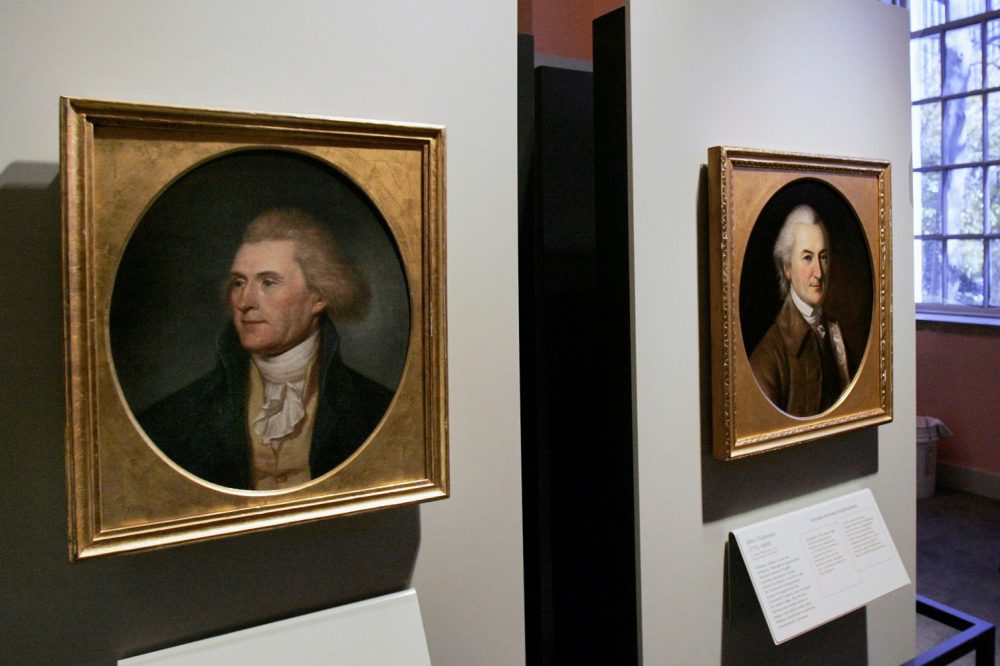

NEW YORK (AP) — For 25 years, scholar Jane Calvert has been fighting a battle that very few historians have taken up: defending the legacy of John Dickinson, a founding father best known today — when he is remembered at all — as the man who refused to put his name on the Declaration of Independence.
“It has been a constant struggle,” says Calvert, a former associate professor at the University of Kentucky who has written extensively about Dickinson and founded the John Dickinson Writings Project, an effort to make his body of work more widely accessible.
As the country prepares to mark the 250th anniversary of independence this Saturday, most Americans will be celebrating and reflecting on the nation’s founding. But for Calvert and a small group of like-minded scholars, the milestone is also an opportunity to push back against the enduring image of a man who has been dismissed, mocked, or simply left out of the story altogether.
Dickinson was born in Maryland and spent much of his life in Delaware and Pennsylvania. In his day, he was considered one of the most influential and admired founders. His “Letters from a Farmer in Pennsylvania” — a series of twelve essays published in the 1760s — were widely circulated critiques of Britain’s authority to tax the colonies, and they helped forge a common sense of identity among Americans. He also wrote the lyrics to one of the young nation’s earliest patriotic songs, “The Liberty Song.” Admirers gave him the title “Penman of the Revolution.”
Yet Dickinson also pushed for a peaceful resolution with Britain long after the first shots rang out at Lexington and Concord. In July 1775, he was a key author of the Olive Branch Petition, an appeal for reconciliation that King George III effectively rejected. When the Continental Congress voted for independence in July 1776, Dickinson and fellow Pennsylvanian Robert Morris chose to abstain. Morris eventually signed the Declaration — Dickinson never did.
“He wasn’t opposed to independence per se, but he thought it should happen gradually and without bloodshed,” Calvert explains.
“America wasn’t prepared in any sense, including militarily, and there was no constitution, no foreign allies, and no domestic manufacturing. Neither was there unanimity on the independence question,” Calvert adds. “But as critical as all these things were, Dickinson’s main concern was that there were no legal protections for the most vulnerable Americans. He was most worried about religious dissenters, particularly the Quakers in Pennsylvania.”
His reputation as a man of hesitation rather than action has followed him ever since. At the Signers’ Hall exhibit inside Philadelphia’s National Constitution Center, Dickinson’s statue stands alone in a corner, posed in quiet reflection. Prominent storytellers of the Revolution — from documentary filmmaker Ken Burns to “Hamilton” playwright Lin-Manuel Miranda — have largely left him out. In the musical “1776,” he appears as a smug, pro-British character. In the 2008 HBO miniseries about John Adams, he is cast as a compromising obstacle to Adams’ bold patriotism.
“It’s pretty egregious,” Calvert says. “He is depicted as a scowling and sunken-eyed naysayer of the Patriot cause. We know that he was a compelling and charismatic figure, well-liked among his colleagues and seen as a devoted Patriot leader. He did not wear a wig, don fancy clothes, walk with a cane or speak with a Scottish brogue — all things added in the show to make him appear aristocratic.”
After independence was declared, Dickinson did not retreat from public life or align himself with the British. He served in both the Pennsylvania and Delaware militias. He helped draft the Articles of Confederation, supported the U.S. Constitution as a Delaware delegate, and served as president of both Delaware and Pennsylvania. He and his wife, Mary, lent their name to the first college chartered after the founding of the United States — located in Carlisle, Pennsylvania. When Dickinson died in 1808, President Thomas Jefferson remembered him as “one of the great worthies of the revolution.”
Calvert believes Dickinson deserves a place in the top tier of founders, alongside figures like Adams and Jefferson. Thomas Donnelly, lead scholar at the Constitution Center, says Calvert has deepened his appreciation of Dickinson, and he speculates that the statue’s contemplative pose was intended as a nod to Dickinson’s “scholarly nature.”
Not all historians agree. Joseph Ellis, the Pulitzer Prize-winning author of “Founding Brothers,” acknowledges Dickinson as the leading voice of colonial resistance in the decade before 1776, but regrets that he failed “to take the last step.” Fellow Pulitzer winner Jack Rakove describes Dickinson’s 1776 decision as a “quirk of his conscientious political personality” that shouldn’t overshadow his other contributions — but he still wouldn’t place Dickinson in the first rank of founders. He puts him just below that level, alongside figures such as Benjamin Rush and John Jay. “Perhaps his qualms of conscience in 1776 have affected his reputation,” Rakove says.
Dickinson himself acknowledged the damage, calling his opposition to the Declaration a “finishing blow” to his “diminished popularity.” John Adams was among his harshest critics, dismissing him as a “piddling genius whose fame has been trumpeted so loudly.” In the 1840s, historian George Bancroft helped cement a negative view of Dickinson by condemning him for how he “dulled the resentment of the people, and paralyzed the manly impulse of self-sacrificing courage,” according to Calvert.
Calvert has not been alone in making the case for Dickinson. His defenders include the late conservative commentator William Murchison, who authored a 2013 biography drawing on Calvert’s research, as well as historians and Dickinson Project editors Ian Iverson and Nathan R. Kozuskanich. Calvert even credits the creators of “South Park” for a 2003 episode, aired during the Iraq War, in which the character Cartman travels back to 1776 and witnesses the independence debate — finding echoes of modern-day protests along the way.
“It’s the only pop culture representation of Dickinson I’ve seen that portrays him as being motivated by principle — that we shouldn’t found a country based on war,” Calvert says.
“Here Dickinson is the forefather of those antiwar protesters,” she adds. “Whether he would have gone so far as to say that the reasons for the Revolution were trumped up, I don’t know. Maybe. In any case, there is a lot to like!”