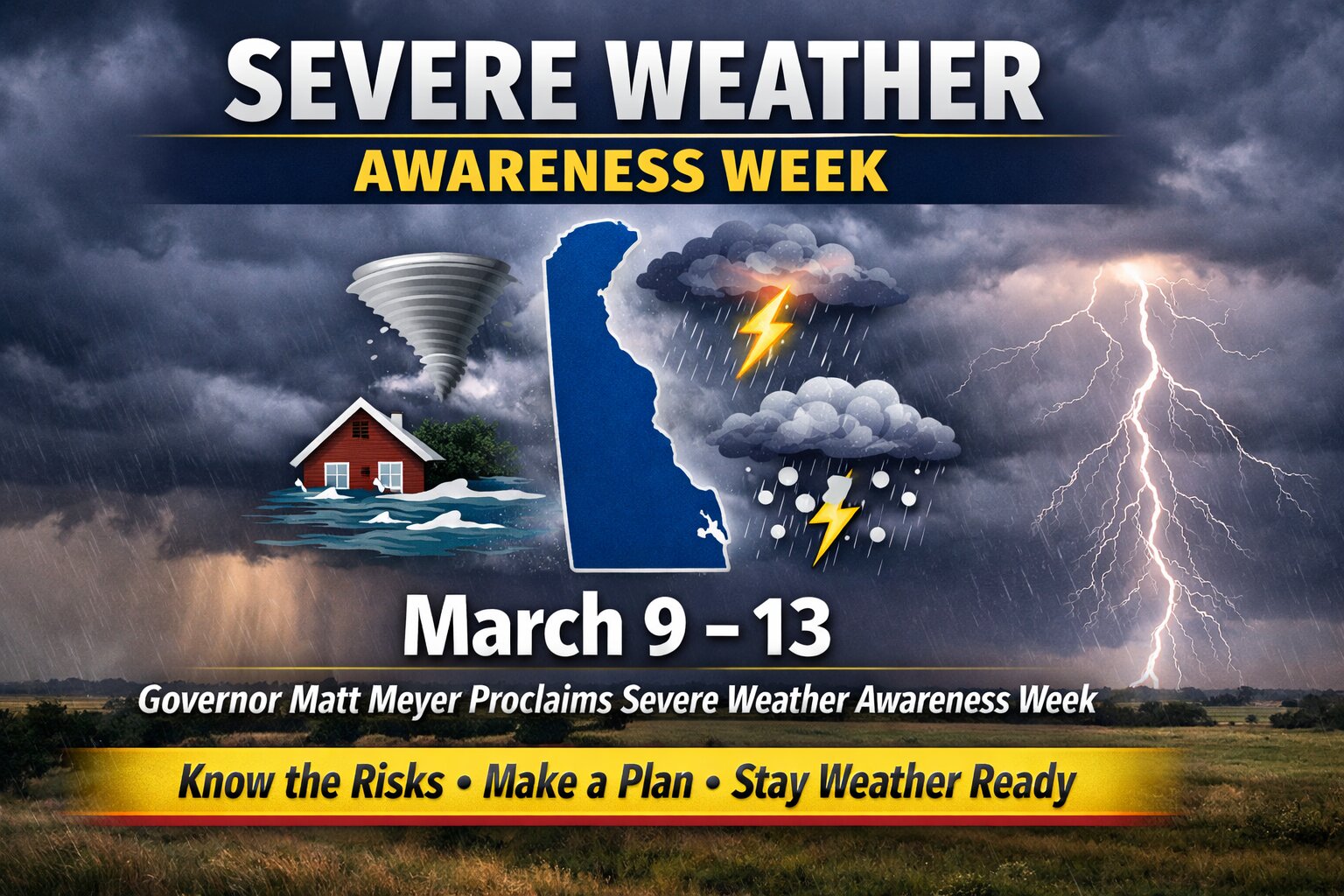

Governor Matt Meyer has officially proclaimed March 9 through March 13, 2026 as Severe Weather Awareness Week in Delaware, encouraging residents across the First State to prepare for potentially dangerous weather events that can occur throughout the year.
The initiative is led by the Delaware Emergency Management Agency (DEMA) in partnership with the National Weather Service, the University of Delaware’s Center for Environmental Monitoring and Analysis (CEMA), the Delaware Department of Transportation (DelDOT), and Delaware Sea Grant. The goal is to increase awareness about severe weather threats and encourage residents to take steps now to protect their families and communities.
State officials say the week serves as a reminder that Delaware regularly faces weather hazards such as flooding, tornadoes, severe thunderstorms, lightning, and coastal storms. Many of these events can develop quickly, giving residents little time to react without proper preparation.
Daily Severe Weather Safety Topics
Throughout the week, emergency management officials will focus on a different severe weather hazard each day, sharing safety tips and preparedness information.
- Monday: Flood safety
- Tuesday: Tornado safety
- Wednesday: Severe thunderstorms and hail
- Thursday: Lightning safety
- Friday: Preparing for severe weather
Residents are encouraged to follow along on social media and online resources to learn how to respond when severe weather strikes.
Recent Severe Weather Highlights Need for Preparedness
Delaware has experienced several significant weather events in recent years that highlight the importance of preparedness.
In 2020, the remnants of Tropical Storm Isaias produced the longest tornado ever recorded in Delaware, carving a destructive path from Dover in Kent County to Glasgow in New Castle County. More recently, a tornado in Sussex County in April 2023 resulted in the state’s first tornado-related fatality in decades.
Flooding has also been a growing concern. The remnants of Hurricane Ida produced historic rainfall and flooding in Wilmington in 2021, underscoring the risks associated with extreme weather across the region.
Nationally, severe weather continues to cause major impacts. According to federal climate data, the United States recorded 27 separate billion-dollar weather disasters in 2024, with the majority tied to severe thunderstorms.
Steps Delaware Residents Can Take Now
Emergency management officials say preparedness before severe weather strikes is critical. Residents are encouraged to:
- Sign up for alerts through the Delaware Emergency Notification System (DENS)
- Build a basic emergency preparedness kit
- Create a family emergency plan
- Know evacuation zones and local hazards
- Stay informed through weather alerts and trusted forecasts
More preparedness information and resources are available at PrepareDE.org.
Officials say even small steps taken ahead of severe weather can significantly reduce risks to lives and property when dangerous conditions develop.