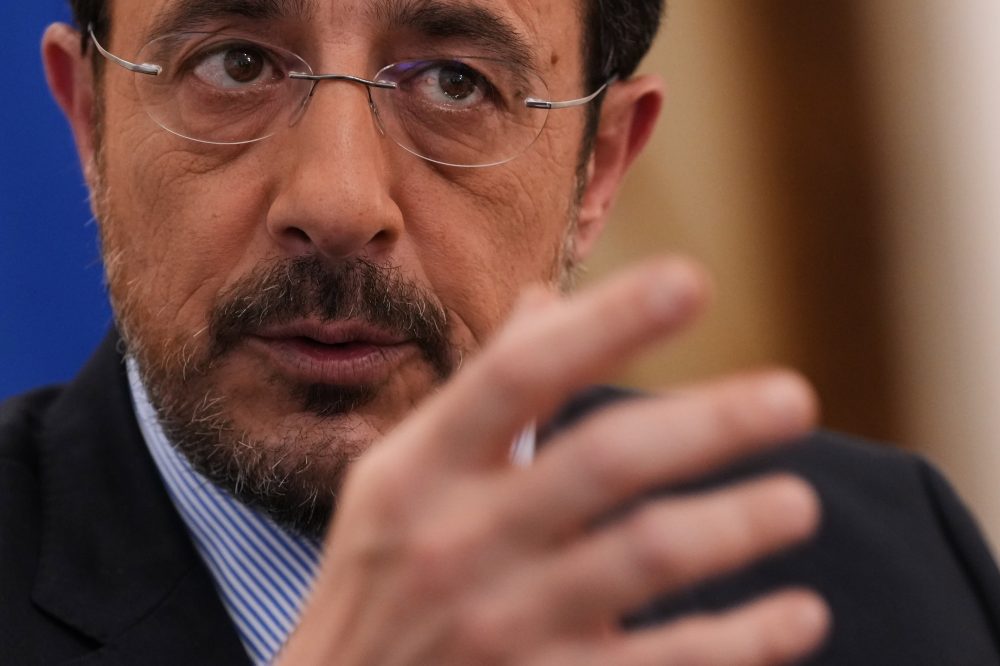

NICOSIA, Cyprus — The leader of Cyprus is urging European Union officials to develop a concrete action plan for responding when member nations face military threats, following a recent drone attack on his island nation.
During an exclusive interview with The Associated Press on Tuesday, President Nikos Christodoulides emphasized the need for EU leadership to define specific procedures under Article 42.7 of the union’s founding documents, which requires all 27 member countries to provide mutual aid during emergencies.
The provision mandates that when any nation faces armed aggression within its borders, fellow members must offer “aid and assistance by all the means in their power.” However, this clause has never been activated, leaving no established guidelines for how EU countries should coordinate their response to assistance requests.
“We have Article 42.7 and we don’t know what is going to happen if a member state triggers this article,” Christodoulides explained before hosting an EU-Middle East summit focused on regional conflicts and their consequences. “So we’re going to have a discussion and prepare, let’s say, an operational plan of what is going to happen in case a member state triggers this article, and there are a number of issues.”
The topic holds special significance for Christodoulides after he requested help from EU partners last month when a Shahed drone attacked a British military facility on Cyprus’s southern shore. According to Cypriot authorities, the unmanned aircraft originated from Lebanon, located just 207 kilometers (129 miles) from Cyprus’s southern coastline. In response, Greece, France, Spain, The Netherlands and Portugal deployed naval vessels equipped with anti-drone technology to protect the island.
Christodoulides noted that since numerous EU members also belong to NATO, any emergency response framework must address potential conflicts between EU obligations and commitments to the military alliance.
NATO’s security provision, Article 5, declares that an assault on any member constitutes an attack on the entire alliance, mandating coordinated retaliation.
“So what is going to happen in this situation if a member state is both NATO member state and an EU member state? What is going happen?” Christodoulides questioned.
Additional considerations for Article 42.7 implementation include determining whether responses should involve collective action similar to NATO’s approach or focus on neighboring countries assisting the threatened nation. Officials must also establish which resources would be deployed based on different types of emergencies.
Christodoulides expressed satisfaction that other EU leaders now “understand the importance” of strengthening the bloc’s relationships with Middle Eastern nations through programs like the Mediterranean Pact, which funds various projects covering healthcare, education and energy initiatives in the region.
Developing stronger EU connections with Middle Eastern countries represents a central goal of Cyprus’s EU presidency, which Christodoulides described as a “very good opportunity … to give substance” to this mission. The upcoming informal EU summit will include leaders from Egypt, Lebanon, Syria and Jordan, creating chances “not just to exchange ideas but to see in action how we elevate our cooperation in a strategic level.”
“We can represent the interest of the countries of the Greater Middle East to Brussels, but at the same time, and this is very, very important, the countries in the region, they trust Cyprus to represent them in the European Union,” he stated.
Christodoulides actively supports the India-Middle East-Europe Economic Corridor (IMEC), an ambitious infrastructure project designed to create trade, energy and digital connections between the continent and the world’s most populous democracy while promoting regional peace and stability.
Under Cyprus’s EU leadership, officials have established a “Friends of IMEC” coalition to advance the initiative, though Christodoulides acknowledged it currently lacks sufficient concrete projects. One example is the Great Seas Interconnector, an electrical cable system linking power networks in Greece, Cyprus and eventually Israel, which has experienced significant construction delays.
“We can work together with the Americans, with the U.S. Government, with President Trump in order to give substance because it will be a win-win situation for both the European Union and the United States” through additional specific projects, Christodoulides said.
Recent Middle Eastern conflicts have highlighted the EU’s urgent need to diversify its energy supply sources. Christodoulides revealed ongoing discussions with EU executives about utilizing Cyprus’s offshore natural gas reserves to help the bloc secure alternative energy supplies and distribution routes.
He indicated that Commission President Ursula von der Leyen will announce “very specific proposals” on Friday addressing energy expenses and strategies for achieving greater energy independence.
The Cypriot leader acknowledged that while the EU has improved its decision-making speed, the organization has failed to fulfill promises of adding new members over the past two years, eroding confidence among candidate nations.
“So we have a strong geopolitical tool that we are losing mainly because of our mistakes. The situation today is much better. We are deciding in a much faster, let’s say, pace,” Christodoulides observed. “And enlargement is one of the geopolitical tools that, as a European Union, we need pretty soon to have specific decisions.”