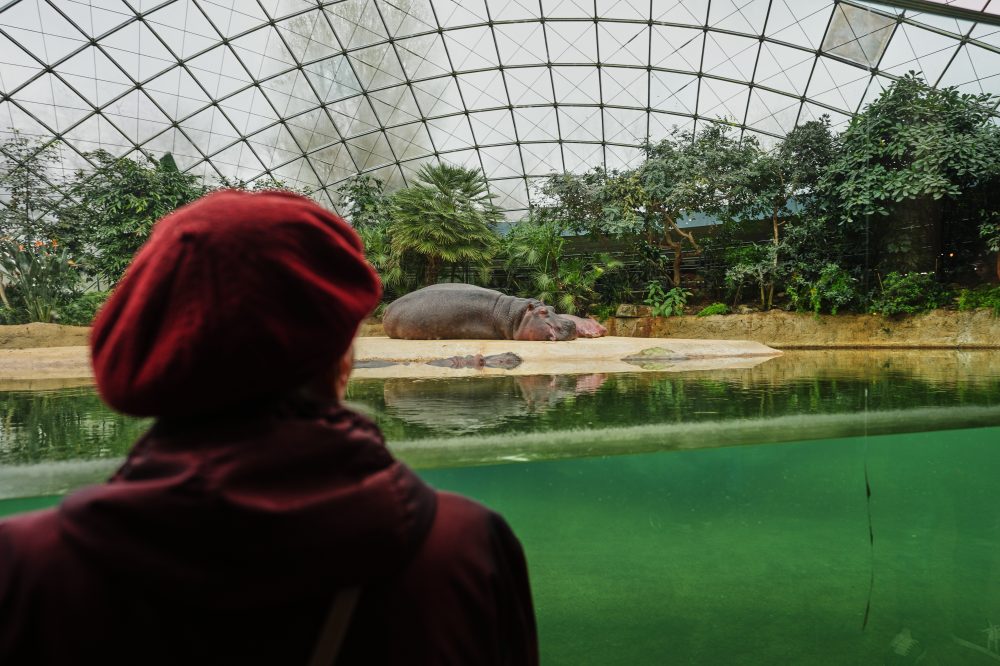

At the Berlin Zoo, 86-year-old Christel Krueger gazed through the thick glass enclosure, watching in wonder as a hippo mother and baby rested together on a sandy island in the murky water.
Krueger and her daughter participated in a special zoo visit designed for individuals with dementia, organized by Malteser Deutschland, which is affiliated with the global Catholic charitable organization Malteser Order of Malta.
During the same outing, fellow participant Ingrid Barkow observed elephants wandering their enclosure from her wheelchair, while 85-year-old Monika Jansen stretched up on her toes for a clearer look at the rhinoceros exhibit.
“When I get home, I’ll still be thinking about it,” said Jansen, 85. “Maybe even at night, while I’m sleeping and dreaming about it.”
These three women represent a portion of approximately 1.6 million Germans currently living with dementia, according to the Office of the National Dementia Strategy. Projections indicate this number could reach 2.8 million by 2050.
Cultural venues and museums worldwide have increasingly introduced accessible programming and specialized guided experiences in recent years, with some innovations enabled by technological developments.
Such offerings encompass sign-language interpretation for deaf and hearing-impaired visitors, tactile experiences for individuals with visual impairments, and specialized programming for people with autism.
Last year, the Berlin branch of Malteser Deutschland launched a cultural initiative in the German capital specifically targeting people with dementia.
“People with dementia aren’t very visible in our society. It’s still a major taboo subject, yet it actually affects a great many people and it’s important that they continue to be at the heart of society,” project coordinator Christine Gruschka said. “They have a right to participate, just like everyone else.”
Dementia affects millions globally, involving progressive deterioration of memory, thinking abilities, language skills and other mental functions. Individuals may experience personality changes, difficulty controlling emotions, and altered visual perception. While Alzheimer’s disease represents the most commonly known form, numerous other types exist with distinct symptoms and biological causes.
Malteser Berlin currently conducts dementia-focused visits at four venues: the zoo, the Museum of Natural History, Britzer Garden and Charlottenburg Palace, with plans to add additional sites.
“‘Normal’ tours — so-called normal tours — are often too fast, too loud, with too many people and too many distractions,” Gruschka said. “That’s why we’ve made it our goal to create programs specifically for people with dementia: Where they still feel seen, where they feel comfortable, and where they can still show that they’re still here and can still be part of it.”
Tour coordinator Carola Tembrink guided Krueger, Jansen and Barkow through the Berlin Zoo, joined by their daughters and a caregiver.
Rather than attempting to cover the zoo’s extensive attractions, Tembrink concentrated on just the hippo, rhino and elephant areas to prevent participants from becoming fatigued or overstimulated.
“The zoo is a wonderful place for tours like this because almost everyone who grew up in Berlin has been here as a child,” Tembrink said. “And especially for people with dementia, childhood memories are often still present — they just need to be jogged a bit — and that happens naturally when they see the animals, smell the air as they enter the zoo, or when they go into the rhino house and catch a different scent.”
These specialized tours provide crucial support for caregivers and family members. During challenging and sometimes frustrating periods of caring for someone with dementia, such programs offer opportunities to connect with others facing similar experiences.
While Krueger received her official dementia diagnosis last year, her daughter Kerstin Hoehne noted that symptoms had emerged more than two years earlier.
“What’s nice is that it’s also with, let’s say, like-minded people, that you’re not alone, but that you have a sense of belonging because everyone else might have the same problem,” Hoehne said.
Manuela Grudda, Barkow’s daughter, described how the zoo visit strengthened their relationship. Grudda pushed her mother’s wheelchair throughout their visit, gently touching Barkow’s shoulders and directing her attention to various animals.
“I can’t really communicate with her in a normal way, of course, but I see that when I show her something, she looks at it, she’s paying attention, and that’s important,” Grudda said. “And it just makes me happy that she’s not just in her own world, but also in this one.”