
African American lawmakers on Capitol Hill are preparing for potentially devastating losses to their congressional representation following a Supreme Court decision that weakened critical voting rights protections for minority communities during redistricting processes.
The Wednesday Supreme Court ruling opens the door for states controlled by Republicans to redesign House districts without considering racial demographics, which could lead to significantly more conservative-leaning congressional seats nationwide.
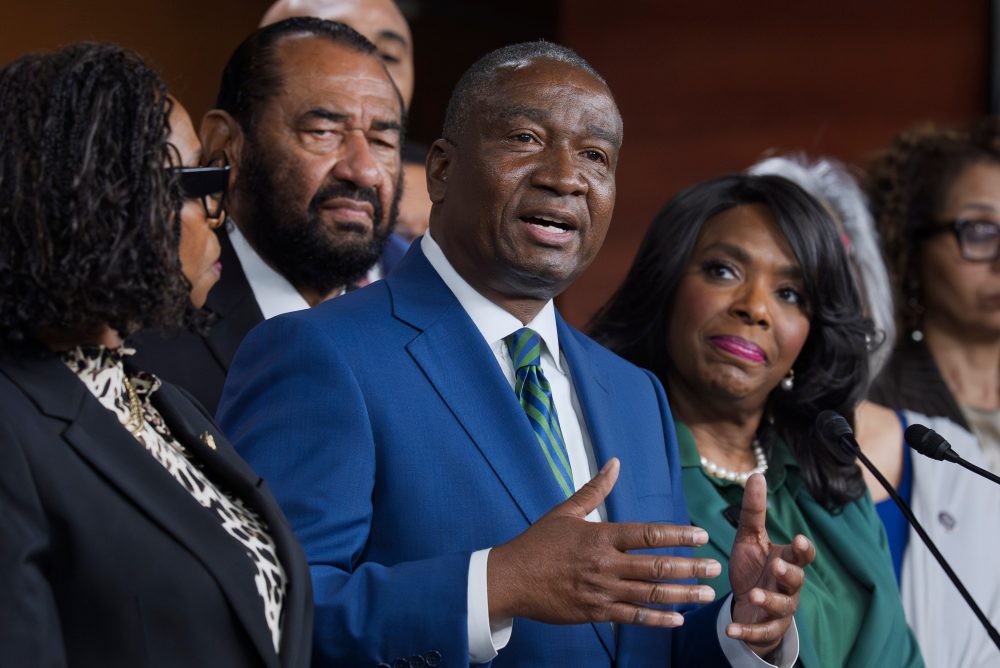
Congressional Black Caucus Chair Rep. Yvette Clarke addressed media members, stating that caucus representatives and Democratic colleagues would resist the consequences of this judicial decision.
“The Supreme Court has opened the door to a coordinated attack on Black voters across the country,” Clarke stated. “This is an outright power grab.”
Previously, Section 2 of the Voting Rights Act allowed voters to contest district maps that seemed to weaken minority communities’ power to choose their preferred candidates. Political experts anticipate that Republican-controlled states will launch widespread congressional redistricting efforts following Wednesday’s decision, particularly targeting the 2028 elections and future cycles, which will likely result in a significantly reduced Black Caucus membership.
More than twelve of the 60 Black Caucus members joined Clarke at the press conference, including House Minority Leader Hakeem Jeffries. Their reactions to the court’s decision varied from anger to determination to grief.
While the exact number of affected seats remains uncertain, redistricting specialists believe that over a dozen seats currently held by minorities could be eliminated.
Louisiana Rep. Troy Carter, one of two African American Democrats representing the state that was central to this case, described the decision as “a devastating blow to our democracy, plain and simple.”
Republican leadership across multiple Southern states has already begun discussing implementation strategies for the ruling to develop new conservative-friendly congressional maps. Florida Republicans quickly moved forward with approving a revised House map that included redrawing a district originally designed to elect African American representation.
“I would be surprised if we do not see former slave-holding states moving at lightning speed to target districts that provide Black voters and other voters of color an equal opportunity to elect candidates,” explained Kristen Clarke, NAACP general counsel and the first African American woman to serve as assistant attorney general in the Justice Department’s civil rights division.
She noted uncertainty about whether state voting legislation or constitutional anti-discrimination provisions will offer any safeguards.
Republican officials and conservative African American leaders celebrated the decision as a win against race-based requirements. Project 21 Black Leadership Network’s Linda Lee Tarver released a statement saying civil rights legislation was never meant “to institutionalize racial line-drawing as a default feature of our political system.”
The Congressional Black Caucus originated in 1971 during court-mandated redistricting under the Voting Rights Act, which had been enacted six years prior, resulting in increased minority congressional representation.
African American House representation grew from nine to thirteen members. Shirley Chisholm, the first African American woman in Congress, chose to expand the Democracy Select Committee established in the 1960s by Democratic Rep. Charles Diggs into the more structured Congressional Black Caucus.
The CBC gained national attention during its inaugural year by boycotting President Richard Nixon’s State of the Union speech after he declined to meet with the organization. Nixon later agreed to the meeting. The organization developed more than 60 policy recommendations to benefit the African American community, including fighting racism and improving housing access. This earned them recognition as the “conscience of the Congress.”
“That caucus has had such an important voice in American politics — the things that we’ve been able to achieve together, the creation of equity and access,” Georgia Democratic Sen. Raphael Warnock said during a Wednesday press conference. “And I’m afraid that with this ruling, we could see that caucus shrink in a hugely significant way.”
New Orleans resident Thomas Johnson expressed frustration about the ruling while visiting Louisiana’s Capitol in Baton Rouge. Johnson, who is African American and represented by Carter, worries that Republicans might redesign the state’s congressional boundaries to eliminate predominantly Black districts.
“I feel like this is an embarrassing attack upon the minorities, particularly the Black community,” Johnson said. “We have very little (voice) in Congress.”
Democratic strategist Antjuan Seawright, who advises the Black Caucus, predicts the organization will engage in numerous legal battles defending members whose districts face targeting after the Supreme Court ruling. He emphasized that the decision makes voter mobilization efforts even more critical “if we want to change course on some of the things that are likely to happen because of this decision.”
Alabama Democratic Rep. Terri Sewell, whose state was involved in a significant Voting Rights Act case that favored Black representation nearly three years ago, emphasized that the party must now concentrate on energizing voters before this year’s midterm elections.
“Now more than ever, we need communities across this nation to mobilize — in state legislatures, in the courts and at the ballot box,” Sewell said. “We need to vote like we’ve never voted before.”