
VIENNA (AP) — Eurovision Song Contest performers have just three minutes to create a memorable impact.
Capturing audience attention among 25 competing acts in Saturday’s grand finale in Vienna requires maximum effort in both musical and visual presentation.
For this year’s leading contenders, Finnish performers pop vocalist Pete Parkkonen and classical musician Linda Lampenius, their strategy includes fire jets, an antique violin from the 18th century, and a crew of “ninjas” dedicated to preventing mishaps.
Their track “Liekinheitin,” which translates to “Flamethrower,” has gained favor among supporters and gambling odds with its fusion of popular and classical music styles — plus its dramatic presentation.
Here’s the process behind crafting their attention-grabbing act.
Parkkonen and Lampenius describe their musical style as “new pop with a classical touch.” Their composition about passionate love delivers explosive energy where Parkkonen’s intense singing creates contrast with Lampenius’ dynamic violin playing.
The Finnish team needed to obtain special authorization for Lampenius to perform her instrument live. Eurovision regulations require that main vocals be sung live, while instruments use pre-recorded tracks to facilitate quick transitions between performances.
Lampenius explains “Flamethrower” was “written as a duet,” requiring both artists to perform live for proper execution.
“It’s a woman and a man, it’s a female voice and a male voice. So I do all my lyrics through my violin, by playing, and you (Parkkonen) are singing it with words. But we are talking. We are (equally) as important, both of us.”
The duo remained uncertain upon reaching Vienna whether Eurovision officials would approve their request. Final authorization came only after they demonstrated their act before a live audience during rehearsal.
The European Broadcasting Union, Eurovision’s organizing body, stated that competition rules permit “live audio capture of instruments may exceptionally be permitted where artistically justified.”
Lampenius traveled with two violins as backup — a prized Gagliano crafted in 1781 for optimal live sound quality, plus a less expensive alternative for potential playback use. This strategy would protect the Gagliano from the somewhat dangerous staging elements.
Lampenius and Parkkonen report they have been practicing for this opportunity since November. After winning Finland’s national Eurovision selection in February, they estimate having performed their song hundreds of times.
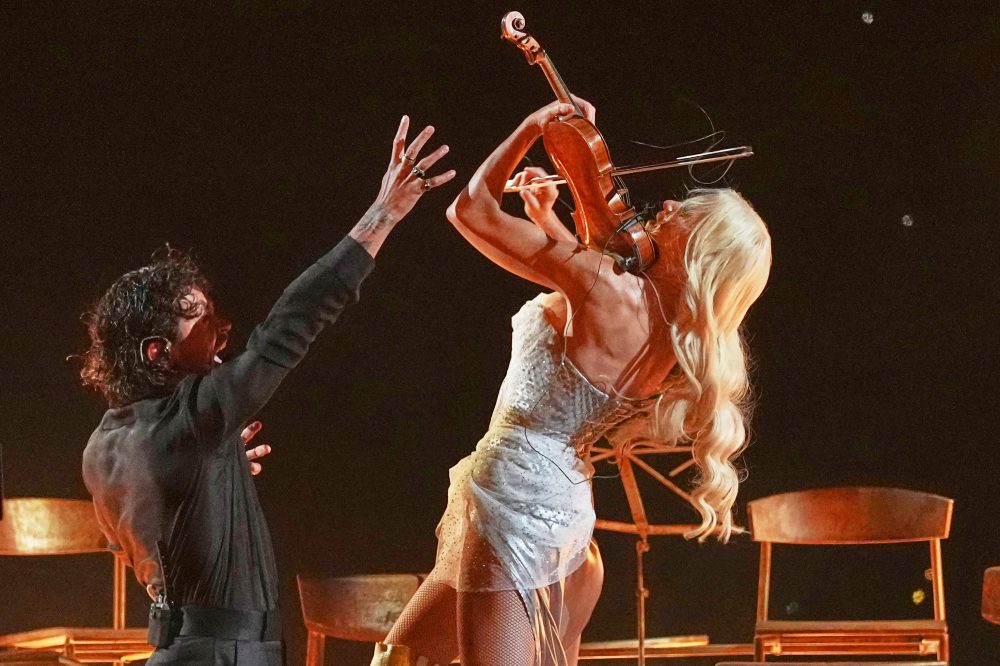
Precision is essential. Their act culminates with fire bursts erupting from the stage while Lampenius, wearing a flowing gown and aided by a leaf blower, plays her valuable violin.
Lampenius admits it’s “a bit scary when you think of it.”
However, she feels confident knowing she has dark-clothed crew members who refer to themselves as “ninjas” standing by to protect her costume from the flames — a critical but invisible element for home viewers.
“They’re running with me – first one guy carrying my dress when I’m running, then the other one catching me during my run,” she explained. “And he helps me also when I jump up on the stage and do the pirouette.”
During the dramatic concluding pose where Lampenius balances on chairs in high heels while holding her violin high, Parkkonen manages both his vocal performance and serves as a safety observer, ready to catch her if she falls.
“That’s my work,” the vocalist explained.